
Aptose Biosciences Faces Liquidity Constraints While Advancing Tuspetinib in Myeloid Malignancies
The company's latest quarter highlights operational progress with its lead product candidate, tuspetinib, amid ongoing financing challenges and a pending acquisition by Hanmi Pharmaceutical.
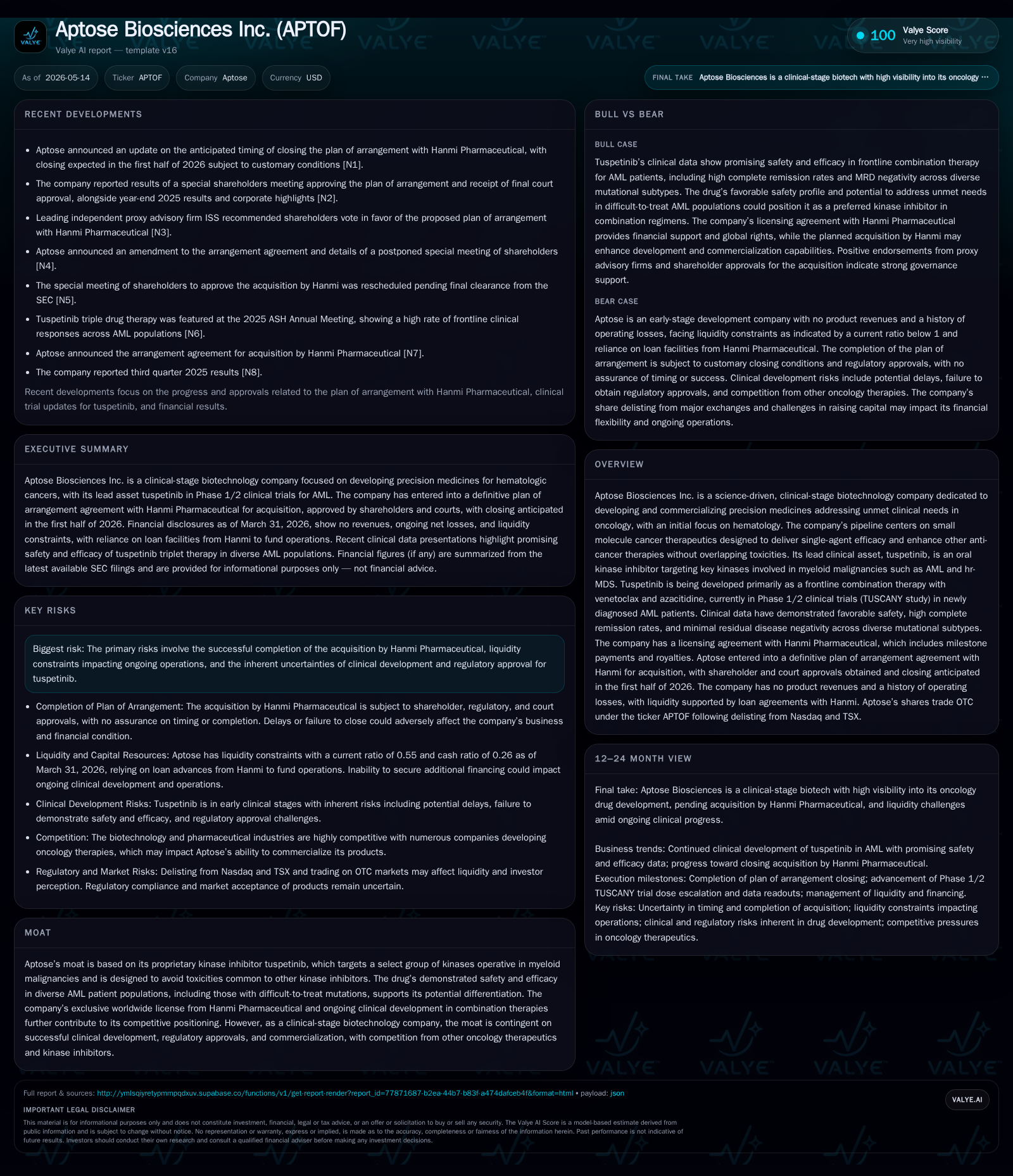
Aptose Biosciences Inc., a clinical-stage biotechnology firm focused on precision oncology therapies for hematologic malignancies, reported ongoing development of its oral kinase inhibitor tuspetinib, emphasizing promising combination data in AML treatment. The company's recent 10-Q filing underscores continued liquidity pressures with a current ratio of 0.55 and reliance on loans from Hanmi Pharmaceutical to sustain operations. Aptose is pursuing completion of a definitive acquisition agreement with Hanmi, which if closed, would provide some financial stability but remains contingent on regulatory approvals and other closing conditions. The company’s growth potential hinges on advancing tuspetinib’s clinical trials and demonstrating differentiation in a competitive kinase inhibitor landscape.
Recent Operating Update
Aptose Biosciences’ most recent quarterly filing (10-Q dated May 13, 2026) reveals an ongoing emphasis on advancing its principal oncology asset, the oral kinase inhibitor tuspetinib. The company continues development under the TUSCANY Phase 1/2 clinical trial focusing on newly diagnosed acute myeloid leukemia (AML) patients primarily as a combination frontline therapy alongside venetoclax and azacitidine. Data from ongoing trials indicate encouraging safety signals with no unexpected toxicities and strong biological activity demonstrated by high complete remission rates and minimal residual disease negativity across genetically diverse AML cohorts [S2][S3][N1]. This positions tuspetinib as a potentially differentiated therapy addressing unmet needs in myeloid malignancies.
However, the financial disclosure also highlights material liquidity concerns: as of March 31, 2026, Aptose reported cash and restricted cash totaling approximately $4.1 million against current liabilities exceeding $11.2 million—yielding a constrained current ratio of just 0.55 [F1][S2]. Management explicitly acknowledges substantial doubt about the company’s ability to continue as a going concern absent additional financing or completion of the planned acquisition by Hanmi Pharmaceutical [S2][S16]. Given the early-stage nature of its clinical trials and lack of product revenues, negative cash flow is expected to persist until regulatory approval or milestone-triggered revenues can be realized.
Supporting operational funding are multiple loan facilities from Hanmi Pharmaceutical totaling over $20 million advanced since 2024 under evolving agreements. These unsecured advances are uncommitted and cancellable at Hanmi's sole discretion—with repayments due in 2028 plus interest at approximately 6% [S2][S11][S16]. The reliance on this funding underscores a precarious liquidity position that may affect the pace of clinical development if not supplemented.
Critically, Aptose entered into a definitive Arrangement Agreement in November 2025 whereby Hanmi will acquire all outstanding common shares it does not already own for C$2.41 per share. Shareholders approved this transaction in March 2026; however, closing awaits customary conditions including regulatory approvals predominantly from Korean authorities [S23][N3]. This anticipated buyout could alleviate capital constraints upon successful completion but remains uncertain given standard acquisition risks.
Business Model
Aptose Biosciences operates as a clinical-stage biotechnology enterprise deriving value primarily through discovery, development, and eventual commercialization of precision oncology therapeutics focused initially on hematologic cancers—specifically AML and high-risk myelodysplastic syndromes (hr-MDS). Its revenue model is currently pre-revenue but centrally dependent on advancing its exclusive kinase inhibitor candidate tuspetinib through costly multi-center clinical trials to establish safety/efficacy profiles compelling enough for regulatory approval.
Tuspetinib is engineered as a small molecule oral agent targeting select kinase pathways implicated critically in disease pathogenesis while designed to minimize overlapping toxicities encountered by earlier generation inhibitors—intended both as monotherapy and combinational partner to enhance existing standard-of-care regimens. The value proposition hinges on delivering improved remission rates with favorable tolerability.
Currently lacking approved products or commercial manufacturing scale-up means all expenditures are allocated towards R&D initiatives funded by equity financing cycles, private placements (including an ATM facility), contractual loans (notably Hanmi arrangements), and milestone-dependent licensing deals [S1][S11]. Upon future approval(s), revenue streams will depend on sales royalties or direct commercialization profits either internally or via licensing partners.
The firm retains worldwide rights to tuspetinib through licensing agreements with Hanmi Pharmaceutical that include obligations regarding milestone payments and royalties post-commercialization. Risk factors center on maintaining these licenses without breach amid capital constraints—noncompliance could jeopardize key intellectual property access critical for pipeline sustainability [S14][S24].
Industry Structure and Competitive Position
The biotechnology sector specializing in hematologic oncology is marked by rapidly evolving science coupled with intense competition among both established pharmaceutical majors and emerging biotechs developing targeted therapies. Within this context, kinase inhibitors have become foundational components in AML treatment regimens; however, multiple candidates face challenges related to efficacy variability across mutation subtypes and toxicities limiting combinational flexibility.
Aptose seeks differentiation through tuspetinib’s specificity—targeting kinases central to malignant cell survival mechanisms while circumventing adverse effects that restrict patient eligibility or dosing in comparable therapies. Early-phase clinical results highlighting broad mutational coverage response rates arguably provide a competitive edge potentially translating into superior frontline use cases compared to more narrowly active compounds.
Nevertheless, the company's smaller scale relative to large competitors limits its ability to independently conduct extensive global trials or commercial operations without strategic alliances or acquisition—highlighting the strategic relevance of the pending Hanmi takeover which may infuse necessary resources and distribution channels [S1][N1].
Biotech valuations are also sensitive to regulatory timelines; any delays in enrollment or pivotal data releases can erode investor confidence given market expectations for rapid evidence generation underpinning product approval paths [S10][S16]. Aptose faces headwinds from market perceptions intensified by its Nasdaq delisting due to equity rule non-compliance—a hurdle often signaling operational risk affecting financing prospects [S8].
Growth Drivers
The primary growth engine lies in successful clinical progression and regulatory approval of tuspetinib focused initially on AML front-line therapy combinations. Positive Phase 1/2 trial outcomes regarding safety and remission quality pave potential pathways into later-stage pivotal studies needed for U.S., European, Canadian, and South Korean marketing authorizations.
Given AML’s poor prognosis especially among elderly or high-risk subsets refractory to existing treatments combined with expanding incidence driven by aging populations globally (structural demand driver), there exists significant unmet medical need fostering substantial market opportunity upon commercialization.
Secondary growth catalysts include potential label expansions into other hematologic indications such as hr-MDS or relapsed/refractory AML settings based on mechanistic rationale supported by emerging data trends thus broadening commercial reach if demonstrated.
Additionally, combination strategies pairing tuspetinib with approved agents like venetoclax enhance adopted therapeutic regimens’ efficacy thereby increasing likely physician uptake provided manageable toxicity profiles hold true [S1][N1]. Also notable are opportunities arising from international market penetration contingent upon local approvals augmented by Hanmi's established presence particularly in Asia-Pacific regions post-acquisition.
Lastly strategically managing intellectual property protection timelines alongside initiating next-generation molecules within the pipeline secures innovation continuity facilitating medium-term growth scaffolding beyond initial product launches.
Risks / Watchpoints / Growth Constraints
What To Watch Next
Key execution points include:
- Closing Status of Hanmi Acquisition: Timely fulfillment of regulatory approvals especially Korean authorities expected mid-2026; any delays or failure materially impact liquidity status required for uninterrupted development activities [N3][S23].
- Enrollment Pace & Data Releases From TUSCANY Trial: Milestones tied to patient accrual numbers directly initiate subsequent trial phases impacting investor confidence; interim data readouts highlighting efficacy/safety balance remain critical decision triggers for partnering/commercial strategies [N1][S1].
- Additional Financing Efforts: Monitoring announcements concerning debt refinancing attempts or alternative equity sales reveals management’s ability to secure operating capital beyond current loans concentrated from Hanmi [S16].
- Clinical Program Expansion: Updates around label-extension studies into other myeloid indications or new combinational regimens signal pipeline strengthening enhancing valuation bases.
- Licensing & Regulatory Developments: Notifications regarding intellectual property status stability alongside filings progress through FDA/EMA stages provide forward visibility into commercial timelines.
- Market Listing Developments: Any progress addressing Nasdaq relisting prerequisites could improve market access maximizing share liquidity boosting capital raise capacities [S8].
Financial Profile Summary
Latest financial snapshot
| Metric | Value | Period |
|---|---|---|
| Cash & equivalents | $935000 | |
| 2025-12-31 | ||
| Current assets | $6mm | |
| 2026-03-31 | ||
| Current liabilities | $11mm | |
| 2026-03-31 | ||
| Current ratio | 0.55x | |
| 2026-03-31 |
Source: SEC companyfacts cache [F1].
These figures illustrate the prevailing tight liquidity situation—with liabilities nearly double current assets—and persistent net losses reflecting heavy investment in R&D activities essential for pipeline progression but straining financial sustainability absent transactional support or new capital infusions [F1][S2][S16].
In summary, Aptose Biosciences embodies a high-risk clinical-stage biotech profile characterized by promising product differentiation potential yet constrained by financial fragility mitigated only partially by an acquisition transaction currently underway. The success trajectory depends heavily on operational execution milestones related to tuspetinib’s trial outcomes coupled with strategic capital management facilitated by integration under Hanmi Pharmaceutical ownership.
This analysis is based entirely on publicly filed SEC documents up to May 13, 2026 ([F1], ) and related news disclosures () without offering investment recommendations. Any forward-looking statements referenced herein should be considered carefully within inherent biotech sector risk parameters including clinical trial unpredictability and financing uncertainties.
Disclaimer: This is research-only, informational analysis and not investment advice. It may include AI-generated interpretation and general industry context. Always verify important details using primary sources.

Comments