
Microbot Medical Advances Commercial Rollout of LIBERTY® Robotics System
Recent filings reveal Microbot Medical’s initial commercial traction for its LIBERTY® robotic system amid ongoing operational challenges.
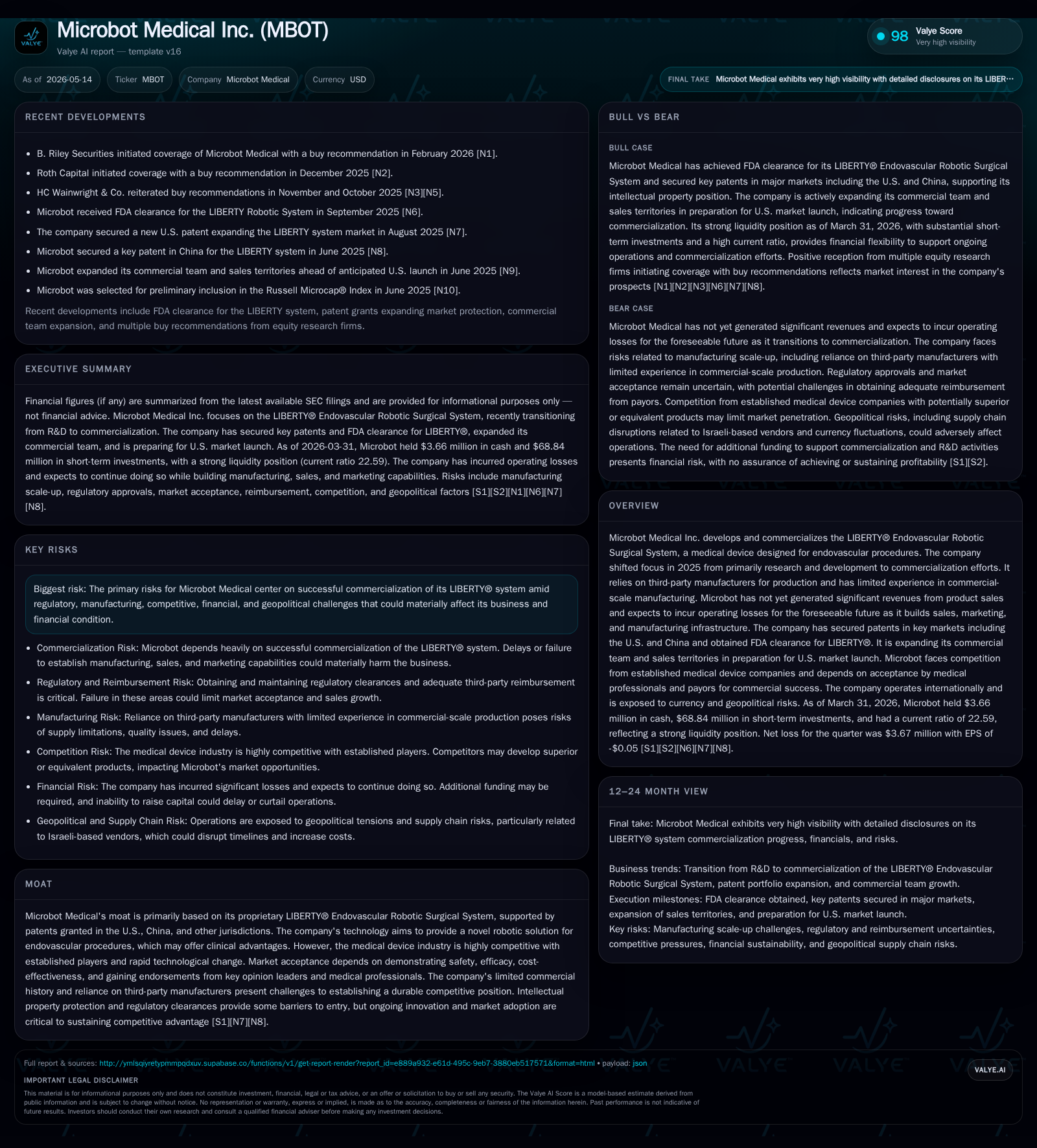
Microbot Medical has transitioned from R&D to a commercialization phase with its FDA-cleared LIBERTY® Endovascular Robotic Surgical System, beginning full U.S. market release in early 2026. The May quarter filings document nascent sales progress highlighted by physician interest and pivotal trial account wins but confirm ongoing significant operating losses and limited prior revenue history. The company faces typical medtech start-up execution risks including manufacturing scale, regulatory compliance, and competitive pressures from established players. Near-term growth depends on expanding sales territories and broader clinical adoption while managing liquidity constraints.
Latest Operational Highlights: Q1 2026 Progress and Market Feedback
Microbot Medical’s latest quarterly filing dated May 13, 2026, confirms that the company is actively transitioning from development to commercialization of its LIBERTY® Endovascular Robotic Surgical System [S2]. The commercial launch began shortly before this period with a full U.S. market release officially initiated at the Society of Interventional Radiology (SIR) annual meeting in early 2026. Following the event and subsequent public announcement on May 5 [S3], Microbot reported strong physician and hospital executive interest.
Initial traction includes securing engagements within key sales territories—including two hospitals that were part of the ACCESS-PVI pivotal clinical trial—signaling favorable uptake among influential clinical centers [S3]. This is particularly notable given the importance of key opinion leaders in driving hospital procurement decisions for medical devices. While these account wins highlight encouraging demand validation for LIBERTY®, overall product sales remain nascent with minimal reported revenue generation in this early commercialization stage [F1].
Operating losses persist as expected at this phase due to scaling sales teams, marketing efforts, and establishing manufacturing capabilities required for broader market supply [S2]. This financial profile typifies medtech pioneers moving beyond R&D towards commercial readiness but underscores substantial execution risk.
Business Model and Product Assessment: LIBERTY® System Capabilities and Commercial Transition
Microbot Medical’s core value proposition is centered around the LIBERTY® Endovascular Robotic Surgical System—a proprietary robotic platform engineered for minimally invasive endovascular interventions. This system received FDA clearance prior to commercialization and benefits from granted patents across principal markets including the United States and China [S1].
The company historically focused heavily on research and development until mid-2025 when it strategically pivoted towards full-scale commercialization efforts. This involved expanding commercial personnel and broadening geographic reach within the U.S., laying groundwork for the ongoing launch wave.
Revenue mechanics revolve around selling or leasing the LIBERTY® units to hospitals or surgical centers alongside consumables or procedural accessories tied to its robotic platform's use. Hospitals pay upfront or per-use fees under contractual arrangements typically characterized by high switching costs due to integration complexity and clinician training requirements—a structural advantage in customer retention once critical mass is achieved.
That said, Microbot remains dependent on third-party contract manufacturers for production as it lacks direct commercial-scale manufacturing experience. This outsourcing model introduces operational risk in quality control consistency, production capacity sufficiency, and supply chain responsiveness which could constrain near-term fulfillment ramp-ups if not well managed [S1].
Overall product relevance is high given growing medical practice shifts favoring robotics-enabled precision surgery—but translating technical innovation into commercial success demands overcoming entrenched provider habits favoring legacy equipment vendors.
Industry Context: Competitive Dynamics in Endovascular Robotics
The niche of robotic-assisted endovascular procedures is rapidly evolving but remains dominated by several legacy medical device giants possessing extensive distribution networks, installed base relationships with hospitals, and entrenched pricing power [S1]. Switching costs for hospitals are elevated by procedural familiarity requirements and regulatory validations attached to devices already integrated into clinical workflows.
Microbot’s intellectual property portfolio provides a modest moat via patents protecting its robotic technology; however, sustaining differentiation will require continuous innovation as incumbents aggressively develop competing robotic platforms or procedural adjuncts. Gaining broad market acceptance hinges critically on demonstrating superior clinical outcomes—safety profiles, procedural efficacy—and convincing leading interventional radiologists to endorse usage.
Manufacturing scalability is another barrier where major competitors enjoy cost advantages through large volume facilities unlike Microbot whose outsourced production might face hurdles achieving economies of scale quickly enough to compete effectively on price or reliability metrics [S1].
Regulatory compliance frameworks such as FDA’s rigorous 510(k) clearance process impose ongoing monitoring obligations increasing operational complexity—any adverse event requires timely reporting under Medical Device Reporting (MDR) regulations posing potential liability risks [S4][S7].
Growth Catalysts: Commercial Expansion and Demand Drivers
There are several tangible near-term growth catalysts underpinning Microbot’s commercial opportunity:
- The company expanded its U.S. sales territories from four at late 2025 up to eight as announced in Q1 2026 filings with an explicit goal of reaching twelve territories by year-end aiming to improve regional penetration coverage [S6].
- Strong engagement post-SIR conference resulted in multiple new accounts including facilities involved in pivotal ACCESS-PVI trials—these institutions act as recommendation hubs validating real-world performance potentially accelerating adoption waves beyond trial sites [S3].
- Rising physician interest fueled by demonstrated clinical benefits such as precise catheter navigation via robotics could lower procedure times or improve patient outcomes enhancing demand appeal.
- Positive feedback loops driven by opinion leader endorsements catalyze purchasing decisions within hospital purchasing committees who weigh cost versus potential performance improvements carefully.
While these drivers signal constructive momentum at this inflection point for Microbot’s offerings, their ultimate translation into sustainable revenue streams depends heavily on execution excellence across sales campaigns and manufacturing reliability.
Risks and Constraints: Regulatory, Manufacturing, and Market Adoption Challenges
Amid cautiously optimistic commercial cues lie significant risk factors:
- Continued operating losses are expected as costs accrued from marketing expansion efforts, clinical support infrastructure build-out, NextGen R&D programs stretch cash reserves without immediate offsetting revenue inflows [S1].
- The medical device sector’s stringent regulatory environment exposes Microbot to product recall risks triggered by material design or manufacturing defects—potentially leading to costly enforcement actions including fines or mandated production shutdowns impacting reputation and finances [S4][S7].
- Ongoing adherence to Medical Device Reporting mandates requires thorough documentation/reporting of serious adverse events; failure could escalate penalties.
- Dependence on third-party manufacturers lacking commercial production expertise poses supply chain reliability threats that can delay product availability or raise unit costs adversely affecting margins.
- Intense competition from large incumbents possessing scale advantages may reduce pricing flexibility constraining revenue growth potential while eroding relative technological differentiation if competitors introduce superior solutions swiftly.
- Geopolitical uncertainties influencing global healthcare procurement environments can dampen cross-border sales prospects considering patent protections extend internationally but enforcement complexities persist.
- Legal proceedings related to employment disputes reflect management distraction potentials albeit currently assessed as immaterial by Microbot but still warrant watching given smaller organizational scale limits crisis absorption capacity [S19].
Key Near-Term Watchpoints: Milestones and Investor Signals
Stakeholders monitoring Microbot should focus closely on several evolving indicators:
- Revenue ramp progression in forthcoming quarterly disclosures beyond Q1 low baseline levels serves as primary gauge if commercial pipeline maturity yields measurable product sales upticks [S2][N1].
- Expansion milestones towards achieving targeted twelve U.S. sales territories underpin broader market coverage ambitions directly affecting demand realization likelihood.
- Updates from pivotal or post-market clinical trials including ACCESS-PVI offer confirmation of safety/effectiveness metrics crucial for professional endorsements enhancing procurements decision-making confidence.
- Contracts or partnerships reflecting increased manufacturing capacity/supply agreements mitigate risk exposure around product availability constraints improving operational outlook.
- Management communication tone during earnings calls or investor events provides qualitative insights into how the leadership perceives commercial trajectory sustainability amid complex medtech start-up dynamics.
Financial Snapshot: Capital Position and Operating Costs
Latest financial snapshot
| Metric | Value | Period |
|---|---|---|
| Cash & equivalents | $4mm | |
| 2026-03-31 | ||
| Current assets | $77mm | |
| 2026-03-31 | ||
| Current liabilities | $3mm | |
| 2026-03-31 | ||
| Current ratio | 22.59x | |
| 2026-03-31 |
Source: SEC companyfacts cache [F1].
As reported in the latest quarter ending March 31, 2026, Microbot maintains approximately $3.66 million in cash equivalents set against current liabilities totaling approximately $3.39 million resulting in a robust current ratio of 22.59 denoting strong short-term liquidity reserves relative to obligations [F1].
Revenues remain negligible with no meaningful top-line contribution recorded thus far consistent with early-stage commercialization status; operating losses continue reflecting investments into R&D plus scaling expenses totaling over $14.7 million as last reported annually ending December 31, 2025 — underscoring a significant cash burn rate that capital raises or cost controls must address imminently to sustain runway longer term [F1][N1].[N8]
Debt levels are comparatively low at about $2 million last recorded though dated end-of-year figure suggests limited leverage minimizing immediate solvency concerns but also indicating dependence principally on equity funding channels amidst pre-revenue operating loss absorption phases [F1].
Disclaimer: This analysis is for informational purposes only based on publicly available data including SEC filings through May 13, 2026. It does not constitute investment advice nor an endorsement of any security mentioned herein.
Disclaimer: This is research-only, informational analysis and not investment advice. It may include AI-generated interpretation and general industry context. Always verify important details using primary sources.

Comments