
U.S. GoldMining's Strategic Progress at Whistler Project Underpins Exploration Stage Growth
Recent quarterly updates highlight operational milestones and corporate changes shaping U.S. GoldMining Inc.'s exploration trajectory.
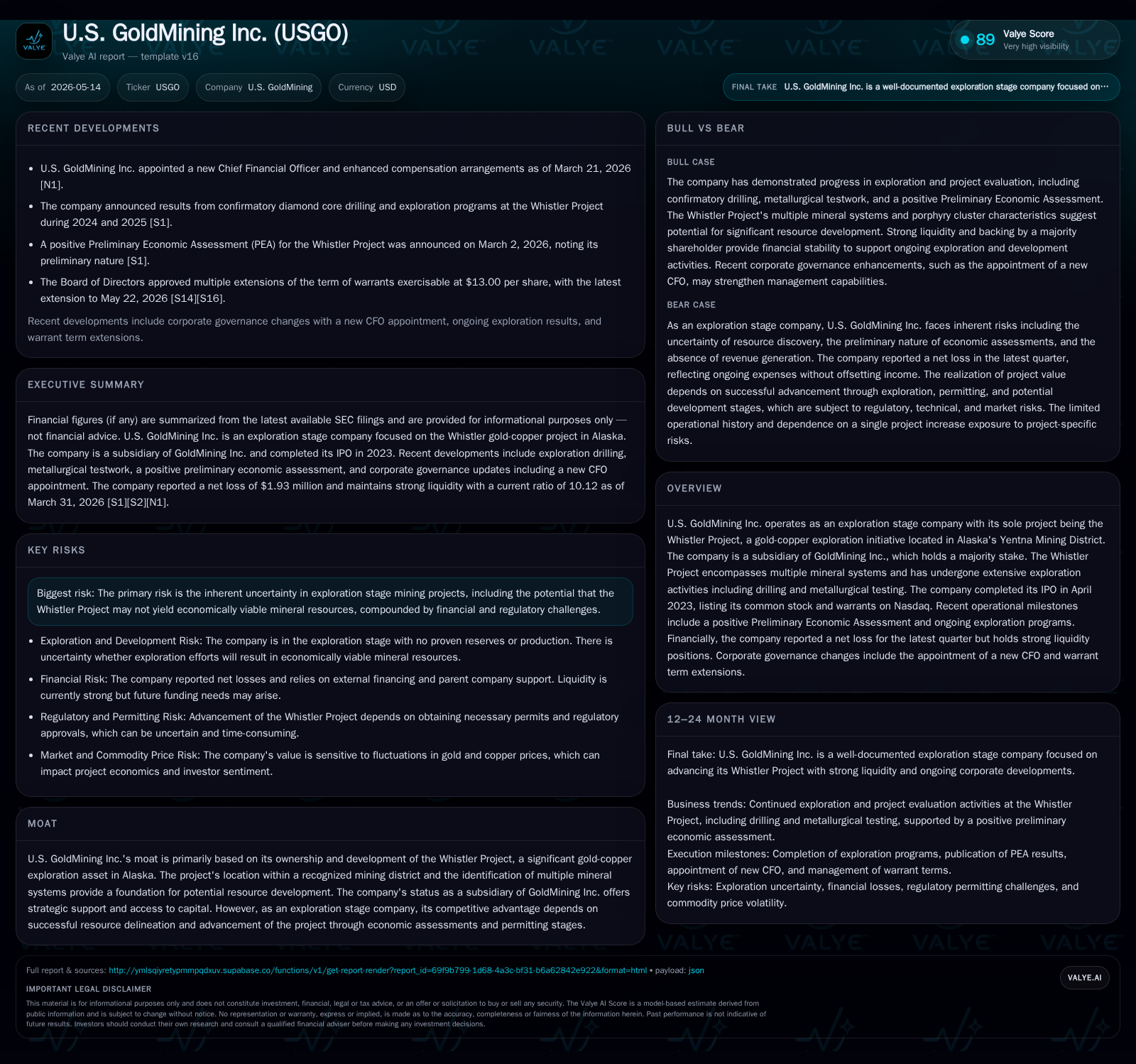
U.S. GoldMining Inc., primarily focused on its Whistler gold-copper exploration project in Alaska, remains an early-stage exploration company advancing its asset through drilling, metallurgical testing, and economic assessments. The latest quarterly filing confirms ongoing exploration initiatives and stable liquidity, alongside leadership appointments signaling project development focus. As a subsidiary of GoldMining Inc., the company benefits from parent-level strategic support yet faces typical exploration-stage risks related to resource delineation and project advancement in a capital-intensive environment.
Recent Operating Update
U.S. GoldMining Inc.'s latest quarterly filing dated May 13, 2026 [S2] reaffirms the company's ongoing commitment to advancing its sole asset, the Whistler Project, a gold-copper exploration endeavor located in Alaska's Yentna Mining District. The filing reveals no material changes to risk factors but emphasizes continuing expenditure on exploration activities such as drilling and metallurgical testwork that underpin forthcoming technical evaluations. Notably, recent event filings [S3] outline corporate developments including the appointment of Imola Götz as Vice President of Project Development effective March 2026 [S4], highlighting intensified focus on progressing Whistler from exploration toward feasibility.
Liquidity metrics from the latest snapshot confirm a strong financial position: cash and equivalents stood at approximately $4.7 million by March 31, 2026, with a current ratio exceeding 10 [F1], signaling sufficient resources to fund near-term work programs.
Business Model
U.S. GoldMining operates strictly as an exploration stage mining company currently without income-generating operations. Its entire value proposition is anchored in the development of the Whistler Project owned by U.S. GoldMining as a wholly directed initiative supported by majority owner GoldMining Inc., which holds 74.2% of common shares including warrants exercisable through April 2026 [S1]. Revenue mechanics are presently non-existent since no production or sales occur; instead, capital inflows derive primarily from equity issuances—the IPO completed in April 2023 being a significant source [S1].
Costs are predominantly capitalized expenditures targeting resource delineation through drilling campaigns, assay validation, and metallurgical testwork aimed at establishing processing flow sheets—critical inputs for economic modeling exercises such as the Preliminary Economic Assessment (PEA) finalized in early 2026 [S27]. Margins or profitability remain negative given ongoing exploration expense recognition consistent with industry norms.
This exploration business model is inherently risky but strategically valuable if successful resource identification leads to reserve definition enabling eventual mine development or joint ventures/sales to operators with extraction capability.
Industry Structure and Competitive Position
The gold mining industry's upstream section is fragmented into major mining houses operating mines globally and smaller junior companies specializing in exploration risk undertaken earlier in the cycle. U.S. GoldMining fits squarely within the junior/exploration niche focusing on frontier assets with high potential upside but significant uncertainty.
Strategically, ownership of the Whistler Project situates it inside a recognized Alaska mining district known for multiple mineralized zones containing gold and copper—a combination increasing potential commercial attractiveness relative to single-commodity plays. Metallurgical programs underway aim to demonstrate amenability of ores to processing techniques like flotation and cyanide leaching that enhance recovery rates.
While competition exists for capital flows among numerous juniors globally, U.S. GoldMining benefits from structural advantages linked to:
- Location within a stable jurisdiction (Alaska) offering mining-friendly regulatory frameworks,
- Backing by senior-level parent entity providing access to technical expertise and financing,
- Demonstrated ability to advance regulatory compliant PEAs aligning with SEC (Reg S-K subpart 1300) and Canadian NI 43-101 standards enhancing investor confidence.
Growth Drivers
Growth prospectively stems from several interrelated vectors:
- Exploration Success: Extension and confirmation of mineralization through drilling campaigns directly increase resource base size and grade profile improving valuation metrics.
- Advancement of Technical Studies: Metallurgical testing outcomes feed into optimized process designs reducing anticipated capex/opex burdens enhancing project scalability.
- Regulatory Milestones: Securing permits required for environmental approvals will unlock subsequent feasibility work stages critical for definitive mine planning.
- Capital Market Support: Ability to attract fresh equity or partner JV engagements hinges on progress delivering tangible data points that derisk asset economics.
- Commodity Market Environment: Sustained positive pricing trends for gold and copper elevate project NPV given revenue linkage; cyclical upward phases boost internal development incentives.
Risks / Watchpoints / Growth Constraints
The foremost risk is typical for any early-stage explorer: failure to establish economically viable reserves at Whistler could impair all growth potential [S1]. Additional constraints include:
- Financing Risk: Exploration programs depend heavily on ongoing capital injections given lack of operating cash flows.
- Regulatory Risk: Permitting delays or challenges may protract timelines impacting cost and investor sentiment.
- Market Volatility: Fluctuations in precious/base metal prices can alter project economics abruptly.
- Execution Risk: Drilling outcomes might not meet expectations despite geological indications; metallurgical complexities could arise undermining process assumptions.
- Dilution Risk: Future equity raises could dilute existing shareholders amid capital needs.
Monitoring these factors closely through reported KPIs such as drill assay results, PEA revisions, permitting status updates, and subsequent financings will be instructive for assessing execution viability.
What to Watch Next
Key upcoming deliverables that will serve as catalysts or indicators include:
- Further drill results from the ongoing 2026 campaign emphasizing increased resource confidence or potential discoveries [S16].
- Updates on environmental permitting engagements advancing regulatory approvals needed for feasibility progression.
- Technical study enhancements refining metallurgical parameters or economic models following completion of variability composites testing.
- Potential strategic partnership announcements leveraging parent company's network to share financing or operational responsibilities.
- Exercise activity around outstanding warrants expiring April 2026 providing insight into shareholder commitment levels.
Performance against these milestones will elucidate whether U.S. GoldMining can transition successfully beyond exploration status toward development-readiness stages within a realistic timeframe.
Financial Profile Brief
Latest financial snapshot
| Metric | Value | Period |
|---|---|---|
| Cash & equivalents | $4.7mm | |
| 2026-03-31 | ||
| Current assets | $6.1mm | |
| 2026-03-31 | ||
| Current liabilities | $599k | |
| 2026-03-31 | ||
| Current ratio | 10.12x | |
| 2026-03-31 |
Source: SEC companyfacts cache [F1].
Although not revenue-generating, U.S. GoldMining's financial position reflects its stage:
| Metric | Value | Period End |
|---|---|---|
| Cash & Equivalents | $4,709,577 | |
| 2026-03-31 | ||
| Current Assets | $6,060,497 | |
| 2026-03-31 | ||
| Current Liabilities | $598,686 | |
| 2026-03-31 | ||
| Current Ratio | 10.12 | |
| 2026-03-31 |
Operating losses remain significant due to capital spending with last full-year net loss ~ $7 million [F1].
This analysis is based solely on disclosed information as of May 14, 2026. It aims to provide an informed industry perspective without investment recommendations.
Disclaimer: This is research-only, informational analysis and not investment advice. It may include AI-generated interpretation and general industry context. Always verify important details using primary sources.

Comments