
Nine Energy Service Emerges from Restructuring with Focus on Completion Tools Market
Post-bankruptcy resumption positions Nine Energy to serve onshore oilfield completions amid operational reset and market uncertainties.
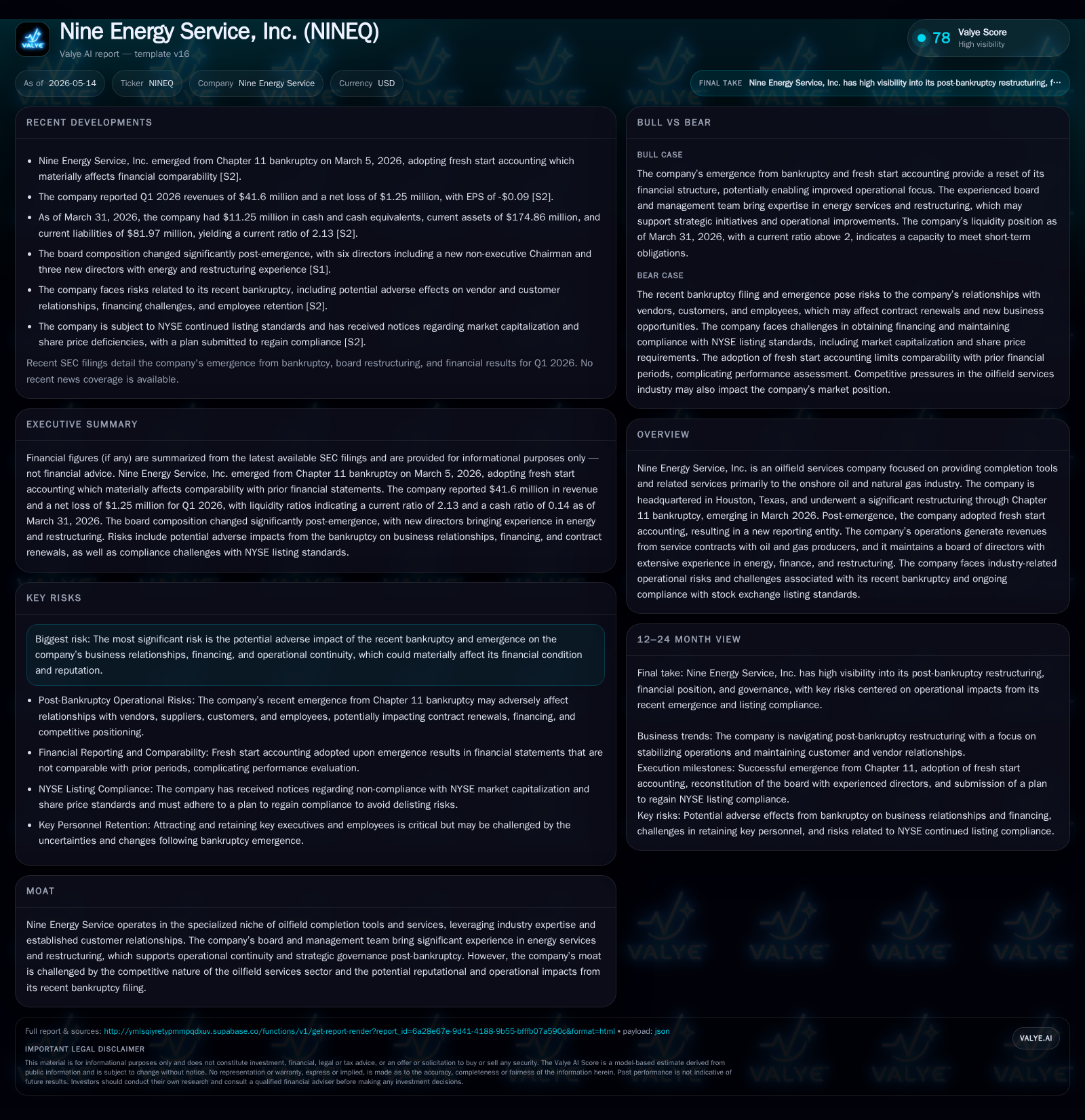
Nine Energy Service, Inc. has emerged from Chapter 11 bankruptcy in March 2026, applying fresh start accounting that resets its financial reporting and operational baseline. The May 2026 quarterly filing details ongoing restructuring impacts on supplier and customer relationships, underscoring risks in contract renewals and financing while highlighting a specialized business model focusing on completion tools for the US onshore oil and natural gas sector. Competitive pressures remain acute in a fragmented industry, but growth can be supported by shale drilling activity and technological advancements in hydraulic fracturing completions. Investors should track contract backlog development and refinancing progress as key near-term indicators.
Latest Operating Update: Emerging from Chapter 11
Nine Energy Service's most consequential recent development is its emergence from Chapter 11 bankruptcy protection in early March 2026 [S1], followed by its May 13 quarterly report filing which constitutes its first major operating disclosure post-bankruptcy [S2]. This transition triggered adoption of fresh start accounting under ASC 852, effectively restarting the company’s financial reporting at zero retained earnings or deficit as of the emergence date [S13]. Importantly, this means pre-bankruptcy historical financial data are not comparable to post-emergence results—a critical framing for understanding performance disclosures moving forward.
Operationally, the restructuring has imposed significant near-term challenges. The company explicitly warns that some counterparties—suppliers, vendors, customers—may seek to renegotiate terms or even terminate contracts due to concerns about creditworthiness or continuity risks caused by the bankruptcy event itself [S2]. Likewise, securing sufficient financing under acceptable terms to execute business plans remains uncertain. Employee retention and motivation also face headwinds amidst uncertainty. These conditions collectively create a fragile environment where competition for contracts intensifies as rivals may exploit any perceived vulnerability in Nine's market standing.
However, Nine continues normal operations servicing primarily hydraulic fracturing completions across US basins and reports having emerged with an experienced board scaled to oversee the fresh entity and implement strategic governance optimized for post-restructuring growth pathways [S1], [S13]. The successful confirmation of the prepackaged plan and conversion of DIP financing facilities into exit revolving credit arrangements underpin financial stability initiatives entering Q2 2026 [S14], [S16].
Business Model and Service Offering Analysis
The company’s core business centers on providing specialized completion tools integral to multistage hydraulic fracturing operations conducted by onshore natural gas and oil producers primarily in North America. These completion tools facilitate wellbore isolation and stimulation efficiency—critical performance points that directly impact well productivity and economics.
Revenue generation is contract-driven, typically under service agreements with operators encompassing tool supply, maintenance services, logistical support, and ancillary engineering support where required. Pricing mechanisms reflect a mixed model balancing negotiated long-term contractual engagements with spot market interventions responsive to fluctuating drilling rig counts and frac job volumes tied to operator CAPEX cycles. Pricing power depends on tool reliability, technical differentiation (e.g., dissolvable plugs versus conventional mechanical systems), and established relationships within the shale operator community.
The restructuring potentially redefines some client mix dynamics as counterparties reassess risk exposure post-bankruptcy; however, deep technical specialization creates switching costs limiting operators’ proclivity to move away rapidly unless superior alternatives present themselves. Operational quality hinges heavily on maintaining consistent delivery schedules, tooling performance integrity under high-pressure environments, and robust aftermarket support — factors emphasized throughout Nine's disclosure filings [S1].
Competitive Position and Industry Context
Nine operates within a fiercely competitive oilfield services niche dominated by large multinational players as well as nimble regional specialists catering to similar hydraulic fracturing completion markets. Scale advantages favor larger firms offering integrated service suites; nevertheless, Nine’s focus on select product lines allows targeted innovation coupled with cost discipline post-restructuring.
Supply chain constraints following global disruptions have challenged equipment availability; regulatory uncertainties—particularly environmental restrictions impacting frac fluid compositions or emissions—add complexity to operators’ capital allocation decisions affecting service providers like Nine [S2]. Declining rig counts or deferred well completions during cyclical downturns exacerbate pricing pressures. Conversely, tightening compliance standards could increase demand for highly engineered completion components where Nine can compete effectively.
Barrier-to-entry effects derive partially from technical knowhow embedded in product design as well as established service presence in prolific shale plays such as Permian Basin and Eagle Ford formations. Customer switching costs are nontrivial given the criticality of downhole equipment compatibility with fracturing pump schedules.
Post-bankruptcy reputational effects introduce competitive fragility; some customers may defer contracts or negotiate stricter payment terms until stable operating rhythms are confirmed [S2]. Thus immediate commercial traction is contingent on maintaining trust through transparent execution in the coming quarters.
Growth Drivers: Capitalizing on Market Niches
Growth impetus emanates primarily from anticipated upticks in US shale drilling activity driven by ongoing energy demand balancing geopolitical supply uncertainties. Increased rig utilization translates proportionally into fracturing completions requiring Nine’s suite of completion tools.
Technological innovation—especially deployment of novel dissolvable plugs designed for operational efficiency improvement—affords potential margin uplift opportunities if proprietary solutions capture incremental share within operator portfolios.
Operational improvements extracted from restructuring initiatives may enhance cost structure flexibility enabling more competitive tendering for contracts while preserving profitability. Incremental aftermarket services such as equipment refurbishment or inspection also provide ancillary revenue expansion avenues.
While explicit KPIs like contract backlog values or renewal rates were limited in recent filings [S2], monitoring these indicators is crucial for validating growth thesis given cyclicality in upstream capex budgets.
Risks and Challenges on the Path Forward
Principal risk elements cluster around lingering structural impacts from the bankruptcy episode: potential supplier/vendor reluctance requiring financial assurances; adverse renegotiation of existing contract terms; constrained access to cost-effective financing limiting working capital agility; attrition of key personnel critical for technical service delivery; intensified competition exploiting transitional vulnerabilities; and ongoing volatility in upstream spending exacerbated by macroeconomic volatility including inflationary pressures impacting labor/material costs [S2], [S1].
Furthermore, reputational recovery remains imperfect; delays in contract renewals induced by counterparty caution could depress near-term utilization rates and revenue visibility beyond Q2/Q3 fiscal periods.
External risks encompass regulatory shifts targeting emissions reduction in fracking processes potentially increasing compliance costs or mandating product reformulations impacting supply chain timelines.
Deep sector knowledge underscores that operational downtime during equipment swaps or disruptions can produce outsized penalties for service suppliers—raising the stakes for execution precision amid restructuring flux.
Upcoming Catalysts and Monitoring Points
Key near-term developments warrant close observation:
- Quarterly financial reports benchmarking revenue recovery trajectory relative to pre-bankruptcy levels acknowledging fresh start accounting discontinuity;
- Announcements of contract wins or renewals signaling restored customer confidence;
- Management disclosures regarding refinancing progress including amendments or covenant compliance within Exit ABL Facility usage;
- Capital expenditure outlays aligned with capacity expansion or efficiency upgrades;
- Personnel retention metrics indicating stabilization of technical workforce;
- Broader shale operator announcements regarding drilling plans that presage fracking intensity trends impacting Nine’s addressable market size.[S3], [S2], [S1]
Tracking these will clarify whether Nine successfully converts restructuring into sustainable operational momentum within the evolving market landscape.
Financial Snapshot: Supporting the Narrative
Latest financial snapshot
| Metric | Value | Period |
|---|---|---|
| Cash & equivalents | $11mm | |
| 2026-03-31 | ||
| Total debt | $94mm | |
| 2026-03-31 | ||
| Net debt | $83mm | |
| 2026-03-31 | ||
| Current assets | $175mm | |
| 2026-03-31 | ||
| Current liabilities | $82mm | |
| 2026-03-31 | ||
| Current ratio | 2.13x | |
| 2026-03-31 |
Source: SEC companyfacts cache [F1].
A focused look at Nine Energy’s balance sheet highlights liquidity posture immediately post-emergence:
This snapshot reveals moderate leverage levels considering operating scale reflected by current assets coverage exceeding current liabilities over twice-fold indicating a reasonable short-term liquidity cushion despite elevated debt load reflecting restructuring-related financing arrangements [F1]. Fresh start accounting constrains trend analysis but these cross-sectional figures provide baseline context for assessing financial flexibility as Nine advances beyond its reorganization phase.
Disclaimer: This analysis is based exclusively on publicly filed SEC documents up through May 13, 2026 ([S1]-[S3]) combined with standardized company financial data ([F1]). It does not constitute investment advice or recommendations but aims solely to synthesize available information into an informed industry perspective.
Disclaimer: This is research-only, informational analysis and not investment advice. It may include AI-generated interpretation and general industry context. Always verify important details using primary sources.

Comments