
Concorde International Accelerates AI-Driven Security Transformation Post-Merger
Concorde International Group Ltd. transitions to a new Nasdaq ticker and strategic AI focus following its merger with YOOV Group Holding Limited.
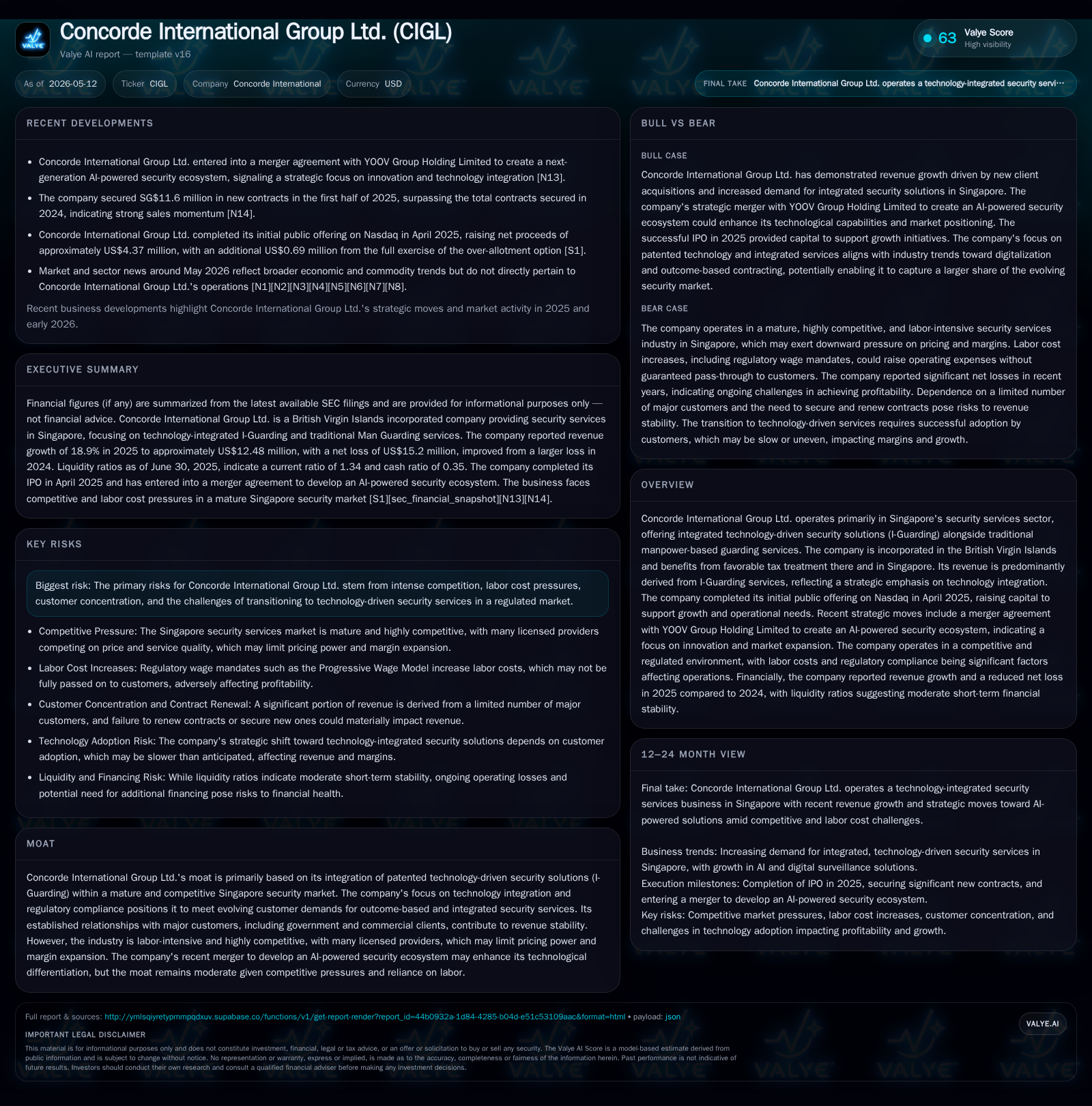
In April 2026, Concorde International Group Ltd. commenced trading under the Nasdaq ticker 'YOOV' after merging with YOOV Group Holding Limited, marking a pivotal shift toward an AI-driven security ecosystem. The company's core revenue continues to be driven by its integrated technology-driven I-Guarding services, which grew 18.3% in 2025 amid rising regulatory demands and digital surveillance adoption in Singapore. Operating within a mature, highly regulated, and labor-intensive market, Concorde faces wage pressure from Singapore’s Progressive Wage Model and intense competition but aims to leverage AI integration and outcome-based contracts as growth engines. Recent financials show improved profitability post-IPO with net losses declining significantly, providing operational runway for delivering on innovation-led expansion.
Ticker Symbol Change Marks Strategic Milestone
In its latest Form 6-K dated April 14, 2026, Concorde International Group Ltd. formally announced commencement of trading under its new Nasdaq ticker symbol "YOOV" effective April 13, 2026 [S2]. This follows the February 2026 merger agreement with YOOV Group Holding Limited aimed at creating an integrated AI-powered security ecosystem [S8]. The rebranding onto a new ticker captures a strategic pivot from a pure-play manpower-focused security firm toward one that harnesses advanced AI technologies. It also represents a milestone in Concorde’s capital markets presence since its initial public offering in April 2025.
This near-term corporate development frames the company’s positioning as it seeks to lead Singapore's evolving security services market by leveraging innovative technology solutions rather than competing solely on traditional guard services [S3][S8]. The official filings stress that this last quarter marks the beginning of expected operational transformation under the merged entity structure.
Integrated Technology-Driven Security Services Business Model
Concorde’s core business model revolves around integrated security services composed primarily of I-Guarding—technology-driven solutions that blend electronic surveillance, remote monitoring platforms, and data analytics—with a complementary traditional Man Guarding segment [S1][S26]. Revenue from I-Guarding services showed robust growth of 18.3%, rising from approximately US$10.2 million in 2024 to over US$12.1 million in 2025 [S1][S26]. This reflects both increasing client migration towards digitally empowered security models and regulatory drivers such as outcomes-based contracting endorsed by Singapore authorities.
Man Guarding revenues also grew but form a relatively small component at roughly US$175k (45.7% increase year-over-year), highlighting a structural preference shift among Concorde’s customer base towards comprehensive / outcome-oriented tech-enabled offerings rather than legacy guarding alone [S26]. The company’s revenue mechanics are thus volume-driven through securing larger-scale I-Guarding contracts which rely on software deployments combined with physical personnel at sites demanding mandated wage compliance.
Customer payment is typically contract-based for service packages that bundle manpower provision with proprietary monitoring equipment usage fees under long-term arrangements. Margins benefit from technology adoption which can scale coverage without linear manpower cost increases but remain exposed due to subcontracted labor cost volatility — often outsourced to related parties — as well as minimum wage constraints imposed by regulatory frameworks [S1].
Competitive Dynamics and Regulation in Singapore’s Security Industry
Operating in Singapore’s matured but highly fragmented security sector means Concorde faces intense competition from numerous licensed agencies all vying for market share amid stringent regulatory oversight [S1]. Underpinning cost structures is the Progressive Wage Model (PWM), mandating baseline salary enhancements over time for security personnel — a key factor pushing up labor expenses materially for all players in the industry [S1].
While regulations elevate barriers to entry (license qualifications, workforce training standards), they simultaneously compress industry-wide margins because clients remain cost-sensitive even as they demand higher service quality and integrated technology capabilities at scale. The government's Security Industry Transformation Map (ITM) initiative actively encourages productivity improvements via automation and digitalization—underpinning demand for Concorde’s I-Guarding technologies—but also sets an institutional benchmark that all firms must meet or exceed.
The combination of mature market saturation, enforced wage floors, outsourcing trends to related-party subcontractors, and increasing technological complexity creates both headwinds and differentiation opportunities. Concorde's patented tech platform attempts to capitalize on these dynamics by targeting customer preferences shifting towards data-driven outcome-based security investments rather than commoditized guard-only models.
Growth Catalysts: AI Integration and Expanding Outcome-Based Contracts
The recent merger with YOOV Group Holding Limited serves as the linchpin for accelerating enterprise-scale AI integration into Concorde’s core offerings [S8]. YOOV brings proprietary artificial intelligence capabilities designed to optimize surveillance analytics, incident prediction accuracy, workflow automation for guards, and real-time anomaly detection.
Singapore’s security environment—with rising urban density, cyber-physical risks targeting critical infrastructure, data centers expansion—favors such advanced ecosystems promoting predictive versus reactive security postures [S1]. Government endorsement of these transformation initiatives further supports wider adoption across both public sector contracts and commercial enterprises prioritizing data-security convergence.
Alongside technological innovation, there is an expanding prevalence of outcome-based contracts where remuneration is increasingly linked to measurable performance criteria such as incident response times or detected anomaly rates rather than fixed headcounts or hours worked alone. This contractual evolution aligns closely with Concorde's integrated I-Guarding model enhanced via AI insights from YOOV collaboration.[S1][S8]
Risks and Constraints in a Labor-Intensive Market Environment
Despite promising growth drivers, Concorde confronts material risks intrinsic to its sectoral characteristics [S1]. Labor costs remain paramount; mandated wage increases under Singapore’s Progressive Wage Model pressure gross margins if clients resist accepting full price pass-throughs — a scenario likely given the competitive landscape.
Top five customers contribute approximately 30% of total revenue raising concentration risk; any loss or non-renewal would materially impact revenues given limited diversification opportunities within Singapore's finite market size [S16]. Competition from numerous license holders exerts ongoing pricing pressure potentially limiting margin expansion while also requiring continuous investments in service quality improvements.
Moreover, scaling proprietary AI technologies alongside traditionally manpower-heavy operations poses execution challenges: successful integration requires seamless coordination between automated systems and human guard workflows without interrupting service continuity or client trust.
These considerations serve as watchpoints informing near-term operational focus areas.[S1]
Operational Priorities: Contract Wins, Tech Deployment, and Customer Retention
Moving forward post-merger filings highlight priorities on solidifying contract wins through active tender participation across commercial/public sectors while negotiating outcome-based terms favorable for scalable revenue growth [S8]. Maintaining rigorous service delivery standards remains critical given client expectations centered on reliability coupled with technology sophistication.
Progress milestones include phased rollout completion of integrated AI surveillance platforms developed jointly by Concorde and YOOV teams alongside comprehensive training programs for guards adapting workflows accordingly.[S8] Customer satisfaction metrics—tracking incident detection effectiveness coupled with speed of response—are emerging KPIs aligned with evolving buyer demands.
Renewal success rates among existing major accounts will provide tangible indications of market acceptance for combined platform offerings versus legacy guarding competitors.[S8] These operational metrics form essential near-term indicators validating strategic trajectory.
Recent Financial Snapshot: Profitability Improvement Post-IPO
Supported by disclosures in the 20-F annual report dated May 12, 2026 and corroborated by companyfacts data through mid-2025[S1][F1], Concorde has demonstrated significant progress reducing net losses following its IPO in April 2025.
For fiscal year-end December 31, 2025 revenue expanded nearly 19% year-over-year reaching about US$12.5 million driven largely by new client acquisitions primarily centered on its I-Guarding segment growing over US$12 million annually [S1][F1][S26]. This top-line expansion reflects improving sales traction within Singapore’s growing demand environment.
Net loss narrowed dramatically by more than 80% compared to previous years totaling approximately US$15.2 million for FY25 vs US$83.6 million loss recorded in FY24 prior to IPO activities attenuation mainly attributable to dramatic decrease in share-based compensation expense (from ~$83M pre-IPO down to ~$11M post-IPO) providing clearer operational profitability signal absent distortion effects[S1][F1].
Nonetheless operating expenses including professional fees and employee benefits increased moderately offsetting some margin gains consistent with ongoing investment spend supporting innovation-led growth agenda.[S1]
Liquidity remains supportive with cash balances exceeding US$2.3 million mid-year 2025 paired with current ratio near a comfortable 1.34 indicating sufficiency for working capital needs.[F1]
Overall financial trajectory supports execution capacity while emphasizing prudence due to sector-specific constraints related to labor intensity and regulatory compliance cost structure.
This analysis synthesizes recent quarterly updates anchored by SEC filings alongside annual context framing Concorde International Group Ltd.'s strategic repositioning through technological innovation aimed at leveraging structural market demand dynamics within Singapore's evolving security industry landscape. It highlights core drivers behind financial improvement while underscoring risks inherent in transitioning from traditional manpower-centric services toward an AI-integrated security ecosystem underpinned by regulatory compliance challenges.
Disclaimer: This report is intended solely for informational purposes based on publicly available filings as of June 2026; it does not constitute investment advice or recommendations.
Disclaimer: This is research-only, informational analysis and not investment advice. It may include AI-generated interpretation and general industry context. Always verify important details using primary sources.

Comments