
Oculus Inc. Pursues Cloud-Native Compliance Innovation Amid Sector Shifts
The company’s latest quarterly filing highlights a strategic reassessment emphasizing cloud-native SaaS enhancements and AI integration within data privacy solutions.
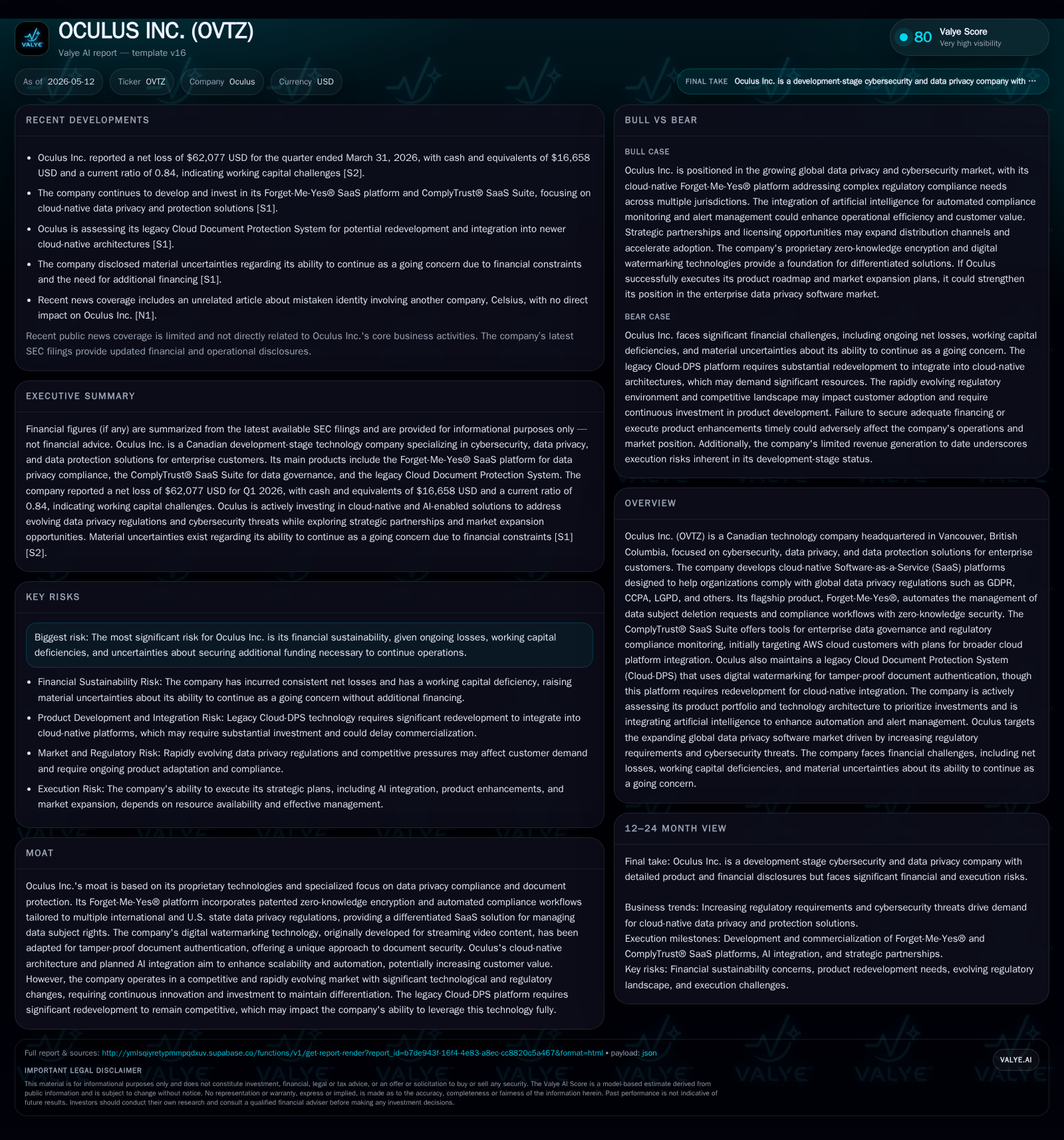
In its Q1 2026 10-Q, Oculus Inc. disclosed a pivotal review of its product portfolio including flagship Forget-Me-Yes® and Cloud Document Protection System platforms. This update signals a deliberate pivot toward cloud-native architectures and artificial intelligence-powered compliance automation, aiming to address evolving global data privacy regulations and competitive pressures. While the firm’s technology offers differentiated zero-knowledge encryption and digital watermarking capabilities, ongoing financial constraints and the need for additional capital raise execution risks. Success in scaling SaaS offerings across multi-cloud environments and embedding AI will be essential milestones in realizing long-term growth.
First Quarter 2026 Operating Update: Strategic Reassessment Underway
Oculus Inc.'s most recent Form 10-Q filed May 12, 2026, marks a critical inflection in its operational trajectory focused on reevaluating core technology platforms [S2]. The company is undertaking an extensive assessment of its product suite — notably the Forget-Me-Yes® data privacy SaaS platform and its legacy Cloud Document Protection System (Cloud-DPS) — with the objective of prioritizing development resources toward enhancing cloud-native solutions integrated with artificial intelligence functionalities. This comes during evolving data privacy regulatory demands worldwide and rapidly shifting customer expectations for automation and interoperability.
This strategic recalibration acknowledges that older architectures like Cloud-DPS require significant redevelopment to remain competitive in a predominantly cloud-first ecosystem [S2][S6]. Simultaneously, Oculus aims to accelerate AI adoption within workflows such as automated compliance monitoring and alert management, which are increasingly critical for enterprise customers facing complex multi-jurisdictional privacy obligations like GDPR, CCPA, LGPD, PIPL, among others.
Business Model and Product Portfolio Overview
Oculus generates revenue primarily through subscription-based SaaS offerings tailored to enterprise needs for data privacy compliance and protection [S1]. Its flagship Forget-Me-Yes® solution automates the "right-to-be-forgotten" (RtbF) and "right-of-erase" (RoE) processes mandated by modern privacy laws globally via a patented zero-knowledge encryption protocol ensuring that subscriber data remains secure and inaccessible even internally — a notable differentiator within the sector [S1]. The platform delivers continuous compliance adherence with policy-driven automation reducing manual intervention costs.
Complementing this is the ComplyTrust® SaaS Suite (CTSS), designed for comprehensive regulatory compliance monitoring across cloud infrastructures. Initially optimized for Amazon Web Services (AWS), CTSS supports data discovery, reporting, backup validation, and disaster recovery oversight with plans for cross-cloud platform integrations [S1][S6]. Experienced demand from enterprises undergoing cloud migration underpins CTSS's relevance.
Legacy Cloud-DPS utilizes real-time digital watermarking technology originally honed in entertainment media for tamper-proof document authentication. Although currently operating as a standalone system post-engineering review showing substantial redevelopment needs to adopt fully cloud-native capabilities, it represents an innovative application of watermarking in cybersecurity contexts – unique among competitors [S1][S6][S25].
Revenue from these offerings depends on subscription volumes charged per customer use cases or licensing models where applicable. Margins hinge on efficient SaaS delivery infrastructure while operational costs are influenced by perpetual R&D investments required to maintain relevant compliance support amid frequent regulatory changes [S1][S6].
Competitive Dynamics and Industry Positioning
The data privacy management landscape is intensely competitive with established players like OneTrust, TrustArc, BigID targeting broad compliance management alongside enterprise governance suites such as OpenText and Varonis competing against ComplyTrust®'s niche SaaS offerings [S24]. Many competitors focus on extensive feature sets or large sales footprints; Oculus positions itself as an innovator specializing in zero-knowledge security automation coupled with domain-specific workflow efficiency.
The cloud-native design philosophy aligns well with prevailing industry trends favoring scalable distributed deployments over legacy on-prem or hybrid models. However, Oculus confronts challenges scaling sales/distribution without larger partner ecosystems currently leveraged by rivals. Additionally, rapid advances in AI-powered analytics introduce both opportunities for differentiation as well as threats from well-funded entrants adopting similar strategies contemporaneously.
Overall, Oculus occupies a niche emphasizing specialized regulatory compliance automation integrated into modern cloud environments — an arena likely to expand as legislation proliferates but also one demanding continuous innovation to sustain competitive moats amid commoditization risks [S24][S25].
Growth Drivers: Cloud-Native Transition and AI Integration
Several structural trends underpin Oculus's growth prospects:
- Public cloud services spending is forecasted near $723 billion by 2025 reflecting accelerating migration of enterprise data workloads into hyperscale environments where native compliance tooling is increasingly demanded [S1].
- Expanding international privacy regulations enforce complex obligations globally increasing use case breadth across industries worldwide.
- Embedding artificial intelligence into compliance workflows promises operational scale benefits including reduced manual audits, faster incident response times, predictive risk spotting which may enhance subscription value propositions significantly [S6][S20].
- Strategic partnerships under exploration with software vendors or OEM channel participants could broaden distribution channels allowing faster market penetration beyond organic sales efforts.
Success depends heavily on execution: timely delivery of enhanced cloud-native platform iterations integrating AI augmentation will be critical milestones along with demonstrated improvements in retention or new customer acquisition facilitated by expanded multi-cloud support capabilities.
Risks and Operational Challenges: Funding and Market Competition
Financially Oculus presents notable concerns:
- Despite operational efforts, the company generated no revenues through recent years reported; net losses persist (e.g., -$319K net loss fiscal 2025) stressing ongoing profitability challenges [F1][S1].
- Liquidity constraints manifest as working capital deficits exemplified by a suboptimal current ratio of approximately 0.84 reflecting current liabilities exceeding assets at quarter-end March 31, 2026 [F1].
- Management projects requirement of $3 million to $5 million additional financing in fiscal 2026 to sustain operations; no binding commitments secured indicate considerable funding execution risk with potential impact on development roadmaps or market initiatives if capital acquisition falters [S4][F1].
- Competitive pressures from both bigger incumbents with deeper pockets investing aggressively in AI/Cloud innovations plus nimble startups threaten market share erosion unless Oculus sustains rapid technological progress.
Oculus must also navigate risks inherent in fast-evolving regulatory landscapes where changes could render parts of existing platforms obsolete or require costly reengineering. Intellectual property protection against infringement claims similarly poses latent litigation risks given industry activity levels around patents related to encryption and digital watermarking technologies [S13][S21].
Upcoming Milestones and Execution Watchpoints
Stakeholders should monitor these indicators:
- Progress reports from product roadmap evaluations initiated in Q1 2026 including announced updates or beta programs reprioritizing cloud-native Forget-Me-Yes® features or Cloud-DPS evolution paths [S2].
- Demonstrable implementation of AI-assisted workflow automation within SaaS suites confirming operational scalability gains beyond proof-of-concept phases [S6][S20].
- Announcements regarding strategic alliance formations particularly channel ecosystems broadened via partnerships with major cloud providers or enterprise software vendors driving wider adoption paths.
- Financial communications revealing success or setbacks meeting planned fundraising targets given funding necessity highlighted in filings; cash burn rate trends quarter-to-quarter will provide early warnings about runway adequacy.
Evaluation of these metrics will illuminate whether transformational strategies articulated translate into tangible competitive differentiation sustaining feasible growth trajectories within constrained cash flow contexts.
Financial Snapshot: Liquidity Constraints Amid Growth Investments
Latest financial snapshot
| Metric | Value | Period |
|---|---|---|
| Cash & equivalents | $16,658 | |
| 2026-03-31 | ||
| Current liabilities | $829,231 | |
| 2026-03-31 | ||
| Current ratio | 0.84x | |
| 2026-03-31 |
Source: SEC companyfacts cache [F1].
| Metric | Value (USD) | Date |
|---|---|---|
| Cash & Equivalents | 16,658 | |
| 2026-03-31 | ||
| Current Assets | 700,521 | |
| 2020-09-30 | ||
| Current Liabilities | 829,231 | |
| 2026-03-31 | ||
| Current Ratio | 0.84 | Latest Qtr |
As of March 31, 2026, Oculus held modest cash reserves around $16.7K while current liabilities outpaced assets resulting in a working capital deficiency that tempers near-term operational flexibility [F1]. Historical revenue absence underscores dependency on external capital infusions anticipated between $3–5 million during fiscal year expenditures outlined previously to finance planned strategic transitions [F1][S4].
Operating losses accumulated over years necessitate careful alignment of R&D spend focused on highest impact projects accompanied by prudent cost controls. Navigating fundraising uncertainty amid aggressive product modernization remains a principal challenge going forward.
This analysis synthesizes latest SEC disclosures concerning Oculus Inc.’s evolving business strategy amid competitive market dynamics characterized by rapid technological change driven by regulatory frameworks expansion globally. It highlights critical tradeoffs faced balancing innovation imperatives against operational cash constraints requiring close observation going forward.
Disclaimer: This report does not constitute investment advice or recommendations. It reflects analyst synthesis of publicly available information as of filing dates cited.
Disclaimer: This is research-only, informational analysis and not investment advice. It may include AI-generated interpretation and general industry context. Always verify important details using primary sources.

Comments