
Mosaic Co’s Volatile Input Challenge and Strategic Outlook for 2026
Mosaic’s Q1 2026 results underscore escalating raw material cost pressures and a cautious operational stance as the firm withdraws phosphate guidance amid market volatility.
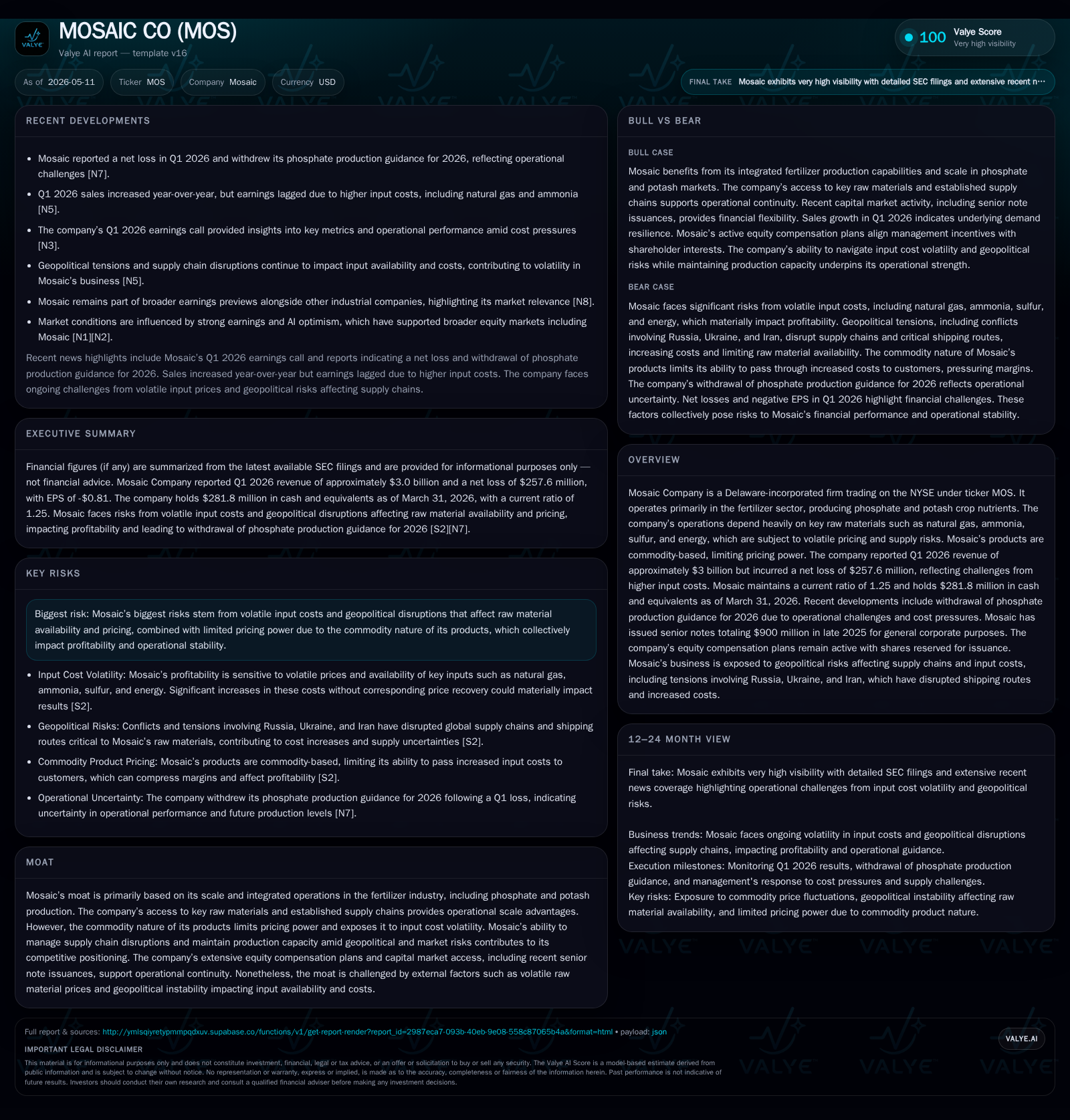
In Q1 2026, Mosaic Company reported about $3 billion in revenue but booked a net loss of $257.6 million, primarily due to significant increases in input costs such as natural gas, ammonia, and sulfur. The company withdrew its phosphate production guidance for 2026 reflecting operational challenges and heightened uncertainty. Mosaic’s integrated scale and established supply chains provide competitive advantages; however, the commodity nature of its fertilizers limits pricing power amid volatile input markets. Going forward, monitoring phosphate production metrics, raw material cost trends, and capital management will be crucial to assessing Mosaic’s ability to navigate ongoing challenges.
Q1 2026 Results Spotlight Rising Cost Pressures and Guidance Withdrawal
Mosaic’s latest quarterly filing dated May 11, 2026 ([S2]) paints a stark picture of heightened raw material cost adversity eroding profits. The company reported approximately $3 billion in quarterly revenue yet incurred a net loss of $257.6 million. This loss primarily roots in sharp cost inflation across key inputs—natural gas, ammonia, sulfur—and associated energy expenses. Natural gas is particularly pivotal since it serves dual roles as chemical feedstock for ammonia-based phosphate products and as an energy source in potash mining operations.
Notably, Mosaic withdrew its phosphate production guidance for the full year 2026 due to these operational challenges and uncertainty over input pricing stability. This withdrawal signals increased caution around sustaining throughput levels amid volatile global markets ([S2][S3][N6]). Additionally, no share repurchases were conducted in this quarter reflecting a conservative capital allocation stance in response to margin pressures ([S2]).
Business Model: Integrated Fertilizer Production Amid Commodity Constraints
At its core, Mosaic operates an integrated fertilizer manufacturing business focused on phosphate and potash crop nutrients ([S1]). The model relies heavily on sourcing natural gas both as a chemical reactant—primarily to produce anhydrous ammonia needed for phosphate products—and as fuel usage within potash solution mining.
This interconnected vertical supply chain offers scale economies and operational leverage; however, the commodity-like nature of fertilizer products constrains Mosaic's ability to pass on rising input costs fully to customers ([S1][S2][F1]). The firm’s revenue mechanics therefore hinge on volume shipped combined with fluctuating commodity prices that determine product pricing power—a dynamic complicated by raw material price volatility.
Furthermore, ammonia and sulfur are indispensable raw materials whose availability influences production scheduling. The company's integrated operations also create exposure to energy market swings given natural gas's double role.
Industry Structure: Scale Advantages Against Volatile Raw Material Markets
The global fertilizer sector is marked by concentrated players with scale advantages in resource access and logistics networks. Mosaic stands among the leaders with vertically integrated capacity spanning mining through nutrient processing ([S1][S2]).
However, supplier-side risks are acute. Geopolitical instability—exemplified by Russia-Ukraine tensions—disrupts supply chains for natural gas and related inputs. Similarly, heightened conflicts around Iran threaten maritime passages like the Strait of Hormuz that are vital conduits for transporting sulfur and ammonia ([S2]). These factors amplify supply uncertainty while pressure on transportation fuels raises freight costs.
Mosaic's prominence provides some insulation through strategic sourcing arrangements and distribution breadth but does not fully hedge cost or availability shocks given the open commodity landscape where pricing competition limits markup flexibility.
Growth Drivers: Managing Capacity, Supply Chain Discipline, and Market Demand
Growth pathways center on optimizing capacity utilization under raw material cost constraints while capturing sustained demand from agriculture-driven fertilizer consumption ([N3]). Agricultural commodity price support sustains farmer purchasing power which underpins fertilizer application rates.
Within this context, operational excellence in managing plant throughput amidst energy input fluctuations becomes critical. Cost discipline along supply chains—especially fuel-efficient logistics and procurement hedging—may also offer incremental margin support.
Though price increases have limited transmission windows due to competitive pressures on commodity fertilizers, rationalizing product mix toward higher-value or specialty nutrient blends could further aid margin expansion if feasible.
Risks and Constraints: Input Price Volatility, Limited Pricing Power, Geopolitical Tensions
Central risk elements revolve around input price surges that Mosaic cannot fully transfer to buyers owing to product commoditization ([S2][N6]). A persistent spike in natural gas or ammonia prices not reflected in end-product pricing compresses gross margins sharply.
Moreover, geopolitical events impacting supply routes—such as ongoing clashes tied to Russia-Ukraine dynamics or Iranian naval tensions jeopardizing Strait of Hormuz shipments—exacerbate logistical uncertainties leading to elevated costs or delays ([S2]).
Such volatility not only undermines short-term profitability but also complicates forecasting and operational planning. On the financial front, Mosaic holds nearly $282 million in cash and equivalents with a current ratio of 1.25 as of March 31, 2026, indicating manageable short-term liquidity ([F1]).
What to Watch Next: Production Metrics, Cost Trends, and Capital Management
In the near term, market observers should focus sharply on whether Mosaic reinstates phosphate production guidance or revises outlook downward given persistent headwinds ([S2][S3]). Second-quarter results will be pivotal for assessing raw material cost trajectories tied to natural gas prices globally.
Monitoring reported phosphate production volumes offers insight into operational resilience amidst input constraints. Additionally, indications of capex moves intended to enhance energy efficiency or expand capacity signal strategic responsiveness.
Capital management initiatives—including potential debt reduction or refinancing efforts—and any shifts in shareholder returns policy will reveal the company’s financial maneuvering posture under earnings stress ([S2][S3][N3]).
Latest Financial Snapshot: Balance Sheet Strength Amid Operational Headwinds
Latest financial snapshot
| Metric | Value | Period |
|---|---|---|
| Cash & equivalents | $282mm | |
| 2026-03-31 | ||
| Total debt | $4.3bn | |
| 2026-03-31 | ||
| Net debt | $4.0bn | |
| 2026-03-31 | ||
| Current assets | $5.3bn | |
| 2026-03-31 | ||
| Current liabilities | $4.3bn | |
| 2026-03-31 | ||
| Current ratio | 1.25x | |
| 2026-03-31 |
Source: SEC companyfacts cache [F1].
| Metric | Amount (USD) |
|---|---|
| Cash & Equivalents | 281.8 million |
| Total Debt | 4.271 billion |
| Net Debt | 3.989 billion |
| Current Assets | 5.340 billion |
| Current Liabilities | 4.288 billion |
| Current Ratio | 1.25 |
As of March 31, 2026 ([F1]), Mosaic retains a reasonable liquidity buffer with nearly $282 million in cash equivalents paired with a current ratio above one indicating manageable short-term obligations coverage.
This analysis synthesizes MOSAIC CO's recent quarterly disclosures emphasizing how rising costs have materially impacted profitability and compelled guidance withdrawal while underscoring Mosaic's strategic positioning given industry dynamics shaped by geopolitical risk and commodity volatility. Ongoing execution across operational efficiency levers alongside macro supply-demand trends will define the company's trajectory through the remainder of 2026.
Disclaimer: This article is an industry analysis based solely on publicly available SEC filings and news sources as of May 11, 2026. It does not constitute investment advice or a recommendation.
Disclaimer: This is research-only, informational analysis and not investment advice. It may include AI-generated interpretation and general industry context. Always verify important details using primary sources.

Comments