
Atlanta Braves Holdings Embraces Broadcasting Control and Real Estate Expansion Amid Debt Challenges
The company launched BravesVision in 2026, shifting its broadcasting model while expanding real estate development, all under significant indebtedness pressures.
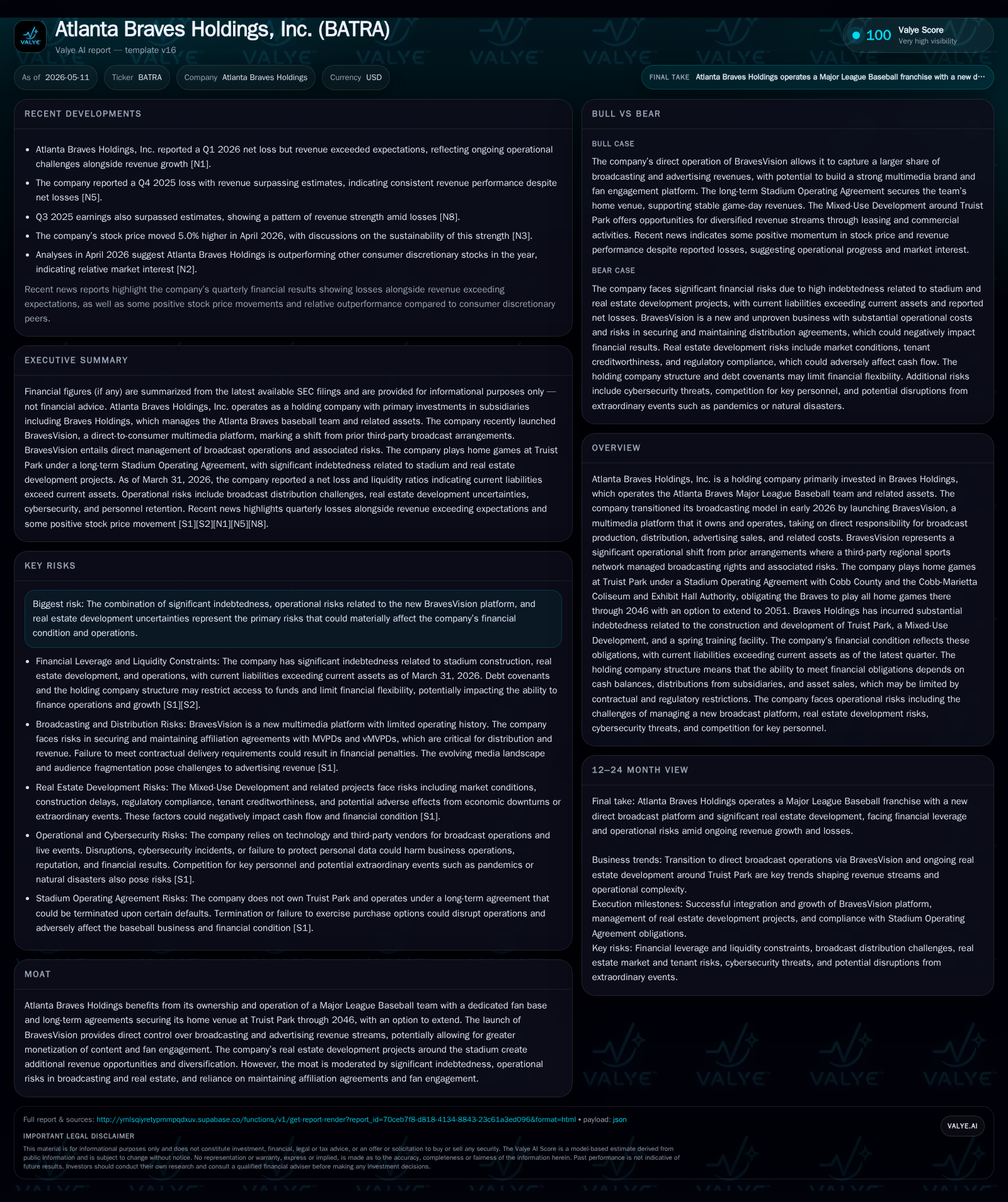
Atlanta Braves Holdings, Inc. transformed its broadcasting approach with the February 2026 launch of BravesVision, taking direct operational control over local broadcast rights previously managed by a regional sports network. This strategic pivot positions the company for greater content monetization but introduces higher operational costs and execution risks against a backdrop of substantial debt. Concurrently, Braves Holdings is advancing mixed-use real estate initiatives around Truist Park, diversifying revenue streams. The team's on-field success remains a critical driver of fan engagement and associated revenues. However, tight liquidity, significant indebtedness, and the nascent BravesVision business model present key operational and financial risks in 2026.
Recent Operating Update
Atlanta Braves Holdings’ latest quarterly filing dated May 11, 2026 ([S2]) reveals a pivotal shift in its broadcasting strategy with the February 2026 launch of BravesVision—a fully owned multimedia platform that transitioned the company away from reliance on third-party regional sports networks. This move follows financial difficulties experienced by its former broadcaster Main Street Sports Group (formerly Diamond Sports Group), which prompted the termination of the previous local Broadcasting Agreement due to missed contractual payments.
BravesVision effectively internalizes responsibilities for production costs, distribution logistics, advertising sales, and carriage agreements with cable and streaming providers. This represents both an opportunity for enhanced monetization of local broadcasting rights as well as a material expansion of operating risk and cost base. The Company acknowledges limited experience in this domain and emphasizes the substantial upfront investments required to establish the platform's technical infrastructure and personnel capabilities ([S2]).
Simultaneously, Braves Holdings continues its real estate development efforts surrounding Truist Park under long-term tenant leases that could generate diversified cash flows beyond traditional baseball operations. However, these projects face typical construction risks alongside broader cyclical economic uncertainties impacting tenant creditworthiness ([S1], [S23]).
The Atlanta Braves maintain exclusive rights to play all home games at Truist Park through the Stadium Operating Agreement with Cobb County and related authorities extending to 2046 with an option to renew to 2051 ([S14], [S19]). Compliance with this agreement remains a foundational operational pillar.
Business Model
Atlanta Braves Holdings operates primarily as the holding entity for Braves Holdings LLC which owns and operates the Atlanta Braves Major League Baseball franchise. Revenue is generated through several interrelated streams:
- Ticket Sales & Premium Seating: Driven by game attendance including regular season and postseason play.
- Broadcast Rights: Previously licensed via third-party RSNs; now internally operated through BravesVision.
- Advertising & Sponsorship: Leveraged across in-stadium experiences plus multimedia platforms.
- Merchandise & Concessions: Physical sales tied closely to fan attendance.
- Real Estate Development: Mixed-use commercial projects around Truist Park offer rental income diversification.
The recent strategic decision to bring local broadcast control in-house via BravesVision marks a meaningful departure from legacy practices. Previously, Atlanta Braves received fixed fees under carriage contracts; now they assume full operational responsibility including content production, carriage negotiations with cable/satellite providers and streaming services, selling advertising inventory directly—activities with variable revenue potential but also heightened cost exposure. Their control allows tailored fan engagement benefits but execution complexity has materially increased ([S2], [S1]).
Vertical integration into content distribution is emerging among some teams but remains novel with limited track record ([S1], [S2]).
- Venue Control: The Stadium Operating Agreement locks in home venue exclusivity at Truist Park forming a physical moat but also exposes risks if termination occurs ([S19]).
- Ownership Voting Structures: Multi-class stock limits stockholder activism potentially affecting strategic decisions ([S13]).
Competition for attention spans in sports entertainment incorporates both other MLB teams regionally and national sports media entities offering alternative content choices. The team brand strength anchored by historic fan loyalty provides an enduring advantage but local broadcast monetization depends heavily on evolving consumption preferences including streaming adoption.
Growth Drivers
Direct Control Over Broadcasting Revenue Stream
The transition to BravesVision represents a structural growth opportunity analogous to a media company expanding its footprint into localized digital content delivery. Success here could unlock higher per-subscriber revenues through tailored advertising packages and new direct-to-consumer offerings.
Real Estate Development Around Truist Park
Mixed-use developments designed to integrate retail, office space, residential units, or hospitality provide multi-year lease revenues that are less volatile than seasonal sports-related income ([S11], [S23]). These assets benefit from proximity to game-day traffic yet can attract broader tenant bases.
Fan Engagement & Team Performance Linkage
On-field success continues as a clear revenue multiplier affecting ticket uptake – particularly premium suites – merchandise sales surge when fan enthusiasm peaks post-season ([S1]). Maintaining competitive rosters remains essential.
Technology Investments & New Media Models
Investment in scalable multi-platform video distribution aligns with shifting viewer preferences toward streaming. Collaboration agreements with production vendors help mitigate execution risks yet operational command rests with Braves Holdings ([S2]).
Risks / Watchpoints / Constraints
Execution Risks of BravesVision Network
Operating a full-scale broadcast network requires sustained investment in technology systems (including live video production at scale), staffing expert media professionals, sales effectiveness in ad markets and ongoing affiliation agreement renewals amid intense competition for carriage slots ([S2]). Failure to generate adequate subscription or advertising revenue could materially stress margins.
Financial Position and Liquidity
As of March 31, 2026, the company reported total debt of approximately $709 million and cash and equivalents of about $135 million, resulting in a current ratio of 0.46, indicating tight short-term liquidity ([F1]). League-wide issues such as labor disputes or changes in broadcasting rights structures represent systemic risks.
Stadium Operating Agreement Obligations
Failure to meet conditions under this contract could result in loss of venue control disrupting operations; this agreement also contains penalty provisions for non-compliance including timely payments ([S14], [S19]).
What to Watch Next
Key indicators will include:
- Early subscription uptake rates for BravesVision across cable/satellite/streaming providers.
- Advertising sales trends compared against historical RSN contracts maintaining margin targets.
- Announcements regarding carriage agreements or partnership expansions for BravesVision distribution.
- Team win-loss records influencing attendance patterns ahead of postseason qualification potential.
- Leasing velocity updates or economic performance disclosures related to Mixed-Use Development tenants.
- Changes or refinements in capital structure responding to debt covenant pressures or liquidity management strategies reported in subsequent quarters.
Financial Profile Summary (Q1 Ending March 31, 2026) [F1]
Latest financial snapshot
| Metric | Value | Period |
|---|---|---|
| Cash & equivalents | $135mm | |
| 2026-03-31 | ||
| Total debt | $709mm | |
| 2026-03-31 | ||
| Net debt | $574mm | |
| 2026-03-31 | ||
| Current assets | $225mm | |
| 2026-03-31 | ||
| Current liabilities | $491mm | |
| 2026-03-31 | ||
| Current ratio | 0.46x | |
| 2026-03-31 |
Source: SEC companyfacts cache [F1].
Liquidity constraints reflected by a sub-unity current ratio highlight ongoing financial strain amidst expansion efforts. Elevated debt levels partly fund stadium-related infrastructure and associated real estate investments which increase fixed obligations despite uncertain short-term cash generation.
This analysis is based solely on information publicly disclosed through SEC filings up to May 11th, 2026. It does not constitute investment advice or recommendations. Readers should consider multiple sources when forming any opinions about Atlanta Braves Holdings’ business prospects or financial condition.
Disclaimer: This is research-only, informational analysis and not investment advice. It may include AI-generated interpretation and general industry context. Always verify important details using primary sources.

Comments