
Steele Bancorp Expands Regional Footprint and Enhances Loan Portfolio Integration
Completion of the Northumberland Bancorp merger redefines Steele Bancorp’s platform, driving increased scale and operational adjustments within Pennsylvania’s competitive regional banking sector.
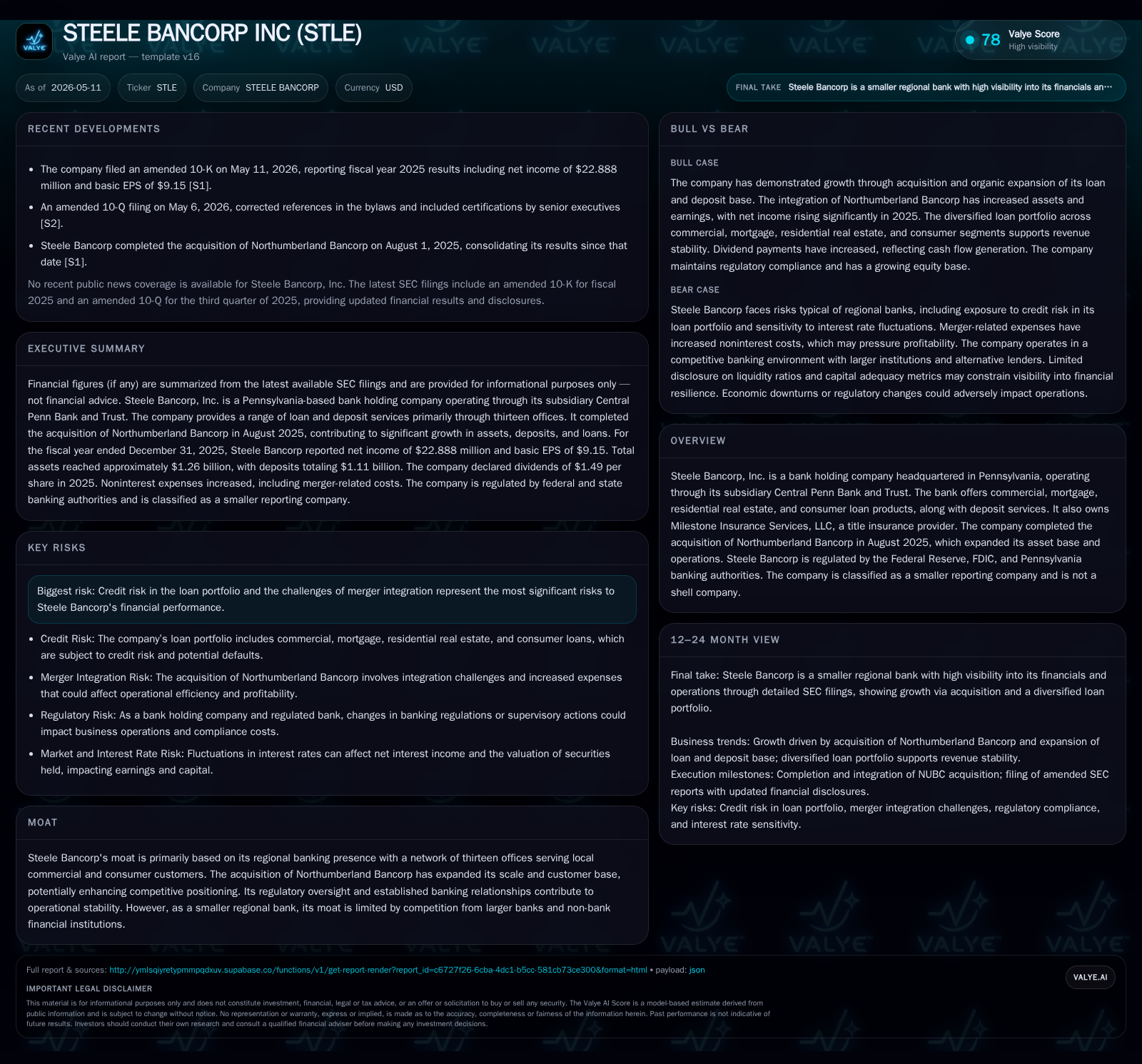
Steele Bancorp finalized its acquisition of Northumberland Bancorp in August 2025, marking a pivotal expansion of its asset base and branch network. The merger increased the combined entity’s footprint to thirteen offices across Pennsylvania under the Central Penn Bank brand, delivering enhanced commercial and consumer lending capabilities. While integration remains ongoing, management is focused on capitalizing on cross-selling opportunities and operational synergies. Risks center around credit concentration in legacy loan portfolios and execution of merger integration tasks amid competitive pressures from larger banks and non-bank entrants.
Latest Operating Developments: Impact of Q3-Q4 2025 and Q1 2026 Disclosures
Steele Bancorp’s operational landscape transformed materially following the August 2025 closure of its acquisition of Northumberland Bancorp [S7]. This transaction effectively merged Northumberland’s subsidiary bank into Steele’s existing Central Penn Bank & Trust franchise, expanding total branch count to thirteen within Pennsylvania. Subsequent quarterly disclosures ([S2], [S3], [S4], [S5], [S6]) highlight ongoing integration efforts with management signaling gradual consolidation of loan portfolios and customer service platforms. The merger consideration involved issuing approximately 1.55 million shares plus cash for fractional shares to Northumberland shareholders, underscoring strategic scale priorities at a time when regional banks face mounting competition.
Post-merger, Steele has sought to harmonize operations across former legacy entities while leveraging an enlarged deposit base and loan portfolio. Branch network density now allows enhanced local market penetration in the central Pennsylvania corridor. The company’s Q4 2025 and Q1 2026 earnings releases indicate adjustments in asset composition reflective of this expanded footprint though detailed segment-level performance remains limited in public filings.
Business Model Overview: Core Banking, Loan Products, and Insurance Services
Operating as a bank holding company headquartered in Mifflinburg, Pennsylvania, Steele Bancorp generates revenue primarily through interest income on an array of loan products originated via its wholly owned subsidiary Central Penn Bank & Trust [S1]. The loan book encompasses commercial loans aimed at local businesses, mortgage loans supporting home purchase financing, residential real estate lending primarily tied to owner-occupied properties, as well as consumer installment loans. Accompanying these lending services are deposit accounts that form a core funding source.
Complementing core banking is Milestone Insurance Services, LLC—a title insurance provider wholly owned by Central Penn—offering bundled real estate transaction services that facilitate mortgage origination pipelines while enhancing client stickiness through integrated offerings. This intersection between lending and title insurance represents a strategic asset for customer retention in a relationship-driven community banking environment.
Regulated by Federal Reserve authorities alongside state regulators and the FDIC, Steele balances growth ambitions with regulatory capital requirements and prudent risk management policies designed to sustain longer-term operational stability.
Competitive Positioning: Regional Presence and Acquisition Synergies
Steele Bancorp's competitive moat is rooted in established community banking relationships supported by deep local market knowledge across Pennsylvania’s mid-state region [S1]. The acquisition of Northumberland Bancorp broadens this presence with additional offices serving adjacent communities previously outside Steele’s network.
This expansion enhances 'branch network density'—a critical factor in regional banking where face-to-face advisory roles remain valued by small- to mid-sized commercial clients and retail depositors. It also raises client ‘switching costs’ by embedding customers within wider product ecosystems blending banking with title insurance solutions.
However, limitations persist owing to the company's relatively smaller scale compared to large regional or national banks which leverage broader capital market access and technology investment scales. Moreover, emerging fintech providers increasingly challenge traditional deposit-taking institutions by offering digital-first lending alternatives.
Synergies targeted from the merger include cost efficiencies via back-office rationalization, consolidated IT infrastructure investments, and improved revenue mix through cross-selling opportunities—the degree of success here will materially influence future competitive positioning.
Growth Drivers: Scale Expansion, Cross-Selling Opportunities, and Community Banking Dynamics
Key growth vectors have emerged post-merger anchored on expanded geographic reach fueling loan portfolio growth across commercial and consumer segments [S7]. Increased scale allows for deeper penetration in local business communities coupled with residential mortgage origination lift tapping expanded branch touchpoints.
Cross-selling between Central Penn Bank's lending products and Milestone Insurance's title services is another critical driver enabling enhanced margins per client relationship through bundled offerings that meet intertwined financing needs during property transactions. Such integration improves customer lifetime value while raising barriers against competitor encroachment.
Achieving operational economies of scale emerges as a near- to medium-term margin lever with merger-related expense rationalization potential bolstering net interest spreads over time if executed efficiently. Additionally, organic growth prospects remain supported by steady demand for housing finance coupled with localized small business credit needs amid Pennsylvania's stable economic profile.
Risks and Watchpoints: Credit Exposure, Merger Integration Challenges, and Competitive Pressures
Significant risks confronting Steele include credit concentration embedded within legacy loan portfolios inherited via acquisition. Such exposures necessitate vigilant monitoring as localized economic downturns could pressure borrower repayment capabilities.
Merger integration risks also merit close observation encompassing IT system harmonization complexities, cultural alignment among personnel formerly serving separate institutions, plus retention of acquired customers critical to sustaining revenue continuity [S1]. Failed integration could erode anticipated cost savings or disrupt client experience.
Competitive headwinds stem from larger banks’ scale advantages enabling broader product suites and technology deployment alongside fintech entrants reshaping customer acquisition paradigms especially among younger demographics seeking digital convenience over branch interactions.
Increased regulatory scrutiny tied to capital adequacy norms post-merger adds compliance cost considerations that must be balanced against growth investments.
What to Monitor Next: Earnings Updates, Integration Milestones, and Regulatory Environment
Market watchers should track forthcoming quarterly earnings reports beyond Q1 2026 ([S3]), focusing on revenue trends reflective of integration progress including loan book composition changes or deposit inflows signaling solidified customer bases. Margins on cross-sold products like title insurance embedded within mortgage transactions will be a meaningful KPI reflecting synergy realization.
Integration milestone KPIs such as backend system consolidation phases completed or employee turnover rates in acquired operations provide indirect gauges of execution health. Regulatory filings disclosing capital ratios post-merger will illuminate balance sheet strength underpinning ongoing growth pursuits.
Loan portfolio performance metrics—delinquencies or charge-offs especially related to identified risk concentrations like the Nottingham Loans—remain critical watchpoints informing credit risk trajectory amidst economic fluctuations.
Operational shifts in response to competitive pressures such as new digital channel launches or partnerships may offer signals about Steele’s evolving market strategy going forward.
This analysis synthesizes publicly available SEC filings up to May 2026 without providing investment advice or forecasts. Please refer directly to company disclosures for comprehensive financial details.[F1][S1][S2][S3][S4][S5][S6][S7][S27]
Disclaimer: This is research-only, informational analysis and not investment advice. It may include AI-generated interpretation and general industry context. Always verify important details using primary sources.

Comments