
Karat Packaging Advances Distribution Scale and Supply Chain Resilience Amid Margin Expansion
Recent quarterly results highlight Karat Packaging's strategic shift toward an asset-light model, leveraging global sourcing and expanded distribution to drive growth.
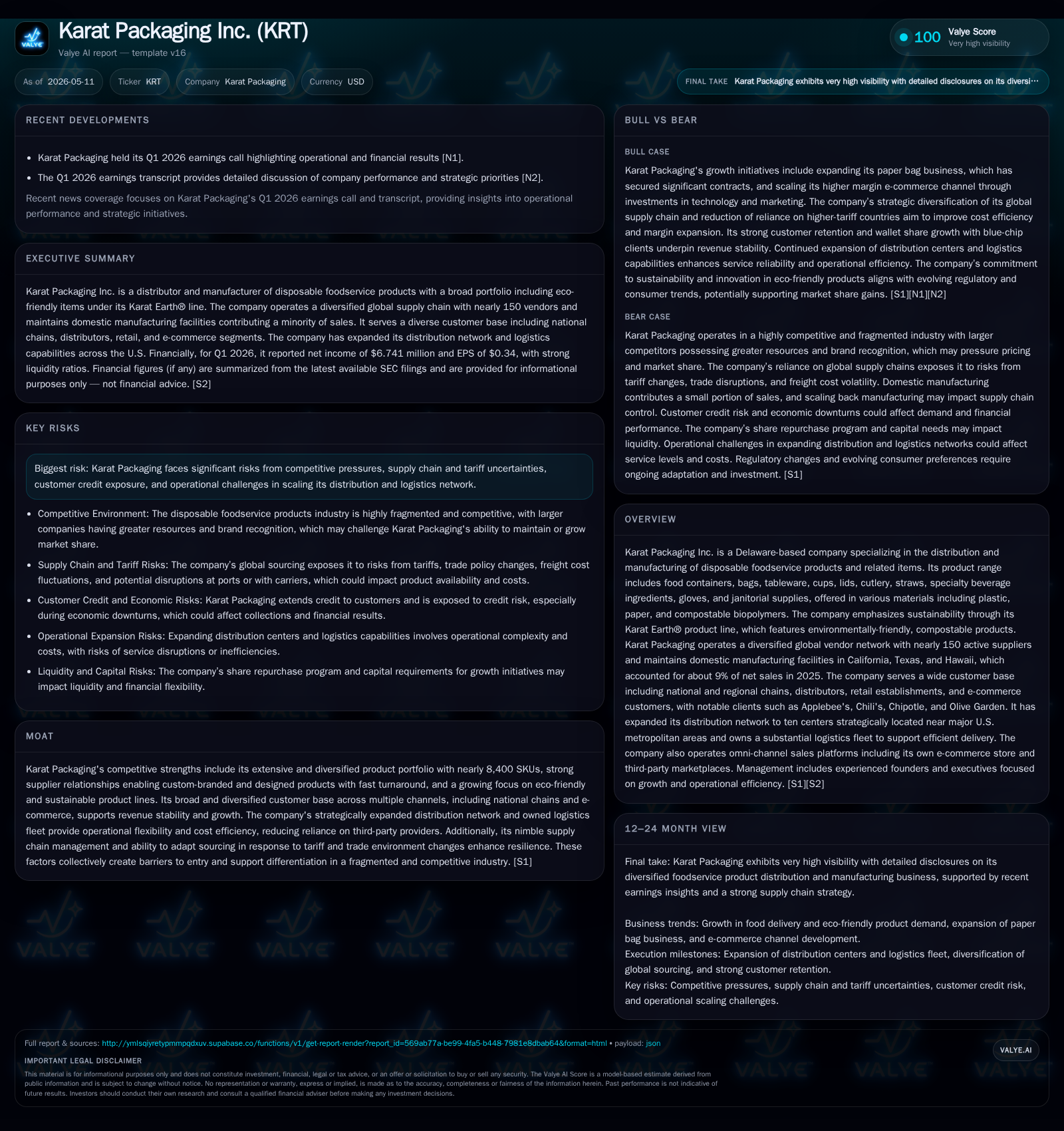
Karat Packaging's latest 10-Q filing for Q1 2026 reveals continued execution of its pivot from domestic manufacturing toward import-driven distribution, supported by a broad supplier network and new warehouse openings. The company’s diversified product portfolio with nearly 8,400 SKUs spans disposable foodservice and specialty beverage items, with a growing emphasis on sustainable offerings under the Karat Earth® brand. Its nimble supply chain management, growing logistics capacity, and multi-channel customer approach underpin resilience against tariff pressures and support margin expansion. Key risks remain focused on supply chain volatility, tariff impacts, and competitive intensity in a fragmented industry.
Recent Operating Update
Karat Packaging Inc.'s Q1 2026 disclosure [S2], complemented by a May 7 earnings release [S3], confirms ongoing progress in operational execution against its strategic priorities. The company highlights expanded distribution capabilities with recent facilities added in Chino (CA) and Mesa (AZ), augmenting its total warehouse footprint by over 230,000 square feet in the last two years [S26]. Alongside this, Karat owns a national logistics fleet comprising over 40 trucks including refrigerated units supporting frozen foods dispatches—a significant operational asset driving delivery flexibility and customer responsiveness.
An explicit shift away from domestic manufacturing—now contributing approximately 9% of net sales as of end-2025 down from prior years—towards import-driven distribution characterizes the recent quarters [S1][S9]. This aligns with their asset-light pivot strategy enabled by declining ocean freight costs against rising domestic labor expenses. The company also reports diversifying its sourcing base going beyond traditional China suppliers to Malaysia and Vietnam, which together accounted for 17% of global sourcing in 2025 up from 9% in 2024 [S28].
The firm’s ongoing adaptation to evolving tariffs and trade dynamics includes negotiating favorable vendor terms while maintaining quick turnaround custom product offerings through its vast supplier network.
Business Model
Karat generates revenue primarily through the distribution of disposable foodservice products sourced globally from almost 150 vendors combined with selected U.S.-based manufacturing operations providing about one-tenth of sales [S14]. It sells across multiple channels: large national/regional chains typically using floor stocking agreements; distributors reselling to schools, offices, government entities; smaller retail outlets such as bubble tea shops; plus direct-to-consumer via robust e-commerce platforms including their own site as well as marketplaces like Amazon, Walmart, eBay, TikTok, and Sysco [S4].
Revenue mechanics hinge largely on volume sales of single-use packaging products—food containers, cups, lids, cutlery—and related specialty beverage ingredients underpinned by broad SKU diversity (~8,400 SKUs). Pricing power stems from customized product innovation capabilities combined with rapid fulfillment enabled by owned logistics.
Margins benefit from the company’s flexibility to toggle between imports and in-house manufacturing balancing cost efficiency with supply reliability. Inventory is managed through strategically located DCs concentrated near major metro areas for faster order fulfillment reducing inventory holding costs at customer sites.[S26]
Industry Structure and Competitive Position
The disposable foodservice industry is large but fragmented featuring players ranging from multinationals handling mass-market consumables to niche regional operators focused on specialty products like boba tea ingredients [S27]. Karat's competitive moat derives from product breadth spanning conventional plastic/paper disposables to eco-conscious biopolymer-based lines branded Karat Earth®, responding proactively to environmental regulations banning materials such as Styrofoam or plastic straws [S1][S14].
Operational differentiation is evident in vertically integrated logistics including a sizeable fleet reducing third-party dependency—a rarity among peers—which enhances service reliability and cost control [S28]. A diversified customer base mitigates concentration risk while exposure across foodservice segments allows growth capture amid evolving demand shifts favoring takeout/delivery services accelerated post-pandemic.[S4][S27]
Supplier relationship strength facilitates rapid custom branding/design turnarounds at competitive price points supporting higher retention rates among large chain clients.
Growth Drivers
Key growth drivers lie in expanded national footprint via new warehouses enhancing geographic reach for faster delivery times; scaling e-commerce channels targeting small businesses and individual consumers which command higher margins; plus innovation-led portfolio expansion notably within sustainability-focused disposables aligning well with regulatory trends favoring compostable alternatives [S14][N1][N2].
Food delivery/takeout market expansion fuels demand for on-the-go packaging solutions projected to grow substantially through the decade according to industry observers [S27]. Ongoing diversification of global sourcing reduces exposure to tariff escalations allowing improved cost pass-through capability to customers without sacrificing volume growth or margins [S28].
Continued investment in sales force scale including regional leadership promotions supports deeper penetration within existing accounts while fostering new client acquisition particularly among national chains expected to drive the bulk of near-term volume growth [S26].
Risks / Watchpoints / Growth Constraints
Tariff uncertainty remains a critical headwind given the import-dependent model; failures to mitigate can compress margins sharply or disrupt supply causing lost revenue opportunities [S20][S21]. Supply chain interruptions due to geopolitical tensions or raw material scarcity/inflation—especially plastic/paper inputs—could trigger cost volatility hard to pass along promptly impacting profitability [S15].[N2]
Competitive intensity in a commoditized category necessitates relentless product innovation alongside efficient service delivery; failure may erode market share or pricing power. Legal/regulatory compliance complexity especially around evolving environmental standards presents execution risk if not managed proactively.
Scaling distribution infrastructure involves execution complexities including workforce recruitment/retention challenges within logistics division that if unmet could impair service performance [S25]. Aggressive share repurchase programs utilizing cash reserves may limit financial flexibility during downturns or opportunities requiring capital investment [S18].
What to Watch Next
Key milestones include progress tracking on planned further warehouse expansions targeting underserved metro areas as outlined previously; updates on vendor diversification efforts expanding beyond Southeast Asia to add resilience against trade policy shifts; quarterly E-commerce growth metrics distinguishing channel profitability contributions; any sequentally reported margin improvement evidencing successful tariff mitigation or raw material inflation pass-through; operational efficiency gains via fleet utilization increases; plus management commentary on external demand environment particularly within national chain contracts renewals or expansions.
Monitoring regulatory developments around single-use plastics or compostability mandates will also be critical given their material impact on product portfolio evolution and customer purchasing behavior.
Financial Snapshot (as of Q1 2026) [F1]
Latest financial snapshot
| Metric | Value | Period |
|---|---|---|
| Cash & equivalents | $29mm | |
| 2026-03-31 | ||
| Total debt | $35mm | |
| 2026-03-31 | ||
| Net debt | $7mm | |
| 2026-03-31 | ||
| Current assets | $161mm | |
| 2026-03-31 | ||
| Current liabilities | $70mm | |
| 2026-03-31 | ||
| Current ratio | 2.29x | |
| 2026-03-31 |
Source: SEC companyfacts cache [F1].
The strong liquidity position supported by a current ratio above two provides financial flexibility for continued capex on distribution expansion while managing leverage conservatively relative to cash balances. Operating income noted at $41.4 million for FY25 further underscores profitable scale achieved [F1].
This analysis is based solely on publicly available information from SEC filings as of May 2026 and relevant news sources noted herein. It does not constitute investment advice or an endorsement of any securities mentioned.
Disclaimer: This is research-only, informational analysis and not investment advice. It may include AI-generated interpretation and general industry context. Always verify important details using primary sources.

Comments