
Procaccianti Hotel REIT Advances Distribution Policy and Portfolio Stability in Q1 2026
Q1 filings show sustained distribution approvals and steady operations underpinning Procaccianti’s focused hotel real estate model.
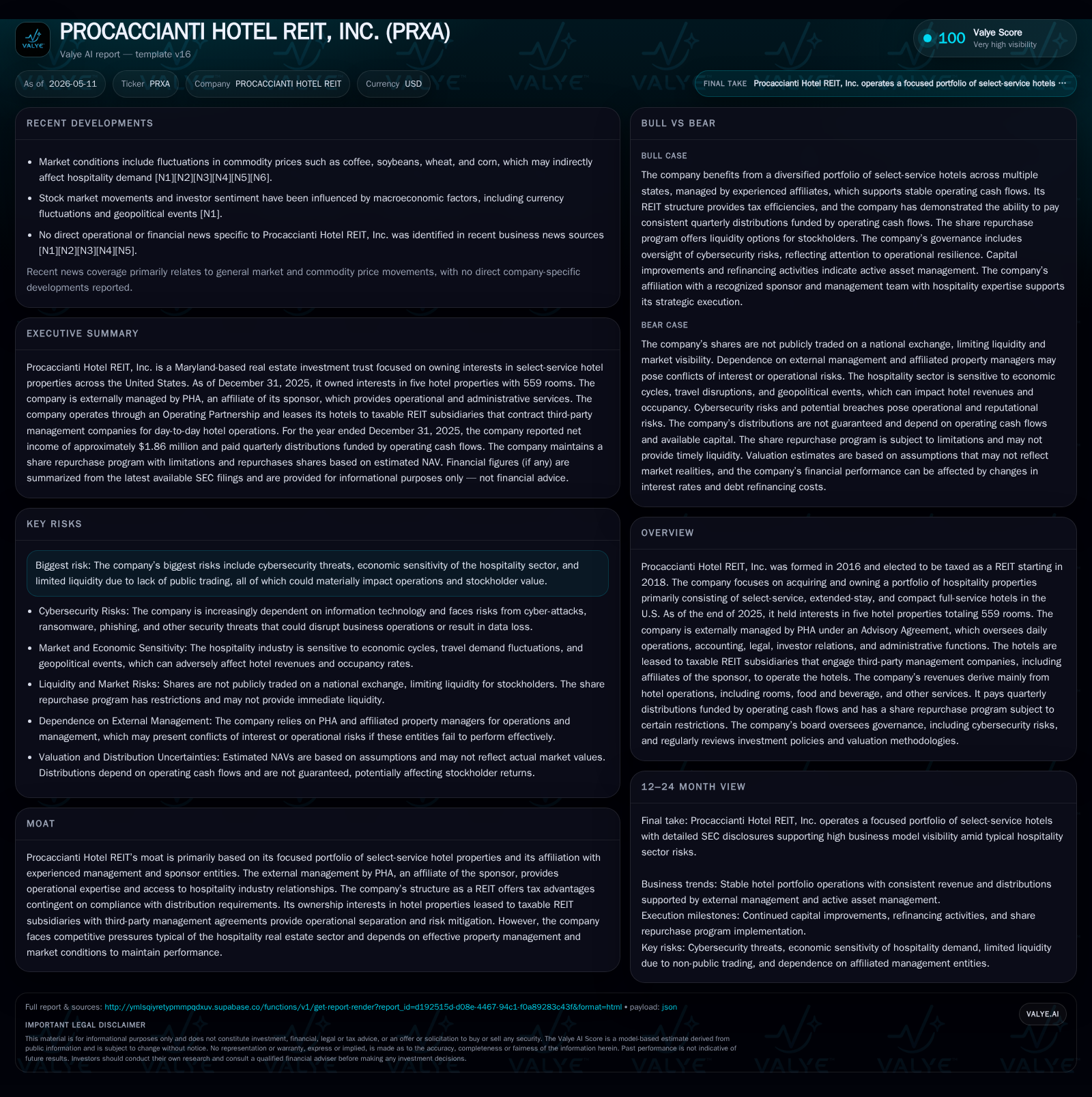
Procaccianti Hotel REIT’s Q1 2026 disclosures affirm its commitment to fixed-rate distributions backed by operating cash flows from its select-service hotel portfolio. The company continues to be externally managed by PHA, leveraging third-party operators for day-to-day hospitality management while retaining ownership and capital risk. Its portfolio strategy centers on a stable mix of five properties with modest leverage, supported by a share repurchase program offering limited liquidity to shareholders. Key risks include cybersecurity exposures and hospitality sector cyclicality, but governance frameworks and legal structure provide mitigating influence. Looking ahead, distribution funding, share repurchase activity, and potential acquisitions remain critical markers.
Q1 2026 Operating Results and Key Developments
Procaccianti Hotel REIT’s latest quarterly report filed May 11, 2026, confirms ongoing stability in its distribution policy and portfolio operations. The Board authorized distributions on all outstanding Class K common units—specifically K Shares, K-I Shares, and Class K OP Units—at an accrual rate of 7% per annum through March 31, 2026. This distribution amount accumulates daily per share basis with payment approved following the quarter end. The aggregate distribution sums for each class were authorized for payout reflecting confidence in operating cash flows sustaining shareholder returns [S3].
No material changes were reported in risk factors compared to the prior annual filing released in March 2026, indicating consistent recognition of cybersecurity vulnerabilities alongside typical hospitality industry cycles without emergent concerns [S2].
Business Model: Hotel Ownership Through External Management
Procaccianti is structured as a real estate investment trust owning interests in five U.S.-based hospitality properties totaling 559 rooms concentrated in select-service segments including extended-stay and compact full-service formats. Importantly, it does not operate hotels directly but relies on an external manager—Procaccianti Hotel Advisors (PHA)—under an established Advisory Agreement for oversight of day-to-day affairs such as accounting, legal compliance, investor relations, and administration [S1].
Day-to-day hotel operations are run through taxable REIT subsidiaries that lease the owned properties under long-term triple-net arrangements. These subsidiaries engage third-party hotel management companies—including affiliates tied to the sponsor—for guest services and operational management. This layered model compartmentalizes asset ownership from operational risk while leveraging specialized operators’ expertise [S1].
Revenue composition centers primarily on hotel room rentals augmented by food & beverage sales plus ancillary guest services fees typical of hospitality real estate portfolios. Procaccianti captures returns mostly through property leases rather than direct operational margin exposure which helps stabilize cash flow profiles amid fluctuating market conditions.
Competitive Position Within Select-Service Hospitality Sector
Within the broader U.S. lodging market, Procaccianti occupies a niche focused on select-service hotels characterized by lower operating complexity compared to full-service resorts but benefiting from stable demand drivers such as business travel and extended stay needs. Its portfolio's geographic diversity across four states moderates regional concentration risk yet still exposes it to localized economic drivers.
The external managerial linkage to PHA—a sponsor-affiliated entity—provides strategic advantages by consolidating operational knowledge and fostering established relationships with third-party operators. However, reliance on affiliated service providers could pose conflicts if not managed transparently.
Given typical scale constraints relative to major branded hotel chains with global footprint advantages in marketing and distribution, Procaccianti’s competitive position rests heavily on effective cost controls via its management structure plus selective property acquisition criteria aligned with sustained demand sub-segments [S1]. Limited scale restricts pricing power somewhat but focus on extended-stay markets often correlates with tenant stickiness.
Distribution Practices and Shareholder Return Dynamics
Distributions remain a cornerstone of Procaccianti’s value proposition. The April 27, 2026 Board authorization reaffirmed payment of distributions accrued at a fixed rate of approximately 7% per annum across the K Share classes including OP Units issued as part of property acquisitions like Hilton Garden Inn Providence. These distributions are funded out of operating cash flow which has shown consistency over sequential quarters [S3][S2].
In addition to quarterly dividends, the Company maintains a share repurchase program governed by parameters limiting aggregate repurchases to approximately 5% of weighted average shares outstanding annually. The repurchases are priced relative to estimated NAVs which stood near $10.17 per share for K-class shares as reported at year-end 2025 allowing the program to provide intermittent liquidity given absence of public listing [S7][S8]. While supportive from a shareholder return angle, this program is constrained in volume meaning it cannot fully substitute for exchange-traded market liquidity.
Growth Drivers and Expansion Opportunities
Future growth hinges chiefly on disciplined portfolio expansion within prudent leverage guidelines—generally capping borrowings at or below half the aggregate fair market value of assets unless independently approved higher limits apply [S5]. Net proceeds from offerings (both primary public/private) combined with operating cash flows finance acquisitions or capital improvements designed to enhance revenue streams or upgrade property competitive positioning.
PHA’s role extends beyond asset management into facilitating operational efficiencies that can boost margins at managed properties without proportionally increasing capital expenditure needs.
Though recent refinancing activities lowered weighted average borrowing costs (e.g., Hilton Garden Inn loan repricing), external macroeconomic factors influencing interest rates could affect future financing availability or cost structures [S4][S5]. Limited public equity access may hamper more aggressive acquisition pacing absent new capital markets solutions.
Risks and Constraints Facing Procaccianti Hotel REIT
Reflecting industry realities and modern technological environments, the Company emphasizes cybersecurity as one of its primary risks given heightened reliance on IT infrastructures both internally and within third-party service providers. With growing sophistication of cyber-attacks such as ransomware or phishing schemes targeting hospitality businesses vulnerable to data breaches or operations disruption, Procaccianti’s governance framework mandates quarterly board-level reviews of cybersecurity risk strategies plus incident reporting protocols [S1].
Economically cyclical demand swings inherent in lodging impact occupancy rates and room pricing which translate directly into lease revenue streams given REIT structure — exposing distributable cash flows to downturns linked with recessions or travel volume declines.
An ongoing constraint lies in stockholder liquidity since shares trade privately without national exchange presence; this limitation curtails investor flexibility despite share repurchase mechanisms providing partial amelioration [S1]. Capital raising options remain focused on offerings at estimated NAV prices rather than open market issuance.
Investor Considerations: What to Watch Next
Key upcoming milestones include future quarterly board determinations regarding distributions reflecting underlying property operating results that define cash flow sufficiency versus payout obligations.
Tracking share repurchase volumes announced quarterly will offer insights into investor demand for liquidity alongside pricing trends relative to NAV calculations drawn from underlying property valuations.
Monitoring debt maturity schedules paired with refinancing announcements—in particular any moves extending maturities or altering interest terms—could signify strategic shifts in capital structure optimizing cost versus financial flexibility.
Potential acquisition announcements notwithstanding capital constraints would mark important growth junctures underscoring balance between portfolio scale expansion and leverage discipline required by the charter’s borrowing limits [S3][S7].
Latest Financial Overview
As of December 31, 2025, total debt outstanding approximated $67.3 million against limited unrestricted cash balances dating from mid-2019 suggesting moderate net leverage near $62.5 million after subtracting available cash equivalents [F1]. Operating income was reported at over $6.28 million for recent periods supporting net income generation despite interest expense rising above $4 million reflecting refinanced mortgage notes.
Cash flows from operations supply core funding enabling consistent quarterly distributions while repayments against mortgage notes align with practical holding period expectations per charters outlined principles ensuring alignment between asset life cycles and financing terms [F1][S4][S5].
Liquidity appears adequate for routine capital expenditures but more sizable acquisitions or redevelopment efforts depend heavily on issuance proceeds or new borrowings given absence of robust public equity market access.
This analysis is based solely on publicly available SEC filings through Q1 2026 and derives insights using embedded financial data alongside disclosed corporate governance practices. It does not constitute investment advice or recommendation but aims to provide factual clarity regarding Procaccianti Hotel REIT’s operating posture, strategic positioning, sector context, and prospective scrutiny points relevant for stakeholders monitoring this hospitality real estate entity.
Disclaimer: This is research-only, informational analysis and not investment advice. It may include AI-generated interpretation and general industry context. Always verify important details using primary sources.

Comments