
CreditRiskMonitor.com Elevates Subscription Revenues with Enhanced Product Pricing in Q1 2026
Q1 2026 results show a 2% subscription revenue increase supported by pricing and subscriber growth, offsetting rising data costs within a resilient SaaS credit risk platform.
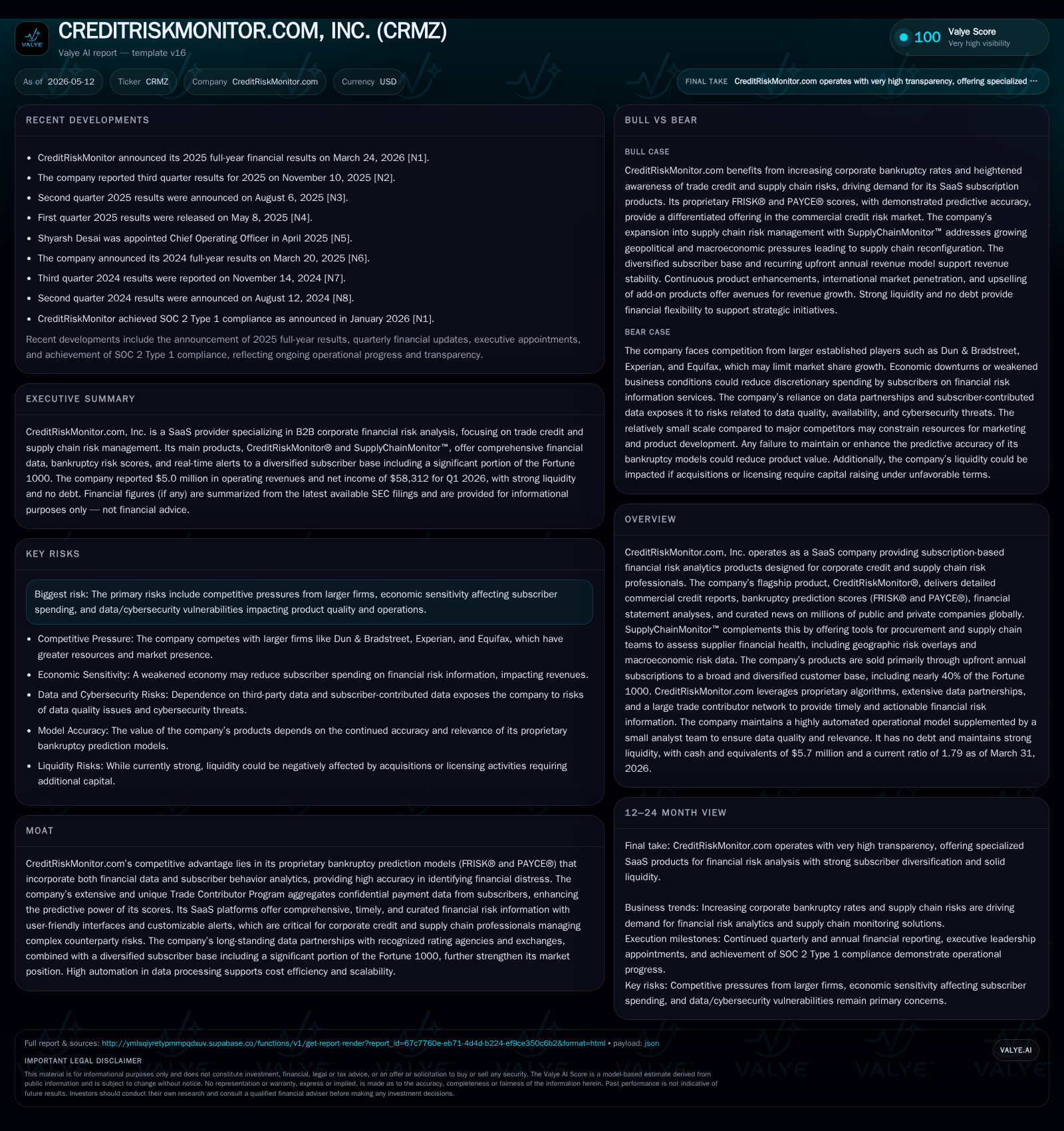
CreditRiskMonitor.com reported a modest 2% increase in operating revenues for Q1 2026 driven by increased subscription sales to new and existing customers along with strategic price hikes. Despite a 10% rise in data and product costs due to technology investments and infrastructure changes, the company maintains strong operational resilience through its proprietary bankruptcy risk models and diversified enterprise customer base. The SaaS model anchored by CreditRiskMonitor® and SupplyChainMonitor™ serves credit and supply chain risk professionals with unique predictive analytics, fostering high customer retention and potential growth via cross-selling. Liquidity remains strong with $5.7 million in cash and no debt, supporting ongoing investments amid competitive industry dynamics.
Latest Quarterly Operating Update Reflects Strategic Revenue Expansion
CreditRiskMonitor.com reported operating revenues of approximately $5.1 million for Q1 fiscal 2026, marking a 2% increase over the year-ago quarter. This topline growth stemmed primarily from higher SaaS subscription product revenue driven by increased sales to both new and existing subscribers alongside targeted subscription price increases [S2]. The company's approach to price optimization indicates some ability to enhance average revenue per user (ARPU) amid competitive pressures.
However, this revenue expansion came alongside a noticeable increase in data and product costs, which grew roughly 10% to just over $2 million compared to Q1 2025. The cost uptick was attributed to hiring senior technology leadership talent, realigning reporting structures for better department accountability, and increased hosted facility expenses linked partly to the expiration of leased office premises at the end of July 2025 [S2]. These rising fixed costs highlight the challenges in scaling while investing in infrastructure and capability enhancements.
Selling, general and administrative expenses edged up only marginally by about 1%, attributable mainly to temporary rises in professional fees [S2]. Other income saw a mild decline tied to reduced short-term interest rates on institutional money market funds versus the prior year.
Overall, these results point toward managed top-line growth powered by subscription sales volume increases and pricing maneuvers balanced against an inflating cost base primarily on the data/product side reflecting ongoing investment in product quality.
Business Model: SaaS Subscription Platform for Credit and Supply Chain Risk Management
CreditRiskMonitor.com operates a web-based Software-as-a-Service (SaaS) business targeting corporate credit managers, procurement officers, and supply chain risk professionals worldwide through annual subscriptions [S1]. Its flagship platforms are CreditRiskMonitor®—offering deep commercial credit reports enhanced by proprietary bankruptcy prediction scores FRISK® and PAYCE®—and SupplyChainMonitor™, geared toward supplier financial health monitoring including geographic risk overlays.
Revenue is derived predominantly from upfront annual subscription fees paid by a broad set of customers that include nearly 40% of the Fortune 1000. The subscription model fosters predictable recurring revenues with unexpired subscription liabilities around $10.8 million as of March 31, 2026 that represent renewal opportunities rather than cash outflows [S2]. These customers rely on CreditRiskMonitor.com's timely alerts, in-depth financial analyses, curated news feeds, and trade payment information aggregated via its Trade Contributor Program—a distinctive network where subscriber payment behaviors enrich algorithmic risk forecasts.
High switching costs arise as clients integrate these proprietary predictive models into their risk workflows making churn rates relatively low and renewals strategically significant given their lower associated sales expense compared to new customer acquisition [S1]. Upsell potential exists through additional seat licenses or cross-selling complementary services such as SupplyChainMonitor™ targeting different organizational units at higher price points.
Competitive Dynamics and Industry Positioning in Financial Risk Analytics
The commercial credit risk analytics space is dominated by larger firms such as Dun & Bradstreet (D&B), Experian plc, and Equifax Inc., who offer overlapping financial intelligence products across various verticals including finance/risk management [S21]. Dun & Bradstreet's Finance & Risk segment alone generated over $1.3 billion in revenue in North America during 2024 placing it far ahead of CreditRiskMonitor.com's modest scale representing just over 1% of the estimated Total Addressable Market (TAM) [S21].
CreditRiskMonitor.com's moat is built on its nuanced bankruptcy prediction algorithms combining traditional financial metrics with unique subscriber-derived payment data. The FRISK® score back-tested with stable high accuracy on U.S.-based companies offers advanced warning capabilities extending at least three months before bankruptcies occur—a critical advantage for decision makers aiming to mitigate counterparty risks proactively.
Its niche focus simultaneously covering public companies with FDA ratings, private firms with curated news feeds, plus supplier relationship analytics distinguishes it from broad credit report aggregators favoring either purely public or consumer-focused data sets. Industry consolidation trends put continual pressure on smaller players but also emphasize the value of specialized platforms addressing both credit extension underwriting and supply chain continuity challenges.
Growth Drivers: Subscriber Growth, Data Enrichment, Price Optimization
Growth momentum hinges on increasing subscriber counts across corporate credit analysts while deepening product adoption within existing accounts via add-ons like SupplyChainMonitor™ offering more comprehensive supplier risk visibility at premium pricing tiers [S2,S1]. Incremental pricing actions have proven viable as evidenced by Q1 revenue lift aligning with volume gains providing positive ARPU trajectory despite inflationary headwinds on content acquisition costs.
Continued investment in data breadth—both public financial disclosures as well as confidential trade payments sourced from subscribers—supports ongoing accuracy improvements in distress scoring models directly impacting client decision confidence (and therefore stickiness) over alternate providers lacking this integrative dataset dimension. Moreover, proactive email alerts tailored around these proprietary metrics encourage active usage fostering renewal retention.
The company enjoys operational leverage characteristic of SaaS businesses whereby scalable automated delivery keeps incremental production costs relatively stable despite ongoing platform enhancements necessitating heightened tech staffing levels recently observed as Q1 incurred higher salary-driven expenses concentrated under data/product categories [S2].
Key Risks and Constraints: Competitive Pressure, Cost Inflation, Cybersecurity
Key risks include intensifying competition from well-capitalized incumbents like D&B expanding digital offerings potentially encroaching on CreditRiskMonitor.com's target segments especially enterprise clients evaluating multi-vendor solutions that bundle broader analytics capabilities beyond credit alone. Economic downturns could depress discretionary spending budgets among corporate subscribers possibly reducing contract sizes or slowing renewals given workforce reductions or tighter procurement controls.
Rising costs related to premium third-party data licenses plus enhanced cybersecurity safeguards inflate fixed operating expense bases complicating margin expansion ambitions particularly if pricing escalations trigger pushback or delayed contract renewals. Given the sensitive nature of the underlying datasets—including confidential subscriber payment comportment—cybersecurity vulnerabilities represent material threats that could undermine product reliability or client trust if breached.
Investor Watchpoints: Upcoming Guidance, Product Innovation, Subscriber Metrics
Investors should monitor management’s upcoming guidance releases following Q1 disclosures for signals on how those price increases are being absorbed across different market conditions; whether subscriber additions continue apace; plus gross margin trajectory amidst rising cost pressures [S2,S1].
Further developments around platform innovation – encompassing AI-driven alert enhancements or expanded macroeconomic overlays intended for supply chain teams – will indicate strategic progress adapting to evolving risk landscapes where speed-to-insight remains paramount amidst increased business cycle complexity.
Subscriber retention rates alongside acquisition pipeline health will serve as leading KPIs reflecting both brand awareness gains and competitive win ratios within an oligopolistic but fragmented market stratum marked by numerous smaller vendors lacking comparable proprietary scoring capabilities.
Current Financial Profile and Liquidity Overview
Latest financial snapshot
| Metric | Value | Period |
|---|---|---|
| Cash & equivalents | $5.7 million | |
| 2026-03-31 | ||
| Held-to-Maturity Assets | $12.7 million | |
| 2026-03-31 | ||
| Current assets | $21.7 million | |
| 2026-03-31 | ||
| Current liabilities | $12.1 million | |
| 2026-03-31 | ||
| Current ratio | 1.79 | |
| 2026-03-31 |
Source: SEC companyfacts cache [F1], latest 10-Q filing [S2].
As of quarter-end March 31, 2026, CreditRiskMonitor.com had approximately $5.7 million in cash and cash equivalents alongside $12.7 million invested in held-to-maturity U.S. Treasury securities—marking slight shifts versus December 31, 2025 balances.
Unexpired subscription revenue liabilities approximated $10.8 million representing deferred income yet equating effectively to upfront recurring revenues providing forward visibility into near-term cash flows after nominal report delivery costs are deducted given efficient automated production processes inherent in the SaaS model [S2].
The views presented here aim solely at evaluating underlying business fundamentals without forming investment recommendations or specific forward-looking profit forecasts.
Disclaimer: This is research-only, informational analysis and not investment advice. It may include AI-generated interpretation and general industry context. Always verify important details using primary sources.

Comments