
Aclarion Advances Non-Invasive Spine Diagnostics Amid Slow Commercial Scale
Aclarion’s proprietary MR Spectroscopy technology shows promise for improved chronic back pain diagnosis but faces early commercialization challenges.
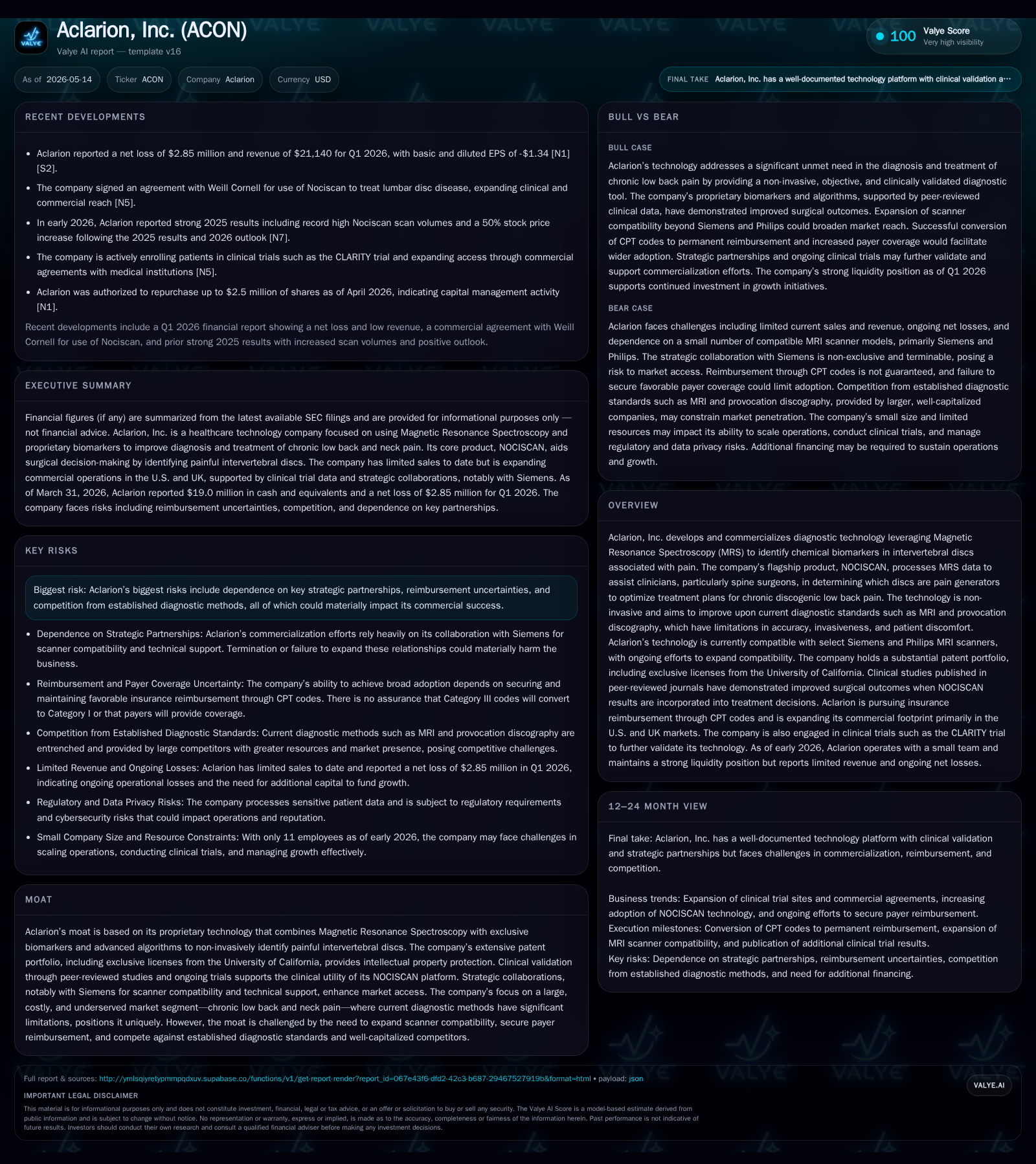
In its latest quarterly update, Aclarion reported ongoing operating losses with modest revenue growth as commercialization of its NOCISCAN diagnostic platform continues at a measured pace. The company’s business model leverages exclusive biomarker patents combined with spectroscopic data analysis to non-invasively identify painful spinal discs, aiming to improve surgical decision-making in chronic discogenic pain. Strategic collaborations and efforts to broaden MRI scanner compatibility and payer reimbursement codes underpin the growth strategy, although adoption remains limited by entrenched diagnostic incumbents and reimbursement uncertainty. Aclarion’s healthy cash position provides a runway to fund these initiatives, but realizing scalable commercial success will depend on overcoming reimbursement, scanner dependency, and market penetration hurdles.
Latest Quarterly Operating Update: Commercial Activity and Capital Moves
Aclarion’s 2026 first-quarter 10-Q filing reveals the company remains in investment mode with limited revenue generation. Reported top-line revenue was approximately $75,730 for the year ended December 31, 2025 [F1], reflecting early-stage commercial traction. Operating losses persisted at around $7 million underscoring the heavy investment in commercialization activities and R&D [F1]. Despite this modest revenue scale, the company’s board authorized a share repurchase program of up to $2.5 million in April 2026 — a move that reflects board confidence while signaling cautious capital allocation during slow commercial scale [S3]. The share buyback flexibility allows management to opportunistically deploy capital while the core business ramps. This latest financial snapshot situates Aclarion in a classic venture innovation phase: proven technology yet nascent commercialization.
Innovative Technology and Product Overview: The NOCISCAN Platform
Aclarion’s core business revolves around its proprietary diagnostic platform called NOCISCAN that utilizes Magnetic Resonance Spectroscopy (MRS) to analyze intervertebral discs chemically rather than anatomically alone. Unlike standard MRI imaging which provides anatomical images, MRS yields spectral waveforms indicating chemical composition — crucially identifying biomarkers like proteoglycan depletion and lactic acid elevation associated with painful degeneration [S1]. This approach aims to non-invasively pinpoint painful discs in patients suffering chronic discogenic low back pain.
The company’s offering caters predominantly to spine surgeons who face diagnostic challenges determining which specific discs are pain generators prior to invasive interventions. Current invasive standards like provocation discography carry risks and patient discomfort whereas Aclarion’s MRS-based solution is radiation-free and requires only an incremental additional scan time during standard MRI procedures (~3-5 minutes per disc) [S1].
Aclarion has secured an exclusive license from the Regents of University of California covering key patents encompassing both biomarkers and MRS methods; this forms a cornerstone of its intellectual property moat alongside AI-driven post-processing algorithms that flag poor-quality spectroscopy data aiding consistent results [S1]. Leveraging AI also underscores future strategic expansion into machine learning-enabled correlations between spectral data and clinical outcomes across various treatment modalities.
Competitive Environment and Industry Dynamics in Spine Diagnostics
In the broader spine diagnostics arena addressing chronic low back pain — a healthcare market exceeding $130 billion annually in the U.S. alone [S1] — Aclarion operates in a niche dominated by traditional anatomical MRI and invasive provocative discography. The entrenched incumbent modalities benefit from widespread clinical familiarity even though they lack specificity or comfort.
Aclarion’s technological differentiation lies in combining proprietary chemical biomarkers with advanced spectroscopy data analysis creating a unique diagnostic proposition. However, geographic rollout is constrained by reliance on compatible Siemens and Philips MRI scanners limiting addressable installed bases given these manufacturers’ market shares among MR device providers [S1][S4]. This dependency could slow widespread adoption until multi-vendor compatibility is achieved.
Regulatory context impacts commercial viability notably through CMS reimbursement policies where obtaining permanent Category I CPT codes remains critical to supporting usage economics for clinicians compared to temporary Category III codes currently held [S1]. Insufficient or delayed reimbursement further raises hurdles against displacing established protocols given clinician cost sensitivity.
Growth Drivers: Expanding Scanner Compatibility, Payer Coverage, and Clinical Adoption
Key vectors for Aclarion’s growth center on broadening technical integration across wider MR scanner platforms beyond Siemens/Philips — an ongoing development priority aimed at opening up new regional markets faced with heterogenous installed scanners [S1]. Successful execution here directly expands patient population reach.
Parallel progress with payer negotiations is visible leveraging relationships through imaging network RadNet (operating over 400 outpatient centers) facilitating early regional rollouts supported by commercial payers' introductions aimed at converting temporary CPT reimbursement codes into standardized permanent categories with sustainable rates [S1][S3]. This step is pivotal since durable payer support drives volume increases via physician referrals.
Clinical partnerships further buttress adoption as illustrated by recent agreements such as Weill Cornell for application of NOCISCAN in lumbar disc disease treatment protocols [N6]. Such partnerships lend clinical validation and generate utilization case studies important for wider market penetration.
Innovation ambitions involve extending applications beyond lumbar discs towards cervical spine diagnostics targeting neck pain populations—a segment presenting additional technical challenges due to smaller cervical discs requiring higher-resolution spectroscopy capabilities and new biomarker validations [S1]. These R&D initiatives involving AI-assisted quality control aim at evolving product relevance through expanded indications over time.
Risks and Challenges: Reimbursement Uncertainties and Market Penetration Hurdles
Despite technological advantages, Aclarion faces structural risks characteristic of early-stage medtech commercialization. Chief among these are uncertainties regarding favorable payer reimbursement outcomes—where failure to obtain or convert Category III CPT codes into permanent categories at adequate rates could severely constrain procedure economics restraining clinician uptake [S4][S11].
Dependency on a narrow set of MRI device manufacturers restricts addressable scanning capacity constraining volume growth until multi-device compatibility is realized. Physician conservatism towards adopting new diagnostics—especially those diverging from long-established anatomical imaging paradigms—poses behavioral hurdles frequently observed in spine diagnostics innovation cycles.
Management continuity risk exists given the lean team structure directing complex development/commercial functions; attracting requisite talent amidst competitive healthcare innovation environment remains essential for scaling operations effectively [S1].
Regulatory compliance complexities related to medical device software status require vigilant quality management systems; lapses could precipitate enforcement actions impacting market access or brand reputation as outlined among FDA-related risk disclosures [S12][S26].
Key Milestones and What to Watch for Next
Short- to medium-term value inflections will come from announcements regarding expansion of ITS scan compatibility across additional MRI platforms impacting available addressable patient volumes. Progress on Medicare/Medicaid CPT code status updates — especially conversion from temporary Category III provisional codes to permanent Category I classification — will be vital indicators of reimbursement stability influencing adoption rates.
Continued clinical evidence generation through partner sites like Weill Cornell may boost physician trust and broaden referral networks; monitoring usage trends within RadNet outpatient centers will offer tangible KPIs for commercialization momentum.
Further steps towards geographical expansion beyond initial US focus areas depend on successful regulatory clearances aligned with CE Mark compliance under new European Medical Device Regulations transitioning imminently affecting product registrations internationally [S28].
Financial Snapshot: Liquidity, Capital Structure, and Funding
Latest financial snapshot
| Metric | Value | Period |
|---|---|---|
| Cash & equivalents | $19mm | |
| 2026-03-31 | ||
| Current assets | $19mm | |
| 2026-03-31 | ||
| Current liabilities | $986208 | |
| 2026-03-31 | ||
| Current ratio | 19.65x | |
| 2026-03-31 |
Source: SEC companyfacts cache [F1].
As of March 31, 2026, Aclarion reported cash and equivalents totaling approximately $19 million alongside negligible debt levels—total debt remained at zero per latest available disclosures—yielding a robust current ratio near 19.65x that reflects strong liquidity positioning relative to current liabilities around $0.99 million [F1][S2].
| Metric | Value | Period Ending |
|---|---|---|
| Cash & Equivalents | $19.0 million | |
| 2026-03-31 | ||
| Current Ratio | 19.65 | |
| 2026-03-31 | ||
| Total Debt | $0 | Latest reported |
| Revenue | $75,730 | |
| 2025-12-31 |
Disclaimer: This analysis is based solely on publicly available SEC filings dated through May 2026 and supplemental news reports without forward-looking statements or investment recommendations.
Disclaimer: This is research-only, informational analysis and not investment advice. It may include AI-generated interpretation and general industry context. Always verify important details using primary sources.

Comments