
NIKA Pharmaceuticals Advances Exclusive Drug and Supplement Rights but Faces Capital and Execution Hurdles
Recent quarter highlights steady operational progress in proprietary drug licensing amid ongoing financial constraints.
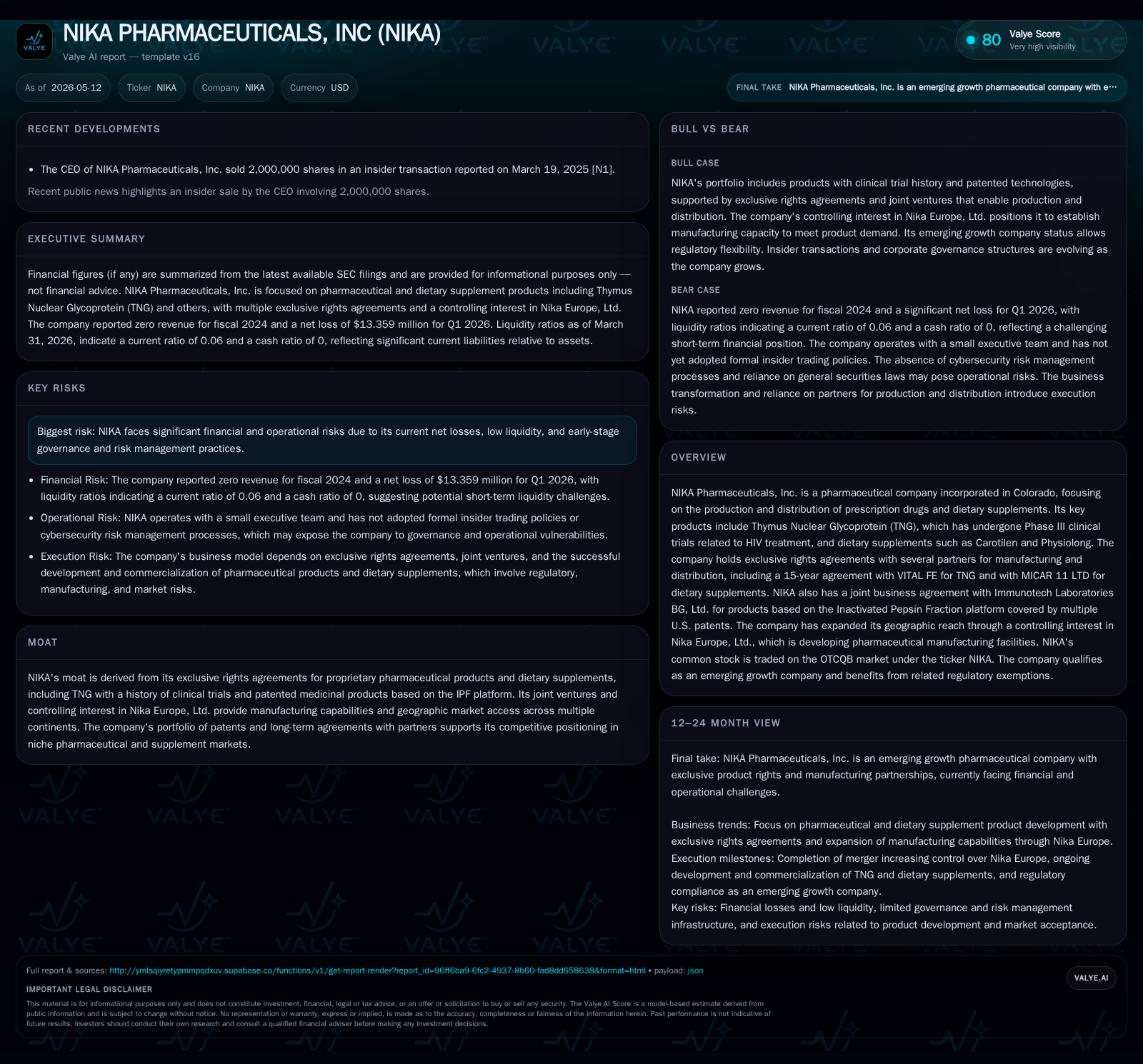
NIKA Pharmaceuticals, Inc. reported no revenue and continued net losses in its latest quarterly filing, reflecting its early-stage development status and heavy investment in proprietary pharmaceutical rights. The company’s business model pivots on exclusive manufacturing and distribution agreements for patented drugs like Thymus Nuclear Glycoprotein (TNG) and dietary supplements such as Carotilen and Physiolong. Strategic moves include expanding geographic reach via controlling stakes in European manufacturing facilities and joint ventures developing patented medicinal products. However, significant risks persist from low liquidity, lack of formal governance policies, and the absence of current revenue streams, constraining growth trajectories despite the structural moat from exclusive product IP and long-term partner contracts.
Recent Operating Update
NIKA Pharmaceuticals' latest quarterly disclosure filed May 12, 2026 ([S2]) reaffirmed that the company remains in an early operational phase without recognized revenue. Despite extensive proprietary rights acquisitions completed between 2022-2024—including pivotal exclusive agreements for Thymus Nuclear Glycoprotein (TNG) production with VITAL FE, plus key supplements Carotilen and Physiolong through MICAR 11 Ltd.—commercial sales have yet to materialize. The company continues operating as a smaller reporting entity under SEC guidelines, exempt from certain detailed risk factor disclosures ([S2], [S11]).
No new material updates regarding regulatory approvals or commercialization were highlighted, underscoring that NIKA is focused primarily on preparing for scale rather than generating sales in the immediate term.
Business Model
NIKA Pharmaceuticals' business model revolves around securing exclusive long-term licensing rights for proprietary pharmaceutical compounds and dietary supplements developed elsewhere but requiring capital injection for manufacturing scale-up, regulatory approval processes, marketing, and distribution. The company does not currently own primary drug discovery platforms but controls critical intellectual property through exclusive agreements:
- A 15-year Exclusive Rights Agreement signed April 7, 2022 with VITAL FE covers manufacturing and distribution of TNG—an immunomodulatory glycoprotein backed by a Phase III clinical trial completed in the late 1990s targeting advanced-stage AIDS patients ([S1], [S7]).
- A similar-length contract with MICAR 11 Ltd grants rights for dietary supplements Carotilen—which modulates epithelial metabolism and supports immune function—and Physiolong—a stimulant for recovery post physical/mental strain ([S1], [S7]).
- The joint business agreement with Immunotech Laboratories BG focuses on developing medicinal products around the patented Inactivated Pepsin Fraction platform covered by multiple U.S. patents ([S7]).
The company finances production jointly with partners under arrangements where costs are split evenly, as is the net profit after expenses ([S7]). This shared-risk structure limits upfront capital outlays but necessitates tight coordination.
Growth levers depend on successful product registrations beyond initial clinical validation phases into commercial markets—supported by NIKA’s expanded geographic footprint via an increased controlling stake (80%) in Nika Europe Ltd., which is constructing multinational pharmaceutical manufacturing facilities ([S5], [S6]). This positions NIKA well to serve diverse regional markets including Europe, Asia, Africa, South America, North America, and Australia.
Industry Structure & Competitive Position
Within the small molecule and biologics pharmaceutical industry focusing on niche immunomodulatory agents and nutritional supplements, exclusivity translates into meaningful competitive advantage given patent protection and regulatory barriers to entry. NIKA’s moat derives principally from these multi-year exclusive contracts combined with patents protecting IPF-based products.
However, competition remains intense globally from larger pharma firms with broader pipelines investing heavily in HIV therapeutics innovation. Dietary supplement markets feature both branded differentiated offerings like NIKA’s Carotilen/Physiolong and commoditized players competing primarily on price.
NIKA’s controlling interest in manufacturing capability via Nika Europe enhances operational independence compared to pure licensing models that rely solely on third-party contract manufacturers. This vertical integration potential can help manage quality control risks inherent to pharmaceuticals produced internationally.
Growth Drivers
Key growth initiatives reside in:
- Commercialization of TNG: Leveraging Phase III trial data validating TNG’s efficacy against HIV-related immunodeficiency could unlock sizable market demand contingent on regulatory approvals outside Bulgaria.
- Expansion of Dietary Supplement Lines: Broadening sales territories under MICAR agreement plus recently acquired rights for additional supplements across global continents enhances total addressable market.
- Scaling Production Capacity: Completion of manufacturing facilities by Nika Europe Ltd. promises internal production agility essential to meet anticipated orders once regulatory hurdles clear.
- IPF Platform Development: Joint efforts with Immunotech Laboratories BG extend potential product pipeline breadth into patented medicinal drugs beyond core franchise, diversifying revenue capabilities over time.
- Geographic Market Penetration: Active targeting of emerging markets via distributor partnerships and proprietary supply chains aligned with international health authorities’ guidelines.
Risks / Watchpoints / Growth Constraints
Despite promising product-level IP assets and strategic partnerships, several substantive risks temper outlook:
- Capital Constraints: With cash reserves at $1.9K against short-term liabilities of $318K at fiscal end 2025 ([F1]), runway appears severely limited without near-term fundraising or operational revenue generation.
- Revenue Absence: Zero reported revenue signals ongoing development-stage status where commercial success remains unproven financially ([F1]).
- Governance Gaps: Lack of formal insider trading policies or cybersecurity risk management frameworks illustrates nascent corporate structure potentially exposing investors to elevated governance risks ([S9], [S3]).
- Regulatory Uncertainties: International drug approvals require sustained expenditures; timelines remain uncertain especially outside established jurisdictions where TNG had clinical data.
- Market Competition: Larger established pharma entrants could introduce alternative therapies undermining TNG’s competitive positioning or eroding dietary supplement market share.
- Execution Complexity: Coordinating multinational joint ventures spanning production financing, IP management, registration processes imposes operational burdens inconsistent with current small executive team size ([S9]).
What To Watch Next
Investors should monitor a blend of strategic milestones including:
- Announcements regarding regulatory filings or approvals for TNG in key markets.
- Progress updates from Nika Europe Ltd.’s pharmaceutical factory construction completion and ramp-up timeline.
- Commercial launch activities or binding distribution agreements advancing Carotilen/Physiolong penetration beyond initial territories.
- Capital raising initiatives intended to extend liquidity runway beyond current burdensome working capital deficits.
- Any expansions or renewals related to IPF platform medicines joint ventures establishing novel product candidates.
- Governance enhancements such as adoption of insider trading policies or cybersecurity protocols signaling maturation toward public company best practices.
Financial Profile (Latest Period Context)
Latest financial snapshot
| Metric | Value | Period |
|---|---|---|
| Cash & equivalents | $1889 | |
| 2025-12-31 | ||
| Total debt | $318624 | |
| 2025-12-31 | ||
| Net debt | $316735 | |
| 2025-12-31 | ||
| Current assets | $20996 | |
| 2025-12-31 | ||
| Current liabilities | $318624 | |
| 2025-12-31 | ||
| Current ratio | 0.07x | |
| 2025-12-31 |
Source: SEC companyfacts cache [F1].
Reflective of its developmental stage, the company's financial snapshot at December 31, 2025 shows a net loss of $76,398 with no reported revenue ([F1]). Cash stands precariously low at $1,889 versus total debt approximating $318K leading to a current ratio near 0.07 that underscores pressing liquidity challenges ([F1]). This leverage position suggests funding reliance external to operations unless meaningful sales materialize swiftly.
The lack of revenue coupled with operating losses highlights dependence on external financing or partner contributions under joint venture agreements covering production/distribution costs equally ([S7]). Capital structure improvements alongside scaling commercial activities remain prerequisites before positive earnings trajectories could emerge.
This analysis reflects available disclosures up to May 12, 2026 including quarterly filings [S2] and annual reports [S1]. The data underscores NIKA Pharmaceuticals’ strategy focused on leveraging proprietary pharmaceutical IP through licensing deals augmented by regional manufacturing capabilities but tempered by significant financial risks characteristic of emerging biotech ventures at early phases prior to sustained commercialization.
Readers should consider this review informational only; it does not constitute investment advice or recommendations.
Disclaimer: This is research-only, informational analysis and not investment advice. It may include AI-generated interpretation and general industry context. Always verify important details using primary sources.

Comments