
CoinShares Bitcoin ETF Updates Asset Exposure Amid Bitcoin Network Challenges
The latest quarterly filing reveals operational risks from Bitcoin protocol development uncertainties and evolving regulatory factors impacting the trust's valuation.
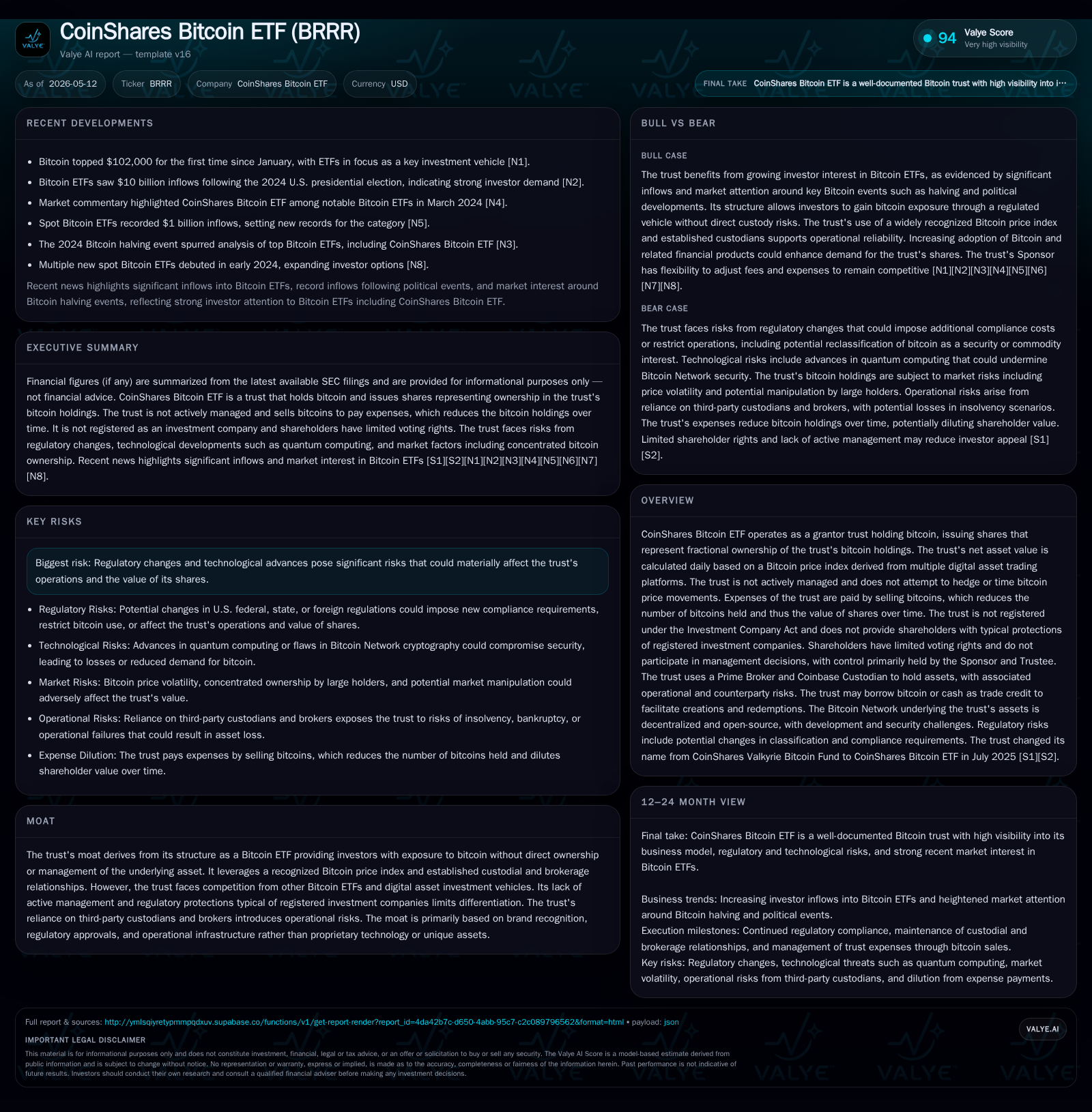
CoinShares Bitcoin ETF (BRRR) reported in its Q1 2026 10-Q increased disclosures on risks tied to the decentralized, open-source Bitcoin Network, highlighting challenges in network upgrades and developer incentives. The trust remains a passive grantor trust offering fractional bitcoin ownership without active management, relying on custodial infrastructure and an aggregate price index. While positioned amid growing spot bitcoin ETF adoption, it faces persistent regulatory uncertainty and operating expense dynamics that dilute net asset value through periodic bitcoin sales. Investor protections are limited versus registered funds due to its unregistered status, with control centralized at the sponsor level. Future growth hinges on continued institutional demand for direct bitcoin exposure products alongside favorable regulatory developments and technological scalability progress.
Latest Quarterly Operating Update: Development and Regulatory Dynamics
In its May 12, 2026 Form 10-Q filing [S2], CoinShares Bitcoin ETF updated shareholders on heightened operational risks stemming from the open-source, decentralized nature of Bitcoin Network development. The filing details concerns around the lack of direct financial incentives for core developers, whose voluntary contributions drive protocol upgrades hosted primarily via Github repositories. This dynamic creates uncertainties about the pace and success of beneficial software improvements critical for scaling and security.
Moreover, the trust underscores unresolved community consensus failures on network scaling that have previously resulted in contentious hard forks (e.g., in 2017), which could lead to confusion or fragmented market responses potentially impairing the bitcoin price underpinning the trust’s NAV. Code vulnerabilities also pose ongoing risks given prior incidents where flaws were exploited or led to diminished functionality.
While these technical risks have been acknowledged before [S1], the quarterly filing emphasizes they remain significant near-term headwinds. Additionally, disclosures reiterate sustained regulatory scrutiny across U.S. federal agencies (SEC, CFTC, FinCEN) and foreign regulators introducing evolving legal ambiguities and compliance costs that could materially affect operations or precipitate premature termination events.
These updates matter now as they contextualize why passive exposure trusts like BRRR must continually manage exposure to Bitcoin’s underlying network risks without actively hedging or mitigating price volatility [S2].
Business Model & Product Structure: Passive Bitcoin Exposure via Grantor Trust
CoinShares Bitcoin ETF operates as an unregistered grantor trust that holds bitcoins directly on behalf of investors who gain exposure by purchasing shares [S1]. Each share corresponds to a fractional interest in the trust’s underlying bitcoin holdings, which are valued daily using a composite Bitcoin Price Index drawn from multiple digital asset trading platforms—platforms that lack formal SEC/CFTC exchange registrations [S1].
No active portfolio management occurs; the trust does not engage in derivative strategies nor attempt timing or hedging to offset bitcoin price movements. Instead, all expenses are covered by selling portions of the held bitcoins, inevitably reducing total bitcoins under custody and diluting per-share value over time. The sponsor manages operations alongside trustee responsibilities but shareholders hold limited voting rights and cannot influence day-to-day management decisions [S12].
Custody is provided by Coinbase Custodian with prime brokerage services arranged through a separate prime broker relationship. This custodial infrastructure aligns with market practice yet exposes operational risk because control depends on third-party providers.
This straightforward model offers investors pure-play passive exposure to BTC price fluctuations without needing technical wallet custody or self-management risk but imposes tradeoffs regarding shareholder protections—namely lack of Investment Company Act registration leaves investors without typical governance safeguards [S9].
Competitive Positioning and Industry Structure: Custodial Infrastructure and ETF Landscape
Within the growing spectrum of digital asset investment vehicles, CoinShares Bitcoin ETF’s moat arises largely from its sanctioned structural form as one of the few spot bitcoin ETFs with recognized regulatory approvals. Its reliance on established custodians like Coinbase provides confidence despite ongoing crypto industry volatility.
Competition comes from other spot bitcoin ETFs—many offered by large asset managers—as well as futures-based ETFs which enjoy greater regulatory clarity but indirect bitcoin price exposure. The relatively narrow universe of liquid cryptocurrency exchanges feeding into price index calculations also contributes complexity; absence of broad exchange regulation or liquidity raises potential market manipulation or valuation skew risks [S1].
Importantly, its lack of active management restricts pricing power. Fees cover administrative costs but are insufficient to build differentiated product features beyond secure custody and simple access to bitcoin price exposure. The trust’s brand recognition within institutional investor communities partially reinforces competitive positioning.
Operationally, dependence on third-party custodians injects counterparty risk absent in fully diversified crypto fund structures; however, specialization focused strictly on bitcoin custody simplifies oversight parameters.
Growth Drivers: Demand Patterns and Market Adoption Factors
Structural growth catalysts for BRRR derive primarily from increasing institutional appetite for regulated spot bitcoin ETFs providing direct exposure without custody complexity. As skeptical institutional investors seek transparent products aligning with fiduciary standards amid evolving crypto acceptance frameworks, such trusts benefit disproportionately compared to less regulated vehicles [S1],.
Additionally, recent shifts toward more constructive federal agency stances (e.g., SEC FAQ guidance allowing some broker-dealer activities related to crypto assets) may smooth pathways for authorized participants facilitating share creation/redemption mechanisms essential for liquidity [S5].
Potential technological improvements in Bitcoin Network scaling – if community consensus is reached – could enhance transaction throughput and lower costs inherent in Bitcoin use cases supporting price stability and broader ecosystem maturation; this would indirectly support demand for passive BTC products holding physical bitcoins [S2].
Finally, growing macroeconomic volatility paired with digital assets gaining footing as alternative portfolio diversifiers supports sustained inflows into marquee spot ETF offerings.
Risks & Constraints: Network Development, Regulatory Uncertainty, and Expense Trajectory
Key limiting factors plague BRRR fundamentally because it tracks an inherently volatile digital asset underpinned by technology still experiencing developmental growing pains. Open-source governance leads to unpredictable upgrade cycles susceptible to internal disagreements resulting in forks or contentious protocol changes affecting market confidence [S2].
Legal ambiguity continues around how US regulators may classify bitcoins — either as securities under SEC purview or commodity interests subject to CFTC oversight — triggering complex compliance regimes potentially forcing costly registrations or trust liquidations [S4], [S6]. Such outcomes would be detrimental both operationally and financially.
Moreover, because expenses including indemnifications arise predominantly via mandatory sales of held bitcoins rather than cash reserves (no cash reported as of end-2023) [F1], cumulative NAV dilution represents a steady drag offsetting capital appreciation potential absent extraordinary performance.
Limited shareholder voting rights create governance concentration risk where sponsor decisions might diverge from holders’ interests without effective recourse [S12]. Lastly geopolitical cyber threats combined with privacy-layer enhancements complicate enforcement visibility adding operational unpredictability [S6].
Key Metrics & Financial Snapshot: Contextualizing Operating Efficiency
Latest financial snapshots reveal operating losses continuing through year-end 2025 at approximately -$1.62 million alongside a significant net loss approaching -$49.7 million reflecting likely impairments or valuation adjustments consistent with prolonged BTC volatility dynamics [F1]. Cash reserves stood absent at zero by 2023-end highlighting full reliance on bitcoin liquidation for expense servicing.
This funding model affirms quantitative cost pressures intrinsic to passive grantor trusts in volatile digital commodity contexts where expense ratios translate directly into ongoing share dilution rather than conventional expense cash outlays analogized in mutual funds.
Understanding these figures is essential to approximate total ownership cost especially given BRRR’s non-managed structure where no active rebalancing exists to mitigate operating drags.
What To Watch Next: Regulatory Milestones and Operating Metrics
Market participants should focus keenly on any forthcoming SEC or CFTC announcements clarifying digital asset classifications which could mandate substantial procedural shifts for BRRR sponsors or trigger forced liquidations if compliance proves untenable [S6], [S8].
Additionally monitoring developer activity reports or GitHub proposals signaling progress toward resolving scalability challenges will provide early indicators about underlying blockchain performance that supports stable ETF operation.
Quarterly filings should continue reporting share registry size fluctuations indicative of investor sentiment while commentary from sponsors regarding continuation intentions will flag material shifts in strategic posture especially if emergent legal obstacles surface.
Index methodology changes affecting constituent platform composition warrant scrutiny given their direct impact on BTC valuation used for NAV calculations.
This analysis synthesizes publicly available disclosures as of the most recent quarter without providing investment recommendations. Investors should consider emerging information dynamically within their comprehensive due diligence framework.
Disclaimer: This is research-only, informational analysis and not investment advice. It may include AI-generated interpretation and general industry context. Always verify important details using primary sources.

Comments