
Humacyte Restructures to Extend Runway as Symvess Rights Realign
Humacyte undertakes significant workforce reductions and regains global commercialization rights for its lead vascular therapy product amid Nasdaq compliance challenges.
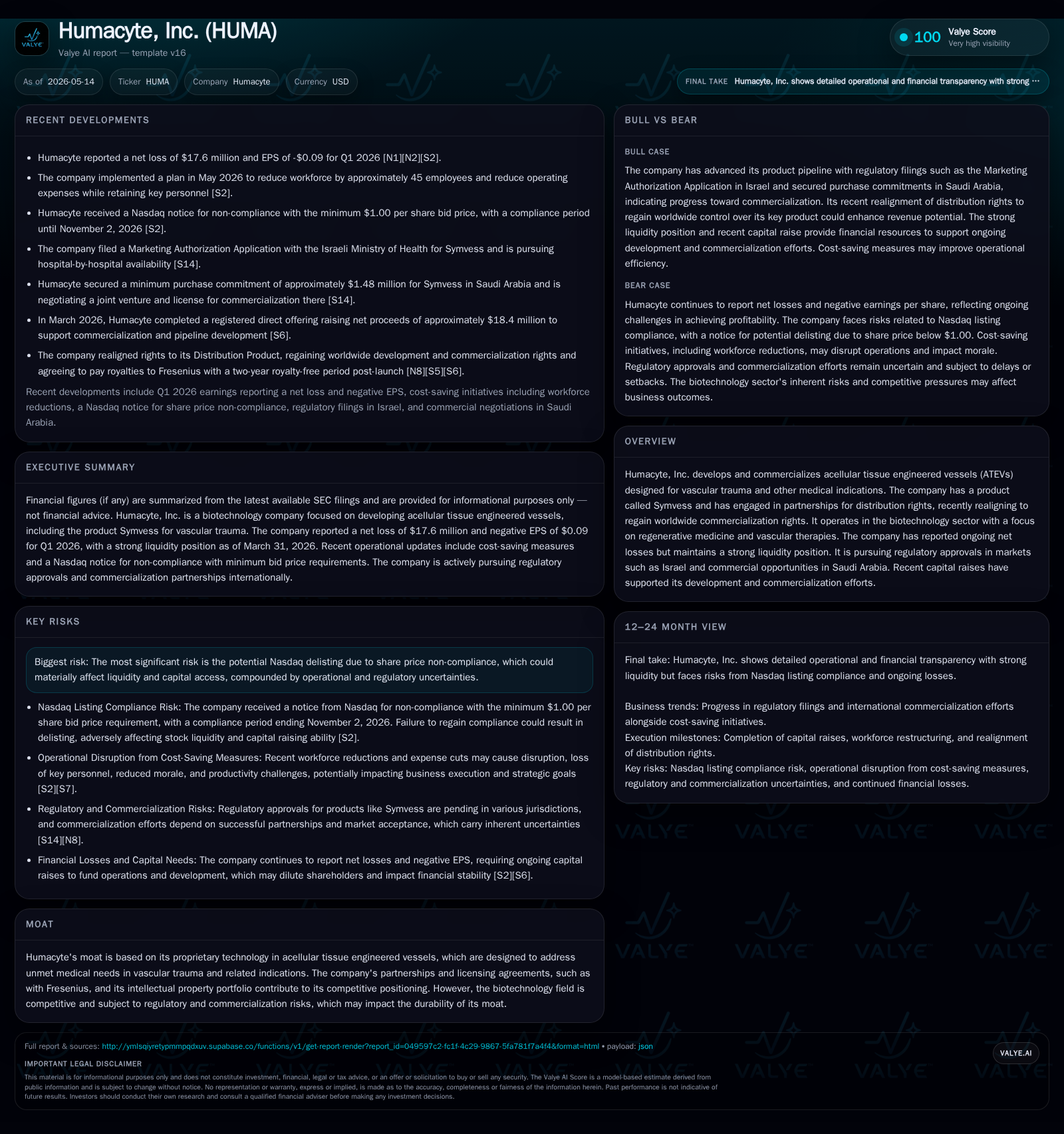
In its May 2026 quarterly filing, Humacyte implemented a workforce reduction of about 45 employees and deferred new hiring as part of cost-saving efforts to extend cash runway. The company also realigned distribution rights for its Symvess acellular tissue engineered vessels (ATEVs), reclaiming worldwide commercialization control while agreeing to low single-digit royalties to Fresenius outside the U.S. These moves come against a backdrop of continued net losses, liquidity management focus, and active regulatory pursuits in markets like Israel and Saudi Arabia. The company faces material risks including potential Nasdaq delisting due to share price non-compliance, posing challenges for capital access and operational execution.
Quarterly Operating Update Highlights
Humacyte's latest 10-Q filing dated May 13, 2026 [S2] reveals an aggressive cost-cutting initiative focused on reducing operating expenses amid ongoing financial strain. The company reduced its workforce by approximately 45 employees in May while deferring additional planned hires. These measures aim to preserve liquidity against a challenging operational backdrop but carry inherent risks such as potential disruption to business continuity, employee attrition beyond planned levels, and impacts on morale that could reduce productivity.
Concurrently, Humacyte disclosed it received a Nasdaq notice dated early May warning of non-compliance with the minimum bid price rule (below $1.00 per share) for at least 30 consecutive business days [S2],[S3]. This notification triggers a compliance period during which the company must regain or maintain the requisite share price or face potential delisting. While management intends to explore options to regain compliance, no assurance exists that Nasdaq requirements will be met timely or at all, placing capital market access at risk—an acute concern for a biotech still in early commercial stages.
These near-term liquidity management steps highlight how Humacyte is balancing its immediate survival against longer-term development and commercialization objectives.
Business Model and Proprietary Technology Overview
Humacyte operates in regenerative medicine by developing acellular tissue engineered vessels (ATEVs), primarily through its Symvess product designed to address vascular trauma—a segment with high unmet clinical need due to limitations of synthetic grafts or autologous vessels [S1],[N10]. The product leverages proprietary tissue engineering technology that creates off-the-shelf vascular conduits that integrate with patient tissue, aiming to improve outcomes over current standard care.
Revenue streams currently derive from Symvess product sales and licensing arrangements. Historically, distribution rights outside the U.S. were licensed to Fresenius Medical Care under an agreement granting them commercialization capabilities on non-U.S. territories [S1]. However, a significant strategic realignment occurred in April 2026 when Humacyte successfully reclaimed global development and commercialization rights for Symvess from Fresenius via a third amendment to their Distribution Agreement [S14]. Under this amendment, Humacyte will pay Fresenius low single-digit royalties on net sales outside the U.S., with a two-year royalty-free period post-launch in each country. In the U.S., royalty payments remain due at rates ranging from mid-single digits to low double digits.
The reclamation enhances Humacyte’s control over marketing strategies and revenue capture globally but also imposes royalty cost burdens partially offsetting incremental returns.
Competitive Position and Industry Structure
Within regenerative medicine’s vascular therapy niche, Humacyte’s acellular vessel technology distinguishes itself from traditional synthetic grafts by promising better biocompatibility and integration [S1]. Yet the space faces competition from various synthetic polymer graft innovations as well as emerging cellular therapies.
Market entry is heavily influenced by regulatory approvals, hospital adoption protocols, reimbursement coverage decisions, and surgeon education efforts—domains where incumbents with established vascular graft products hold entrenched positions.
Pricing power is somewhat constrained given the novelty of Symvess and uncertainties regarding reimbursement rates globally; however, fewer alternatives meeting the same clinical profile provide some pricing leverage if uptake proves clinical benefits [N10],[S1].
The biotech industry dynamics amplify challenges—high fixed costs for manufacturing scale-up combined with extensive regulatory pathways translate into elongated timelines before material break-even occurs.
Growth Catalysts and Commercial Expansion Strategies
Key near-term growth drivers include progress toward market authorizations in targeted geographies: Humacyte filed a Marketing Authorization Application in Israel March 2026 with plans underway for early hospital-by-hospital access pending formal approval [S13]. In parallel, a binding minimum purchase commitment approximating $1.48 million was secured from a Saudi Arabian partner in March 2026 to facilitate surgeon education and hospital evaluations ahead of possible joint venture formation for local Symvess commercialization [S13]. Negotiations are ongoing through July 2026 exclusive window.
Regaining full world-wide commercialization rights over Symvess post-April 2026 allows unified strategic marketing initiatives capable of synchronized global launches without fragmentation that previously accompanied regional licensing [S14]. These moves could accelerate revenue scaling once commercial uptake gains momentum.
Potential expansions into new clinical indications beyond vascular trauma also underpin growth aspirations but remain dependent on further clinical programs not yet fully disclosed.
Risks and Execution Challenges
Among primary risks is the Nasdaq delisting threat due to share price persistently below $1.00 [S2],[S3], which could severely impair investor liquidity and restrict future capital financing options crucial for sustained operations until meaningful commercial revenues accrue.
Workforce reductions implemented in May 2026 may negatively impact employee morale and operational momentum; such disruptions risk delaying critical milestones across manufacturing scale-up, regulatory filings, or commercial rollouts [S2].
Additionally, the biotechnology sector's inherent hurdles—stringent regulatory environments, uncertain reimbursement landscapes across regions, competitive product advances by rivals—pose continuous threats.
Operational delays or failure to achieve anticipated sales ramp could extend cash burn duration beyond existing reserves.
Upcoming Milestones and What Investors Should Monitor
Monitor developments on Saudi Arabia joint venture finalization status before mid-2026 exclusivity lapse [S13], alongside progress updates from Israeli regulatory review timelines post-MAA submission.
Early quarter sales volumes of Symvess as hospital evaluations unfold will serve as practical demand indicators [N10],[S13].
The outcome of Nasdaq compliance efforts—a definitive resolution either through stock price recovery or alternative exchanges—is another pivotal event impacting company narrative going forward [S2],[S3].
Financial Snapshot: Liquidity and Cost-Reduction Impact
Latest financial snapshot
| Metric | Value | Period |
|---|---|---|
| Cash & equivalents | $49mm | |
| 2026-03-31 | ||
| Current assets | $64mm | |
| 2026-03-31 | ||
| Current liabilities | $16mm | |
| 2026-03-31 | ||
| Current ratio | 3.93x | |
| 2026-03-31 |
Source: SEC companyfacts cache [F1].
Data as of March 31, 2026 indicate $48.5 million in cash and equivalents supporting operational activities alongside current assets totaling approximately $63.6 million versus current liabilities near $16.2 million—yielding a healthy current ratio around 3.93 [F1].
Despite robust short-term liquidity ratios reflective of prudent working capital management, annual figures reveal operating income losses over $108 million signaling ongoing high cash burn driven by research & development expenditures and early-stage commercialization costs [F1]. Net income registered negative $40.8 million for latest available year-end point emphasizing pre-revenue investment phase dynamics.
No major debt refinancing actions have been disclosed recently; reported long-term debt remains roughly $30 million based on best-effort prior data points without indication of fresh leverage adjustments [F1].
The implemented headcount reduction intends primarily to extend cash runway within this loss-heavy transitional period while attempting to safeguard developmental priorities [S2].
| Metric | Value | Date |
|---|---|---|
| Cash & Equivalents | $48.5 million | |
| 2026-03-31 | ||
| Current Assets | $63.6 million | |
| 2026-03-31 | ||
| Current Liabilities | $16.2 million | |
| 2026-03-31 | ||
| Current Ratio | 3.93 | |
| 2026-03-31 |
This analysis synthesizes publicly filed disclosures focusing strictly on recent operational shifts underscored by financial realities and industrial competitive contexts without offering forward-looking projections or investment advice.
Disclaimer: This is research-only, informational analysis and not investment advice. It may include AI-generated interpretation and general industry context. Always verify important details using primary sources.

Comments