
BeyondSpring Advances Plinabulin Trials While Divesting SEED Platform Amid Developmental Challenges
BeyondSpring’s latest quarter highlights progress in its lead oncology candidate and ongoing divestiture of its Targeted Protein Degradation platform subsidiary.
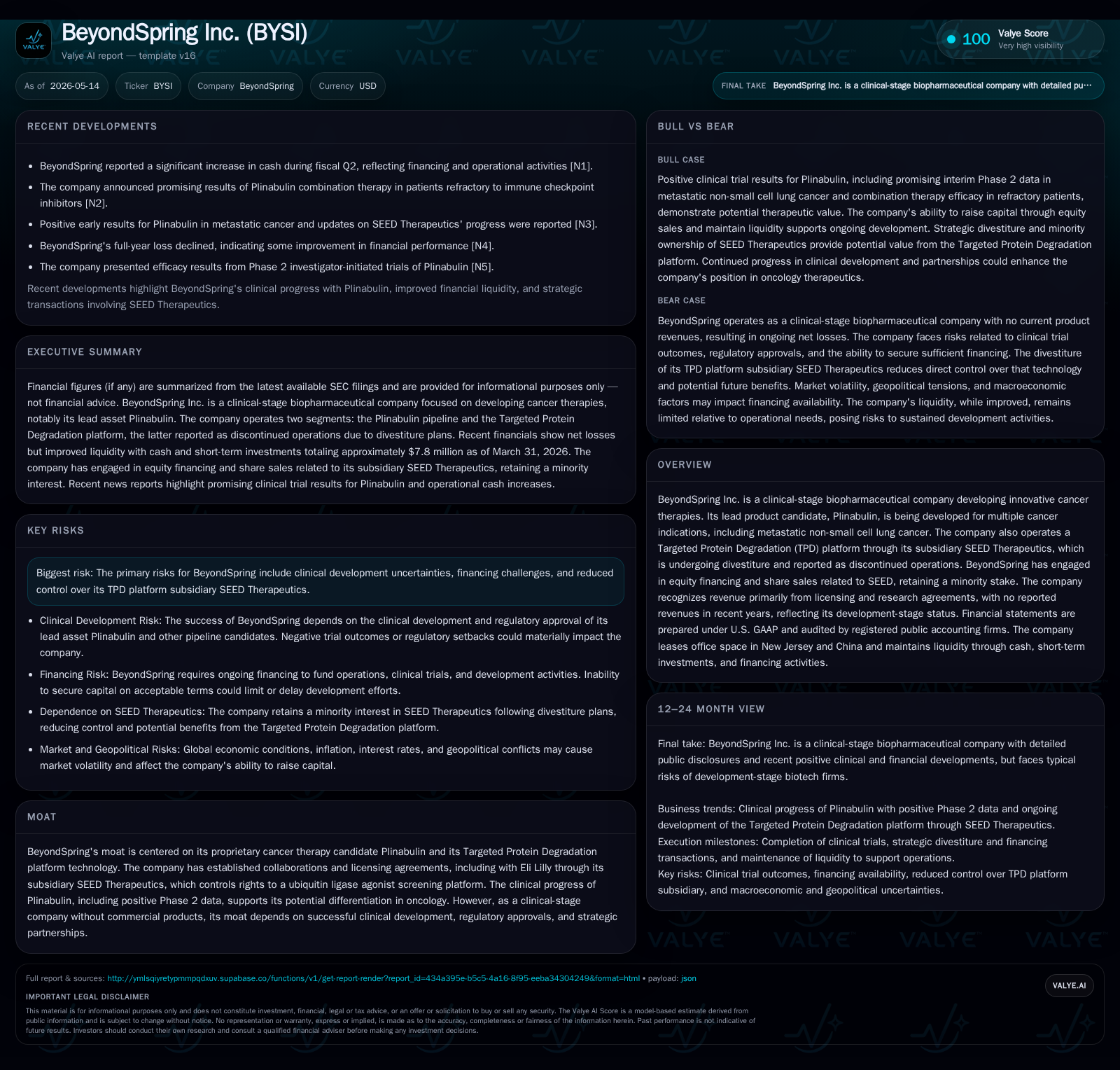
BeyondSpring Inc. reported operational updates for Q1 2026 centering on its flagship drug candidate Plinabulin, which continues clinical development aimed at addressing unmet needs in lung cancer. The company is actively divesting SEED Therapeutics, its Targeted Protein Degradation (TPD) platform, reflecting a strategic refocus. Absent product revenues, the firm sustains activities primarily through licensing and equity financings. The clinical-stage status imposes inherent developmental risks while financial resources remain moderate, with recent cash reserves around $4 million and a current ratio near 1.09. Going forward, regulatory filings and enrollment milestones for confirmatory Plinabulin trials will be key indicators.
Recent Operating Update
In the latest quarterly filing dated May 13, 2026 [S2], BeyondSpring reconfirmed its strategic emphasis on progressing Plinabulin through global Phase 3 clinical trials focusing on second- and third-line treatment of non-small cell lung cancer (NSCLC) patients who have developed resistance following immune checkpoint inhibitor therapy. The company also updated stakeholders on the systematic divestiture of its subsidiary SEED Therapeutics, which develops targeted protein degraders using a molecular glue drug discovery platform [S3]. This divestiture reflects a deliberate reallocation of resources toward oncology pipeline development.
The Q1 2026 report highlights no revenue generation as BeyondSpring remains clinical stage but underscores ongoing licensing activities primarily from collaborations under previous agreements. The dilutive equity financings tied to SEED share sales have reduced the company's ownership stake but provided capital inflows aiding liquidity.
Business Model
BeyondSpring operates as a clinical-stage biopharma entity deriving value by advancing novel therapeutic candidates through rigorous trials toward regulatory approval and eventual commercialization. Its lead asset, Plinabulin, is a first-in-class brain-penetrant microtubule modulator that exhibits a multi-modal mechanism — directly attacking cancer cells while maturing dendritic cells to enhance immune response and modulating tumor vasculature. Importantly, it targets an unmet segment: NSCLC patients experiencing "acquired resistance" after frontline PD-1/PD-L1 inhibitor treatments [S1].
The company generates potential future revenues through license fees, milestone payments upon regulatory achievements or commercial milestones, and royalties from partnered products — although currently it reports no product sales revenue [F1]. In parallel, BeyondSpring established SEED Therapeutics to harness Targeted Protein Degradation (TPD) technology utilizing molecular glue modalities applicable across oncology and CNS indications. However, recognizing the capital intensity and focus demands of maintaining two cutting-edge platforms concurrently, BeyondSpring initiated a plan to reduce control over SEED via share sales while retaining a minority interest [S1][S3].
Industry Structure and Competitive Position
The oncology drug development sphere is fiercely competitive with multiple players pursuing mechanisms to overcome resistance to immune checkpoint therapies—a prevalent challenge in NSCLC management. Plinabulin's unique approach combining microtubule modulation with immune system activation positions it as a differentiated candidate amid existing chemotherapy agents like docetaxel that historically offer modest efficacy combined with substantial toxicity.
Globally, the development ecosystem involves intricate regulatory pathways; BeyondSpring’s planned NDA filing with China’s NMPA for Plinabulin based on DUBLIN-3 phase 3 results leverages heavy Asian patient enrollment (~80%), potentially accelerating approval in a large market [S1]. The company also plans confirmatory global trials engaging US regulators reflecting ambition for international footprint.
SEED Therapeutics’ TPD platform taps into an emergent field seeking to degrade traditionally undruggable proteins via rationally designed small molecules (‘molecular glues’). Partnerships with industry incumbents like Eli Lilly underscore platform validation but concurrent divestiture signals recognition that focused resource deployment may better serve shareholder value than dual-platform expansion.
Growth Drivers
Clinical Progress of Plinabulin: The most immediate and critical growth driver is the advancement and positive data readouts from ongoing confirmatory global Phase 3 trials evaluating survival benefits in NSCLC after checkpoint inhibitor failure. Success here paves the way for regulatory submissions and eventual market launch.
Regulatory Milestones: Submission timing and eventual approvals by China’s NMPA and other agencies represent key valuation inflection points driving partnership interest or licensing revenue realization.
Strategic Collaborations: BeyondSpring’s existing licensing relationships provide potential milestone income streams if Plinabulin progresses successfully.
Divestiture of SEED Therapeutics: By reducing involvement in TPD operations via staged sales of Series A Preferred Shares worth tens of millions USD [S1][S3], BeyondSpring can reallocate capital towards core oncology programs while retaining upside exposure via minority interests.
Pre-clinical Pipeline Expansion: Early-stage immune-modulating small molecule programs may serve as mid- to long-term pipeline candidates contributing incremental growth upon clinical progression.
Risks / Watchpoints / Growth Constraints
Clinical Trial Outcomes: As a development-stage biotech entirely reliant on pipeline success, any negative or delayed clinical trial results materially erode valuation and future prospects.
Funding Environment: Operating losses remain substantial given R&D expenditure requirements (operating income negative $8.945 million at end-2025 [F1]). Liquidity is modest with $4 million cash plus $13.5 million current assets versus $12.37 million liabilities yielding a current ratio of approximately 1.09, requiring careful cash management or further financing on potentially dilutive terms.
Reduced Control Over SEED: Divestitures reduce influence over SEED’s pipeline direction; upside contingent on minority stake value appreciation is uncertain.
Regulatory Approval Complexity: Global regulatory hurdles—particularly in US and China—pose timing risk; any delays impede commercialization timelines.
Competitive Landscape: Multiple agents targeting similar patient populations may limit market penetration or pricing power once approved.
Geopolitical/Economic Factors: Given operations spanning US and China markets—and raising equity capital internationally—macroeconomic volatility or geopolitical tensions could impact financing conditions or operational continuity.
What to Watch Next
Confirmatory Phase 3 Trial Enrollment & Data: Monitoring patient recruitment rates, interim efficacy/safety data will inform timeline visibility.
NDA Submission Milestones: Regulatory filings with NMPA in China and interactions with FDA or other bodies will be pivotal.
Progress in SEED Share Divestitures: Completion of third closing under Preferred Share Purchase Agreements scheduled by year-end 2026 will alter corporate structure and capital base.
Financing Developments: Execution of additional equity/debt financings or partnership deals will be important to sustaining operations beyond current liquidity horizon.
Preclinical Pipeline Advancement: Any IND filings or partner collaborations in early-stage immune agent programs could diversify future growth vectors.
Financial Profile Summary
Latest financial snapshot
| Metric | Value | Period |
|---|---|---|
| Cash & equivalents | $4mm | |
| 2026-03-31 | ||
| Current assets | $14mm | |
| 2026-03-31 | ||
| Current liabilities | $12mm | |
| 2026-03-31 | ||
| Current ratio | 1.09x | |
| 2026-03-31 |
Source: SEC companyfacts cache [F1].
BeyondSpring remains pre-commercial with zero product revenue reported since inception [F1]. Operating losses persist due to R&D intensity focused primarily on oncology drug development (last operating income -$8.945 million as of December 31, 2025) [F1]. Net loss stood at approximately $10 million same period [F1]. Cash and equivalents totaled roughly $4 million at quarter-end March 31, 2026 with total current assets about $13.5 million versus current liabilities near $12.37 million delivering a modest current ratio around 1.09 indicative of limited working capital cushion [F1]. Total debt metrics are dated (last known from Q3 2021) but suggest manageable leverage relative to cash position [F1]. Continuing reliance on external funding through equity offerings tied notably to SEED preferred stock sales supplemented cash flow recently [S3][S6].
Disclaimer: This is research-only, informational analysis and not investment advice. It may include AI-generated interpretation and general industry context. Always verify important details using primary sources.

Comments