
BayFirst Financial Advances Community Banking Strategy with Regional Focus in Q1 2026
BayFirst navigates near-term SBA loan credit challenges while reinforcing its local banking franchise through personalized service and specialized lending.
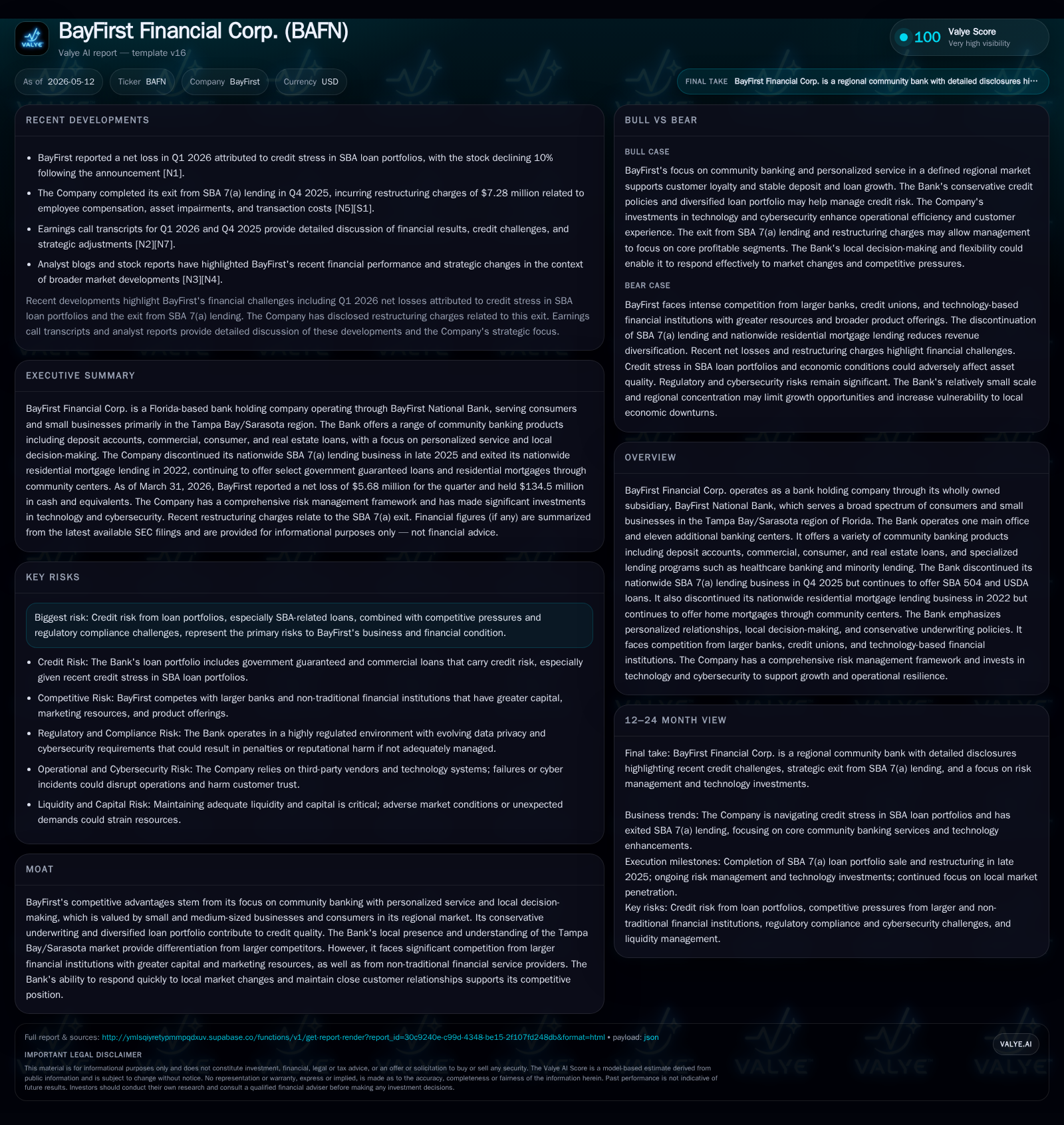
In Q1 2026, BayFirst Financial Corp. faced elevated credit losses linked to its SBA loan portfolio, prompting a strategic retreat from nationwide SBA 7(a) lending completed in late 2025. Despite these headwinds, the company maintains strength in its regional community banking model centered on personalized relationships and conservative underwriting within Tampa Bay and Sarasota markets. Growth prospects hinge on expansion in niche lending sectors such as SBA 504 and USDA loans, alongside deposit growth fueled by tailored consumer and business products. However, credit risks, capital constraints, and competitive pressures from larger banks and fintech providers represent key challenges to watch in the near term.
Latest Quarterly Operating Update: Credit Stress and Strategic Adjustments
BayFirst Financial's latest quarterly report (10-Q filed May 12, 2026) highlights continuing operational pressure stemming from credit stress related to its Small Business Administration (SBA) loan portfolio. The company formally exited the nationwide SBA 7(a) lending business at the end of Q4 2025 as part of its risk mitigation strategy [S2], [S3]. This move reflects a shift towards reducing exposure to higher-risk guaranteed loans that were causing deteriorating asset quality. Despite this retreat from the SBA 7(a) program, BayFirst continues to offer SBA 504 and USDA-guaranteed loans through its local community banking centers situated primarily in Tampa Bay/Sarasota [S1].
These portfolio refinements coincide with the recognition of increased credit losses in Q1 2026 reported during the earnings call held May 1, which negatively impacted net income and contributed to a notable decline in investor sentiment reflected by a nearly 10% drop in stock price shortly after earnings release [N1], [N3]. Management emphasized that conservative underwriting standards remain central to their risk posture going forward even as they adapt their product mix to evolving market realities.
BayFirst’s Business Model and Product Differentiation in Regional Community Banking
BayFirst operates primarily through its wholly owned subsidiary BayFirst National Bank which services consumers and small- to medium-sized businesses within its regional footprint [S1]. Its revenue streams are principally derived from interest income on diversified loan portfolios including commercial real estate, residential mortgages offered locally post-2022 nationwide mortgage business exit, consumer loans, specialized healthcare banking finance solutions, minority lending initiatives, as well as from deposit account fees.
The Bank’s product offering extends beyond traditional deposits—providing unique accounts like Essential Checking aimed at restoring banking access for underbanked customers, TrendSetters Club targeting the 50+ demographic with tailored benefits, and Cash Kids’ Club focused on youth financial literacy enhanced through mobile tools [S1]. These offerings exemplify a relationship-driven strategy emphasizing personalized service underscored by "local decision-making," where on-the-ground banking centers retain authority over credit approvals fostering responsiveness valued by regional customers.
While discontinuations of broader scale SBA 7(a) lending nationally limit diversification somewhat, continuing SBA 504 and USDA loans enable BayFirst to leverage government-guaranteed products with comparatively less credit volatility through localized origination channels [S1], [S2].
Competitive Dynamics and Industry Position: Local Versus Larger Institutions
The competitive landscape positions BayFirst against much larger institutions wielding expansive capital reserves and formidable marketing budgets targeting Tampa Bay/Sarasota’s business community. These larger players benefit from scale-driven pricing advantages but often lack the nuanced knowledge of local economic conditions or the ability to provide personalized service at scale [S1].
BayFirst differentiates itself by cultivating close customer relationships enabled through localized decision centers allowing swift adaptations to client needs—an advantage particularly resonant among small business owners seeking flexible credit arrangements with a trusted regional partner. This strategic focus creates barriers to entry for national banks less nimble or willing to engage intimately with smaller accounts.
Nonetheless, emerging fintech lenders intensify pressure by offering alternative financing solutions with digital convenience that challenges traditional deposit gathering practices. Maintaining relevance thus necessitates continuous innovation in customer engagement combined with prudent risk assessment frameworks.
Growth Drivers: Leveraging Personalized Service and Specialized Lending Programs
Growth opportunities for BayFirst reside principally within expanding penetration of specialized government-backed lending programs retained after the SBA 7(a) exit—particularly SBA 504 fixed asset financing attractive to growing small businesses—and USDA Business & Industry (B&I) loans targeted at rural area enterprises [S1], [S2]. These niches permit continued revenue generation while minimizing risk concentration relative to less granular commercial loan segments.
Supplementary growth avenues include leveraging signature deposit programs designed for distinct client demographics which bolster core deposits—a critical funding source enhancing net interest margins amid competitive rate environments. Adoption of technology-enabled features facilitating mobile banking access (noted via Cash Kids’ Club interactive platforms) helps drive engagement particularly among younger segments.
Success hinges on sustaining advantageous loan-to-deposit ratios demonstrating efficient asset deployment balanced against liquidity requirements mandated by regulatory authorities.
Risks and Constraints: Loan Portfolio Quality, Regulatory Issues, and Capital Needs
BayFirst confronts acute risks arising from elevated credit losses tied chiefly to its legacy SBA guaranteed portfolios that have prompted tightening underwriting standards and divestment from higher-risk segments [S2], [S1]. Given their regional focus, portfolio concentration represents a nontrivial concern compounded by potential adverse economic developments within Florida’s mixed urban-rural footprint.
Regulatory compliance costs have increased concomitant with heightened scrutiny over governance policies related to community banks’ loan quality monitoring protocols. Additionally, management has disclosed uncertainties surrounding potential future capital raising efforts necessary to maintain prudential buffers under Basel III frameworks amid shrinking retained earnings post-losses [S1], [S2]. Regulatory capital classifications remain robust for now but will require attentive stewardship as loss provisions evolve.
Competition-induced margin compression alongside digital disruption threaten traditional fee income sources thereby constraining pricing flexibility further threatening profitability sustainability.
Forward-looking Indicators: Key Execution Milestones and Market Signals
Investors should monitor several critical metrics signaling operational trajectory including quarterly trends in allowance for loan losses particularly within remaining government-guaranteed portfolios (USDA B&I and SBA 504), deposit growth rates within established counties (Pinellas/Hillsborough/Sarasota), regulatory capital ratio movements especially common equity Tier 1 under stress scenarios, and management commentary around potential resumption or adjustments of stock repurchase/dividend policies following recent program terminations [S2], [S3], [N1].
Market reactions and internal execution effectiveness pertaining to these indicators will meaningfully influence valuation perceptions given current uncertainty around sectoral credit cycles impacting smaller regional banks relying heavily on secured loan assets.
Financial Overview: Capital, Liquidity, and Profitability Snapshot
As of March 31, 2026, BayFirst maintained $134 million cash and cash equivalents providing a solid liquidity buffer despite recent operating losses driven largely by increased provision expenses linked to problematic SBA exposures observed during prior quarters [F1].
Reported net income for FY2025 was negative $22.9 million reflecting accumulated credit charge-offs elevating loss reserves substantially. The Bank met regulatory "well capitalized" thresholds as of December 31, 2025 across all major capital adequacy ratios including total risk-weighted assets at over 10%, Tier 1 capital exceeding minimums comfortably though reduced versus historical norms due to retained losses [S6], [S17].
Overall profitability prospects depend materially on containing credit impairment trends while gradually growing core deposits sufficient to fund expanding lower-risk specialized loans driving improved net interest margins sustainably.
This analysis is based solely on publicly disclosed information as of May 12, 2026. It does not constitute investment advice or recommendations.
Disclaimer: This is research-only, informational analysis and not investment advice. It may include AI-generated interpretation and general industry context. Always verify important details using primary sources.

Comments