
Chain Bridge Bancorp Stakes Claim in Political Banking with Solid Q1 Momentum
Q1 2026 results underscore Chain Bridge Bancorp’s leverage of political deposit cycles and its branch-less model to drive growth in a niche market.
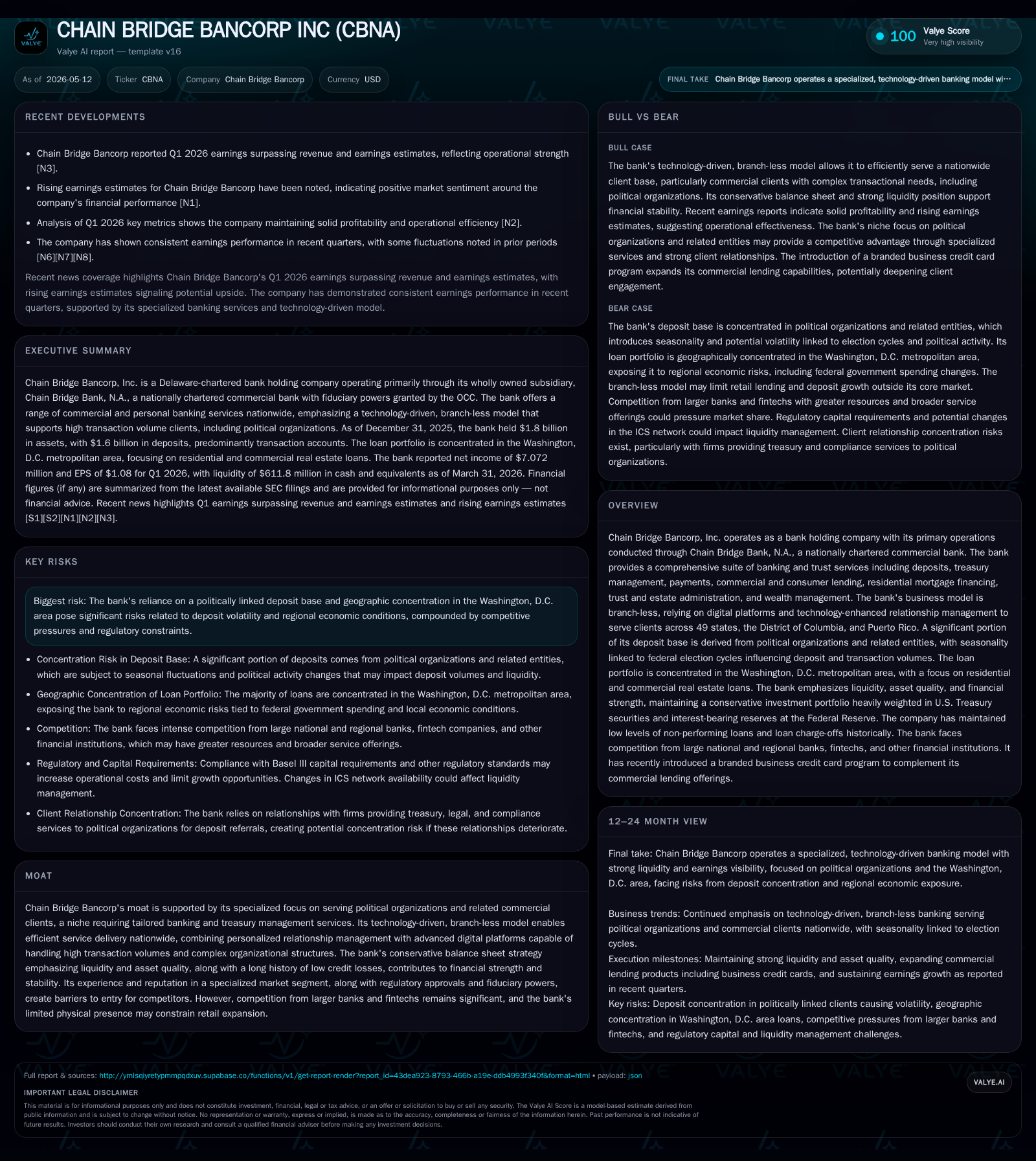
Chain Bridge Bancorp reported strong first-quarter performance driven by seasonally robust deposits linked to federal election fundraising, reinforcing the strength of its politically affiliated client base. The company’s branch-less, technology-enabled banking model supports efficient nationwide reach while focusing heavily on transaction accounts anchored in political organizations. Despite concentration risks tied to political cycles and the Washington D.C. area loan portfolio, conservative balance sheet management and a specialized service offering underpin a stable competitive position. Upcoming periods will test the sustainability of deposit growth beyond election-driven spikes and the expansion of treasury and lending relationships.
Latest Quarterly Results and Implications
Chain Bridge Bancorp delivered an impressive first quarter in 2026 as detailed in its May 12 filing [S2] and April 28 earnings release [S3], highlighting the pronounced effect of federal election cycle seasonality on its deposit base. Deposits surged due to increased fundraising activity by political organizations predominantly affiliated with the U.S. Republican Party, which constitutes a significant portion of the bank’s client mix. This influx contributed to revenue beats against consensus forecasts [N2][N3], affirming demand for Chain Bridge’s specialized offerings during peak political periods.
Transaction volumes remained elevated along with deposits, reflecting heightened campaign spending and associated treasury management activities. Importantly, these trends underscore the structurally embedded seasonality that marks Chain Bridge’s business, with acute deposit inflows clustered around key election milestones yet tempered by conservative asset deployment strategies.
Business Model: Specialization in Political and Commercial Banking
Chain Bridge Bancorp operates through its wholly owned subsidiary Chain Bridge Bank, N.A., a nationally chartered commercial bank distinguished by its branch-less operating model serving clients across 49 states plus D.C. and Puerto Rico [S1]. Eschewing traditional brick-and-mortar branches enables cost efficiencies leveraged through advanced digital platforms that facilitate comprehensive banking services — including demand depository accounts catering mainly to commercial clients managing high transaction volumes.
The bank caters predominantly to political organizations requiring highly customized treasury management solutions such as multi-user account controls with hierarchical approval workflows, image cash letter processing (ICL), and remote deposit capture [S28]. These capabilities address complexities endemic to political entities' financial operations involving multiple stakeholders and regulatory compliance mandates.
With approximately 95% of deposits held in noninterest-bearing transaction accounts, Chain Bridge emphasizes scale via volume-intensive relationship banking supported by technology rather than widespread physical presence [S19][S28]. The loan portfolio is primarily concentrated geographically within Washington D.C., focusing on residential mortgages (notably jumbo non-conforming loans) for sophisticated borrowers plus some commercial real estate loans [S28].
Competitive Landscape and Industry Positioning
Chain Bridge Bancorp's moat derives from its entrenched position servicing politically affiliated clients whose needs for specialized compliance-aware treasury functions pose high switching costs; few competitors possess equivalent fiduciary powers granted by the OCC relevant to trust administration [S1]. Larger national banks may have broader product suites but lack tailored services or culture aligned with politically sensitive clientele.
Nevertheless, competitive pressures stem from fintech entrants innovating in payments and cash management as well as established regional banks encroaching on transactional relationships outside traditional retail settings. Regulatory frameworks impose constraints limiting rapid expansion or capital deployment options [S25].
Growth Catalysts Within the Political Banking Niche
The primary driver remains the federal election cycle which dictates spikes in political fundraising deposits and transactional throughput roughly every two years [S1]. The company's ability to harness this predictable cyclical wave through pre-positioned client onboarding positions it well for recurring income peaks.
Additional growth avenues include increased penetration into complementary political entities beyond core Republican-affiliated groups leveraging tailored treasury products. Also notable is expansion within the ICS® network platform enabling safer distribution of large deposits via reciprocal or "One-Way Sell" placements at other FDIC-insured institutions generating placement fees [S20].
Commercial lending growth focused on Washington D.C.’s real estate market offers incremental scale within a conservatively managed credit risk framework emphasizing adjustable-rate jumbo mortgages preferred by affluent clientele [S28]. Digital onboarding enhancements poised for rollout are expected to reduce acquisition friction thus increasing customer base breadth.
Risks and Operational Constraints Including Deposit Concentration
Chain Bridge Bancorp faces material risks from reliance on politically linked deposits presenting sharp seasonality impacting liquidity needs unpredictably outside peak cycles [S1]. Concentration among fewer depositor clients intensifies vulnerability should political activities or campaign finance regulations shift adversely.
Geographically concentrated loan portfolios heighten susceptibility to localized economic pressures while regulatory limits constrain capital flexibility affecting potential dividend distributions or share repurchases [S25][S26]. Despite low loan-to-deposit ratios enhancing credit risk mitigation, this conservative posture may cap returns relative to peers deploying higher leverage.
Competitive threats exist from fintech platforms offering agile cash management tools appealing especially to younger political groups less wedded to incumbent relationships. The lack of physical branch infrastructure restricts local tactile engagement opportunities but is also a cost advantage if digital channels continue gaining traction.
Monitoring Key Upcoming Milestones and Execution Indicators
Investors should closely watch measures of post-election deposit retention rates as tests of loyalty beyond seasonally inflated balances emerge. Early indicators from expanded treasury services uptake—such as adoption metrics on ICS® network participation—and growth trends in Washington D.C.-centric loan originations will signal organic franchise deepening.
Execution on digital onboarding improvements will be pivotal for scaling new client acquisition cost-effectively across distributed geographies beyond core markets. Capital adequacy metrics following full-year results will illuminate flexibility given strategic capital allocation priorities detailed previously [S26].
Current Financial Position Overview
Latest financial snapshot
| Metric | Value | Period |
|---|---|---|
| Cash & equivalents | $612mm | |
| 2026-03-31 | ||
| Total debt | 0 USD | |
| 2026-03-31 | ||
| Net debt | $-612mm | |
| 2026-03-31 |
Source: SEC companyfacts cache [F1].
As of March 31, 2026, Chain Bridge Bancorp reported $611.8 million in cash and equivalents supporting its liquidity profile while bearing zero outstanding debt at the holding company level [F1]. This net cash position underscores a conservative financial posture aligned with the firm’s banking philosophy emphasizing liquidity and asset quality over aggressive leverage.
It does not constitute investment advice but aims to provide an informed perspective on the company’s operating environment, industry positioning, growth dynamics, risks, and financial posture based on documented facts.
Disclaimer: This is research-only, informational analysis and not investment advice. It may include AI-generated interpretation and general industry context. Always verify important details using primary sources.

Comments