
Range Capital Acquisition Corp. Prepares for Initial Business Combination in SPAC Landscape
Range Capital remains in its pre-combination phase, holding IPO proceeds in trust while preparing to identify an initial target amid a competitive SPAC market.
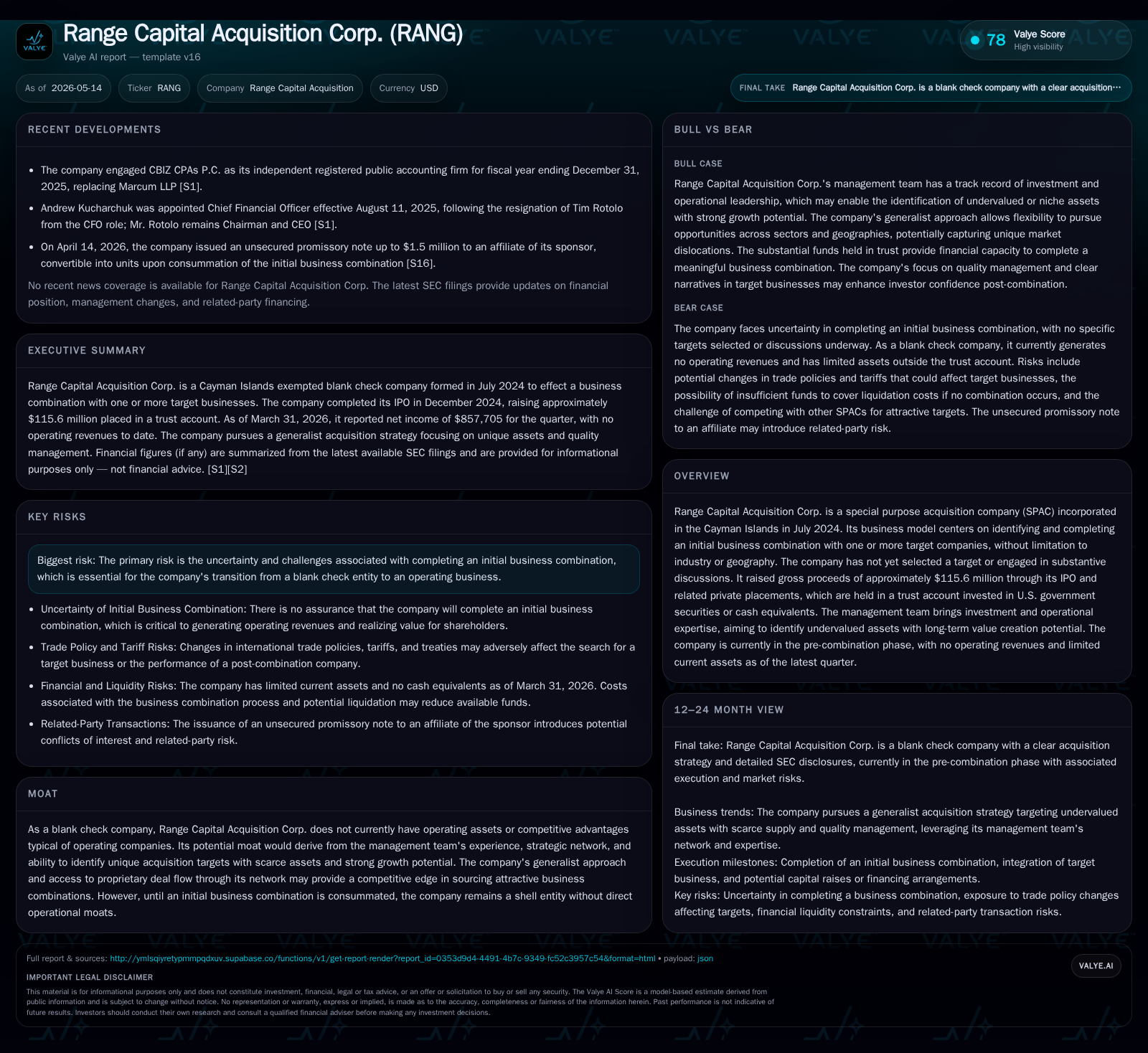
As of its latest 10-Q filing in May 2026, Range Capital Acquisition Corp. continues to operate as a classic special purpose acquisition company (SPAC) without revenue or active business operations. Its strategic focus centers on leveraging management’s experience and network to identify undervalued companies with scarce assets, targeting sectors characterized by structural capital constraints and strong demand. While its generalist approach offers sourcing flexibility, it also presents execution risks. The company’s liquidity is conservatively held in government securities as required by regulatory trust account rules, providing funding readiness for an eventual business combination, though the timing and target remain uncertain.
Latest Quarterly Update: Operating Status and Implications
Range Capital Acquisition Corp.'s latest quarterly report filed May 13, 2026 ([S2]) confirms the company's status as a blank check entity yet to consummate its initial business combination. Consistent with its SPAC structure, it has not generated operating revenues nor engaged in substantive discussions with any specific acquisition targets. The company's net assets largely consist of IPO proceeds held in a trust account invested in highly liquid U.S. government securities or cash equivalents per regulatory requirements ([S1], [S4]). This trust account safeguards investor funds until released for an approved business combination or returned upon liquidation.
Despite this stasis in direct operational activity, Range Capital maintains its readiness posture with sufficient funding reserved for future acquisitions. A recent auxiliary development includes the issuance of an unsecured promissory note up to $1.5 million to an affiliate sponsor entity ([S18]), enhancing working capital capacity on a limited basis ahead of any combination closing.
This cautious but prepared operational posture signals ongoing efforts to source suitable candidates despite no explicit public announcements, reflecting typical SPAC timeline dynamics where searching precedes material deal disclosures.
Business Model and Investment Approach
Range Capital Acquisition Corp. is incorporated as a Cayman Islands exempted special purpose acquisition company formed expressly for merging with or acquiring one or more operating businesses ([S1]). It operates under a generalist investment mandate without predefined sector or geographic limits. This flexibility enables management to pursue opportunities across diverse fields but concurrently imposes execution complexity due to the broad competitive universe.
The company has stressed its intent to identify 'scarce assets' – businesses owning unique or hard-to-replicate resources with strong intrinsic demand amid structural supply bottlenecks ([S1]). Examples include segments within energy (notably nuclear), defense technology, specialty finance, and health sectors where capital constraints create value-creation prospects through favorable entry valuations and sustainable margin models.
Management's strategy incorporates selecting 'pure play' companies amenable to clear growth narratives and operational transparency; this thematic alignment aims to attract long-term public market investors ([S1]). The team emphasizes partnering with quality management cohorts demonstrating strategic focus and capital discipline.
Execution relies heavily on the team's prior entrepreneurial accomplishments, operational involvement beyond passive investment, and access to proprietary deal flow sourced through extensive networks spanning private equity firms, family offices, industry executives, and financial intermediaries (, [S26]). This approach underscores their pursuit of risk-adjusted returns through asset classes often overlooked by traditional capital providers.
Competitive Positioning Within the SPAC Sector
Within the crowded SPAC ecosystem, Range Capital distinguishes itself through its generalist yet disciplined acquisition criteria focused on scarce assets prized for their defensible market positions (). Unlike sector-focused SPACs that specialize but risk narrow pipelines if their themes falter, Range Capital retains adaptability to pivot as opportunity sets evolve.
However, this breadth entails challenges securing truly differentiated deal flow amid intense competition from numerous other blank check vehicles vying for premium targets (). The absence so far of any public target engagement highlights both the uphill work required and the importance of leveraging proprietary sourcing advantages rooted in management’s financial sector relationships ([S26]).
Until an initial business combination is consummated, Range Capital remains structurally similar to virtually all SPAC shells—its moat derives chiefly from managerial capabilities rather than operational scale or technology differentiation ().
Growth Opportunities and Strategic Levers
Post-combination growth potential hinges on identifying entities benefiting from structural capital deficits combined with durable end-market demand—conditions that support price-setting power and margin expansion ([S1]). Range Capital’s thesis targets businesses that can generate sustainable organic growth supplemented by bolt-on acquisitions thanks to scalable cost structures ([S20]).
Sector themes provide qualitative guidance: energy segments challenged by cyclical capital reallocation (such as nuclear power), defense technology requiring modernization investment due to geopolitical shifts, niche specialty finance markets underserved by banks post-2008 reforms, and women’s health innovations responding to demographic tailwinds all constitute plausible verticals ([S23]).
Management plans active involvement beyond financial sponsorship—anticipating hands-on operational guidance during transition periods to enhance commercialization efficacy and investor communications (, [S26]). These factors could potentially differentiate dividend yield stability and valuation multiples relative to generic SPAC roll-ups.
Risks and Investor Considerations
Primary risk centers on successfully consummating an initial business combination within the predetermined timeframe mandated by SPAC regulations; failure results in liquidation with limited recovery upside beyond trust account values (, [S2]). Furthermore, publicly traded SPACs face elevated investor scrutiny due to regulatory tightening around disclosures and underwriting practices.
Additional hazards include execution risks if target companies are nascent or financially fragile. Dilution from private placement units, convertible notes such as the unsecured $1.5 million promissory note facility to sponsor affiliates ([S18]), or subsequent financing rounds may erode shareholder value if not carefully managed.
Another concern arises from management conflicts stemming from duties toward affiliated entities that might compete for deal opportunities ([S27]). Market skepticism toward SPAC vehicles broadly may compound challenges in securing attractive valuation metrics upon announcement.
Upcoming Milestones and Market Watchpoints
Key indicators signaling progress encompass formal announcements regarding potential acquisition targets or transaction structuring intentions visible in forthcoming SEC filings or company press releases ([S2], [S3]). Shareholder approval processes triggered following such announcements will serve as critical vote-of-confidence markers.
Monitoring related-party financing disclosures such as drawdowns on existing unsecured note facilities offers insight into operational runway extension efforts ahead of deal closure dates ([S18]). This structure preserves principal capital integrity pending deployment for approved business combinations or redemptions.
As per latest data reported March 31, 2026 ([F1]), the company exhibits no cash on hand directly recorded outside of immaterial current assets totaling roughly $153 thousand—likely reflecting timing variances rather than actual liquidity shortfalls given segregated trust arrangements.
No third-party debt obligations exist except for internally arranged unsecured promissory notes payable upon combination closing; thus far there has been no leverage raised externally ([F1], [S8], [S18]). Operating losses recorded prior periods reflect standard pre-combination corporate expenses consistent with blank check entity profiles.
This conservative financial stance maximizes optionality while minimizing financing stresses before a qualified target agreement materializes.
Disclaimer: This analysis is based exclusively on available SEC filings and official company disclosures as of May 2026. All forward-looking statements reflect current expectations subject to risks inherent in early-stage blank check companies.
Disclaimer: This is research-only, informational analysis and not investment advice. It may include AI-generated interpretation and general industry context. Always verify important details using primary sources.

Comments