
Green Brick Partners Restates Revenue Recognition While Maintaining Strategic Control Over Land in Sunbelt Homebuilding
Latest quarterly updates reveal a revenue restatement adjusting closing cost incentives and reaffirm Green Brick’s robust land development model in key US markets.
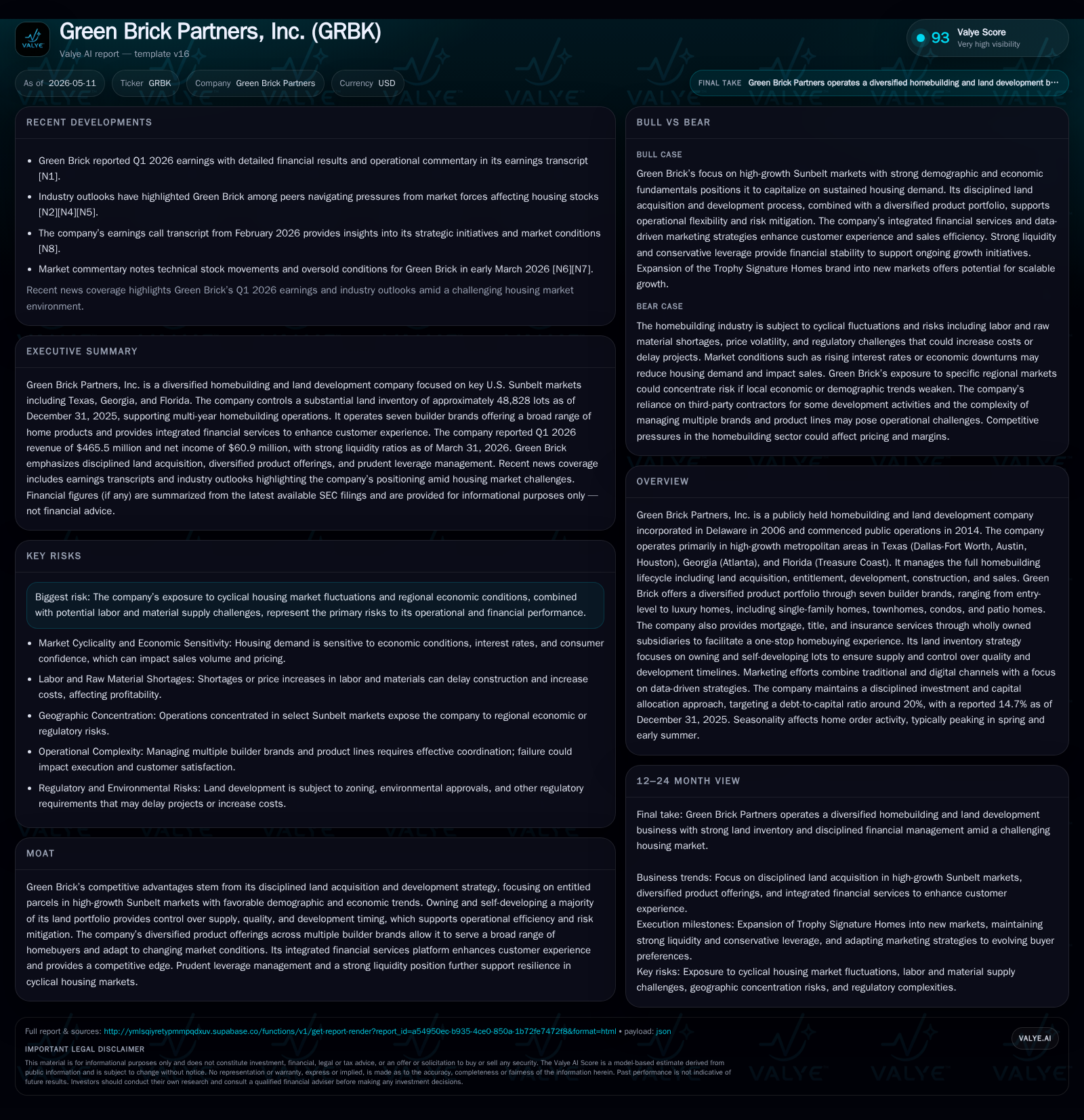
Green Brick Partners issued a revenue restatement for previous periods, reflecting a reclassification of closing cost incentives as revenue reductions rather than costs. This accounting adjustment increases gross margins but does not affect net income or cash flows. The company continues to pursue a disciplined land acquisition and development strategy focused on high-growth Sunbelt metros including Dallas-Fort Worth, Austin, Houston, Atlanta, and Florida's Treasure Coast. Green Brick’s vertically integrated operations across seven builder brands and financial services subsidiaries create a diversified platform that mitigates cyclical risk through product breadth and supply control. Despite cyclical housing market headwinds and potential input constraints, Green Brick’s balance sheet liquidity and leverage profile support ongoing development capacity.
Recent Operating Update
Green Brick Partners’ latest quarter report filed May 11, 2026 ([S2]) centers on an important revision to its revenue recognition accounting for closing cost incentives offered to homebuyers. Following an Audit Committee review disclosed April 29 ([S3], [S16]), the company determined that such incentives—including interest-rate buy-downs—should reduce residential unit revenues rather than be recorded only as cost offsets. This reclassification lowers reported residential units revenue for the years ended 2023 through 2025, as well as for the first three quarters of 2025 when restated. However, the corresponding reduction in cost of residential units ensures that gross profit remains unchanged.
This adjustment increases the gross margin percentage on residential units by roughly 0.8-1.0% across impacted periods but does not alter net income or cash flow metrics. It also impacts certain operating metrics such as average sales price (which decreases due to lower gross revenues) and SG&A leverage ratios (which are compressed after restatement effects).
The episode reflects an adherence to ASC 606 revenue guidance with consideration payable treated as a reduction of transaction price. Importantly, the restatement preserves comparability while clarifying financial presentation nuances for investors.
Business Model Overview
Green Brick Partners is a diversified homebuilding and land development company focused primarily on high-growth metropolitan hubs in the U.S. Sunbelt: Dallas-Fort Worth (DFW), Austin, Houston in Texas; Atlanta in Georgia; and Treasure Coast in Florida ([S1]). Incorporated in Delaware since 2006 with public trading started in 2014, it handles the entire homebuilding lifecycle—from acquiring raw land through entitlement and development to construction and final sale.
Its strategy involves managing a large land inventory—owning or contracting approximately 48,900 home sites as of end-2025—to enable control over supply dynamics ([S1]). This ownership model contrasts with firms reliant on third-party lots or less developed parcels subject to more external timing risks.
The company's product strategy leverages seven distinct builder brands covering multiple price points from entry-level homes up through luxury segments. Product offerings encompass single-family detached houses, townhomes, condominiums, and patio homes—diversification that allows adaptability to shifting demand patterns across customer demographics.
Additionally, Green Brick operates wholly owned mortgage, title, and insurance subsidiaries that underpin a vertically integrated "one-stop" homebuying service platform ([S1]). These subsidiaries help streamline customer financing processes while potentially enhancing conversion rates and generating ancillary fee income; they also differentiate Green Brick amid many pure-play builders lacking such integrated services.
Operationally, having both land development expertise combined with vertical homebuilding capabilities enables tight scheduling coordination between lot delivery and home construction phases—a key efficiency driver in controlling cycle times and costs.
Industry Structure & Competitive Position
The U.S. single-family housing market is highly cyclical but considerably influenced by demographic shifts such as migration toward Sunbelt states driven by employment growth and favorable living conditions. High-growth metros like those where Green Brick operates benefit from structural tailwinds including robust population inflows and constrained housing supply relative to demand.
Competition arises from other publicly traded national builders (e.g., D.R. Horton, Lennar) and local/regional players often specializing in specific niches or geographies. However, Green Brick’s focus on entitled lot ownership coupled with integrated services sets it apart strategically by enabling better control over timing—avoiding costly delays from entitlement hold-ups—and enhancing buyer experience through financing facilitation.
Labor availability constraints and material cost inflation—typical concerns across the industry—pose challenges but can be mitigated partially by local market footprint scale advantages which Green Brick possesses. The company’s multi-brand product portfolio offers some pricing power leverage during variable market conditions compared to firms concentrated solely on one segment.
Growth Drivers
- Land Inventory Expansion: Continued acquisition of entitled parcels in favored submarkets supports pipeline volume growth over the near-to-medium term ([S1]).
- Backlog Conversion: Backlog entered into contracts but unclosed represents future deliverable homes expected mainly within one year ([S1]). Monitoring cancellation rates amidst rising or volatile interest rates remains critical.
- Product Mix Optimization: Expansion of higher-margin luxury or upscale homes alongside affordable inventory may enhance overall margins if consumer preferences shift upward.
- Integrated Services Leverage: Mortgage/title/insurance subsidiaries can drive higher attach rates increasing overall transaction value capture.
- Geographic Diversification: Presence in multiple Sunbelt metros cushions region-specific economic slowdowns allowing more stable aggregate performance.
- Operational Efficiency Initiatives: Process improvements around lot handover timing and construction productivity may lower cycle times/costs (implied from integrated development approach).
Risks & Watchpoints
Primary risk factors center on cyclical macroeconomic sensitivity inherent to homebuilding:
- Economic downturns reducing employment levels or consumer income depress purchase demand leading to cancellations ([S1]).
- Rising interest rates could hamper buyer financing access or affordability impairing sales velocity.
- Competition pressures on pricing potentially compressing margins particularly if excess inventory builds locally.
- Labor shortages or escalating materials prices may squeeze development or construction cost assumptions impacting profitability.
- The ongoing implications of accounting restatements warrant attention regarding financial reporting consistency going forward ([S3], [S16]).
- Leverage constraints imposed by credit agreements necessitate liquidity monitoring given capital-intensive nature of lot acquisition/development ([S24]).
What to Watch Next
Investors should track:
- Quarterly backlog unit fulfillment pace for signs of acceleration/deceleration relative to typical build-to-delivery timelines.
- New community openings especially within the luxury segment indicating willingness to invest capex amidst current cycle conditions.
- Absorption rates reflecting buyer demand strength within each regional market served.
- Pricing trends evidenced by changes in average sales prices post-restatement baseline adjustments.
- Continued enhancements or expansions in ancillary financial service offerings driving customer convenience benefits.
- Any further regulatory updates or financial statement changes related to ASC 606 compliance implementation commitments.
Financial Profile (Brief Support)
Latest financial snapshot
| Metric | Value | Period |
|---|---|---|
| Cash & equivalents | $145mm | |
| 2026-03-31 | ||
| Total debt | $323mm | |
| 2025-12-31 | ||
| Net debt | $178mm | |
| 2025-12-31 | ||
| Current ratio | 4.23x | |
| 2026-03-31 |
Source: SEC companyfacts cache [F1].
As of March 31, 2026 quarter-end ([F1]):
- Cash & equivalents totaled approximately $145 million providing liquidity buffer relative to debt maturities.
- Total debt stood near $323 million (end December 2025), implying net debt around $178 million after cash offsets.[F1]
- The current ratio historically exceeds 4x (based on older data), indicating manageable short-term liabilities coverage.[F1]
- Restated gross margins have increased modestly due to incentive reclassification without impacting net profitability metrics ([S3],[S16],[S26]).
Green Brick’s capital structure balances sustainable leverage while supporting continuous land portfolio funding constraints typical in the homebuilding industry context ([S24]).
Disclaimer: This analysis is based solely on information available through SEC filings dated May 11, 2026, company disclosures including recent event filings April-May 2026, third-party news transcripts dated April 30, 2026 [N1], and quantified companyfacts data current through early Q2 fiscal year 2026 [F1]. Forward-looking statements were excluded from this review per policy requirements. No investment advice is offered here; readers should conduct further independent research before forming conclusions about Green Brick Partners' investment merit.
Disclaimer: This is research-only, informational analysis and not investment advice. It may include AI-generated interpretation and general industry context. Always verify important details using primary sources.

Comments