
General Purpose Acquisition Corp. Charts Path to Initial Business Combination in Q1 Update
GPAC's Q1 2026 filing confirms steady progress toward completing its initial business combination and highlights key governance and liquidity factors shaping near-term outcomes.
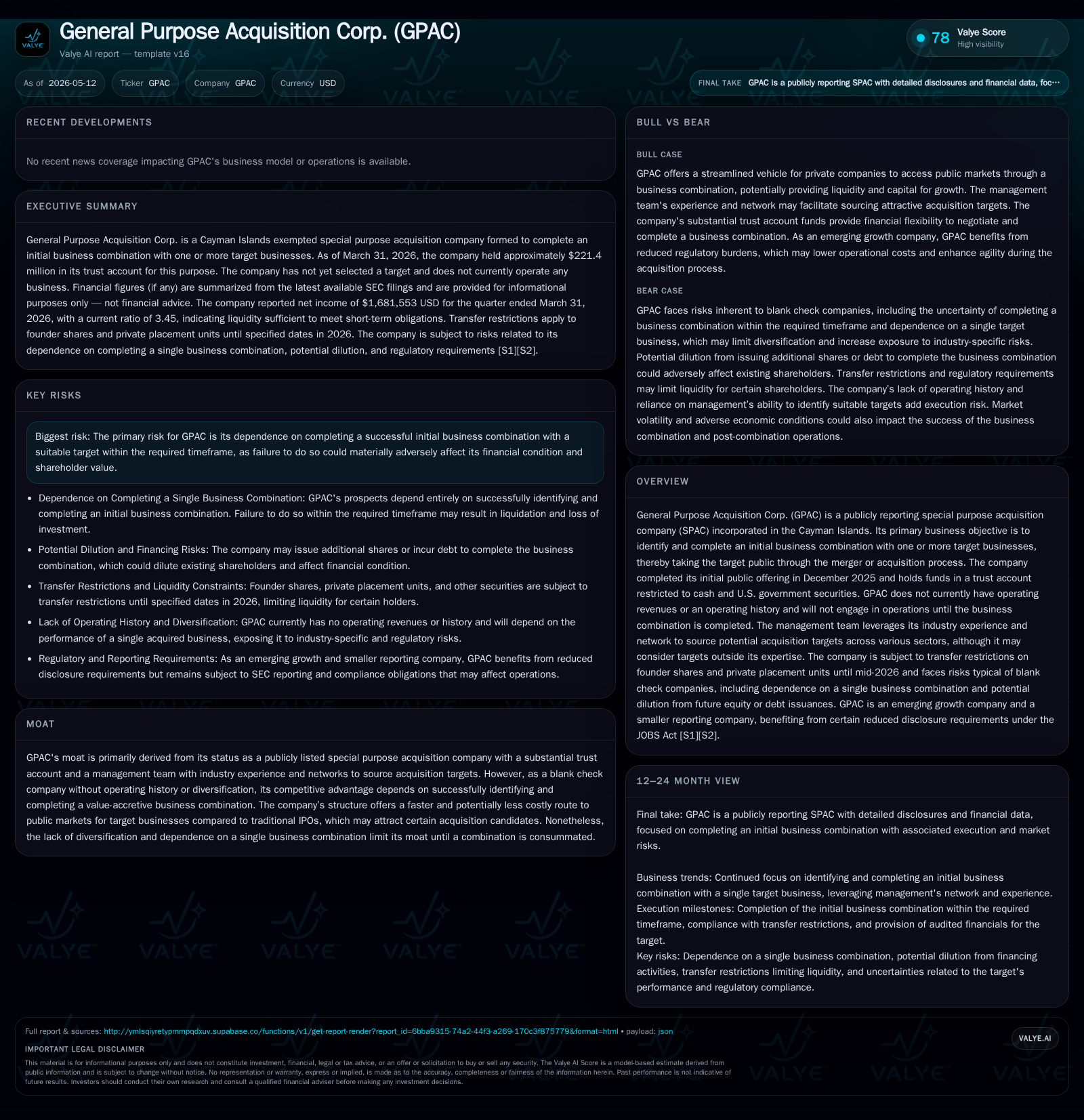
General Purpose Acquisition Corp. (GPAC), a Cayman Islands-registered SPAC, remains focused on identifying and consummating its first business combination following its December 2025 IPO. The latest 10-Q shows no material risk changes or operational shifts ahead of critical May 31, 2026 transfer restriction expirations. GPAC’s trust account retains over $1.16 billion in assets supporting transaction flexibility, while governance mechanisms around founder share lock-ups and warrant redemptions could influence shareholder value post-combination. Absent operational revenues, the company’s path to growth hinges on selecting a suitable target and executing a value-accretive merger.
Latest Quarterly Operating Development
General Purpose Acquisition Corp.'s latest quarterly filing dated May 12, 2026 (Form 10-Q) maintains that there have been no material changes to its risk factors or operational status since the previous annual report filed on March 27, 2026 [S2]. As a blank-check company, GPAC continues to hold its funds exclusively in a trust account consisting primarily of cash and U.S. government securities that are legally restricted until the completion of an initial business combination or redemption events. The filing explicitly reiterates the transfer restrictions that bind founder shares, private placement units, and warrants until May 31, 2026 — exactly six months from the IPO pricing date of December 2, 2025 — underscoring impending liquidity events that could affect trading dynamics for insiders [S2], [S24]. There is no reported litigation or significant operational changes disclosed.
SPAC Business Model and Product Offering
GPAC operates as a Cayman Islands exempted special purpose acquisition company (SPAC) whose primary business objective is to complete an initial business combination while providing the combined entity with immediate access to public markets without undergoing a traditional IPO process [S1]. Unlike operating companies generating revenue streams from products or services, GPAC monetizes by targeting private companies seeking public listing through merger or acquisition transactions facilitated by GPAC’s existing public listing status.
The capital raised via GPAC's December 2025 IPO amounted to $230 million gross proceeds placed into a custodial trust — supplemented by private placement proceeds largely funded by the sponsor and underwriters — structured to preserve capital exclusively in liquid Treasury obligations or cash equivalents pending deployment towards a business combination [S5], [S7]. The management team leverages extensive industry relationships across sectors to identify potential targets but is not limited by sector expertise, emphasizing opportunistic deal sourcing enabled by their market reputation [S25]. Deal consideration may be structured flexibly via cash release from trust funds, equity issuance of Class A ordinary shares including anti-dilution provisions or debt financing depending on transaction specifics.
Competitive Positioning within the SPAC Industry
GPAC's competitive strength stems fundamentally from its substantial trust account balance, which provides targeted entities with immediate access to significant capital resources upon combination completion. Accompanying this is the reputable sponsor team's network credentials which facilitate deal sourcing in an increasingly crowded SPAC marketplace [F1], [S1], [S7].
However, the SPAC space now confronts diminishing arbitrage advantages compared to traditional IPO routes due to tightened regulations requiring more comprehensive disclosures and extended timelines post-de-SPAC announcement. Moreover, the expiration of transfer restrictions for founder shares and insider warrants on May 31 creates ownership unlocks that may pressure share price volatility pre-combination and complicate investor incentives especially due to potential early redemption rights on public warrants which can cap upside for holders relative to private placement warrants retained by insiders—introducing conflicts at both governance and structural financial levels [S1], [S24].
Value-Drivers for Growth after Combination
The value creation lever for GPAC resides entirely in consummating an acquisition target representing not just financial scale but strategic fit amenable to capital market requirements post-merger. Successfully executing this transition promises improved access to public capital markets for the new entity with attendant benefits: enhanced liquidity profile; ability to offer equity incentives aligned with shareholder interests; faster go-to-market versus conventional IPOs; and higher probability of continued growth through possible future M&A enabled by liquid shares serving as acquisition currency [S7].
Tangible KPIs for management hinge on closing transactions within the prescribed timeframe (currently less than twelve months remain from IPO), achieving requisite shareholder votes on definitive merger proposals given resultant dilution effects from share issuance or warrant exercises indirectly affecting valuation accretion for existing shareholders [S7], [S25]. Smooth execution of this process would validate GPAC’s raison d’être as an efficient conduit for private entities seeking public market entry.
Risks and Operational Constraints Ahead
GPAC faces acute timing risks as it approaches expiration of lock-up periods governing founder shares and outstanding warrants — May/June 2026 — creating potential dilution spikes or unanticipated pricing pressures if shareholders opt for redemptions en masse in response to uncertain deal terms or changing capital market conditions [S1], [S2]. These redemptions directly impact available transaction funding if excessive levels materialize requiring restructuring or abandonment scenarios.
Additionally significant is the governance dynamic allowing the board unilateral discretion under fiduciary duties to amend critical letter agreements related to transfer restrictions without shareholder approval; such amendments could adversely impact investor interests by modifying dilution ceilings or redemption mechanics midstream—adding layers of complexity over investor rights protections historically scrutinized in blank-check deals [S1].
Further risk relates to lacking operating revenues until combination closing imposes reliance solely on cash reserves held in trust limiting flexibility outside prescribed corporate expenses including legal fees associated with due diligence or regulatory compliance efforts pre-merger completion.
Upcoming Milestones and What to Watch
Key calendar markers for investors include May 31, 2026 when insider lock-up provisions expire allowing founder share sales subject to underwriter consent requirements potentially increasing share float impacting liquidity conditions shortly after IPO anniversary date [S24]. Concurrently monitoring any official disclosure filings signaling selection of specific target companies will be critical given absence of current engagements beyond informal sourcing efforts by executives documented up through March filings indicating no signed exclusivity [S25]. Subsequent shareholder votes following official merger agreements will determine approval trajectory with close attention warranted on voting turnout amidst potential dilution from warrant conversions evoking mixed investor sentiment dynamics.
Additionally details surrounding any amendments approved affecting warrant redemption triggers will merit scrutiny given noted risks around premature warrant redemption reducing investor upside potential highlighted repeatedly as material risk factors in both annual (March) and quarterly (May) disclosures [S1], [S23].
Concise Financial Position Snapshot
Latest financial snapshot
| Metric | Value | Period |
|---|---|---|
| Current assets | $1,161,235,000 | |
| 2026-03-31 | ||
| Current liabilities | $336,233,000 | |
| 2026-03-31 | ||
| Current ratio | 3.45x | |
| 2026-03-31 |
Source: SEC companyfacts cache [F1].
GPAC’s balance sheet data as of March 31, 2026 evidences robust liquidity supporting near-term transactional flexibility. Such asset base principally comprises highly liquid cash equivalents preserved per SEC-required trust account structures ensuring principal protection pending business combination use cases [F1].
This analysis concentrates exclusively on verifiable documentation from GPAC’s SEC filings throughout late-2025 into Q1/Q2 2026 revealing a blank check company poised at a critical juncture. While standing firmly capitalized with strong governance credentials expressed through management experience and institutional underwriting support, substantive value creation awaits consummation of a well-vetted acquisition target preceding impending contractual milestone dates ending insider restrictions on security trading.
Investors evaluating GPAC should monitor timely regulatory disclosures relating to merger announcements alongside evolving terms impacting warrant structures due to their outsized influence relative to non-operating entities reliant entirely upon transactional success.
Disclaimer: This report is an analytical summary based on publicly filed financial documents as of May 12, 2026 and is not intended as investment advice or recommendation.
Disclaimer: This is research-only, informational analysis and not investment advice. It may include AI-generated interpretation and general industry context. Always verify important details using primary sources.

Comments