
Republic Digital Acquisition Co Progresses Toward Business Combination with $300M Trust Capital
The SPAC advances in its search for fintech and blockchain targets, maintaining strong liquidity but facing typical acquisition execution risks.
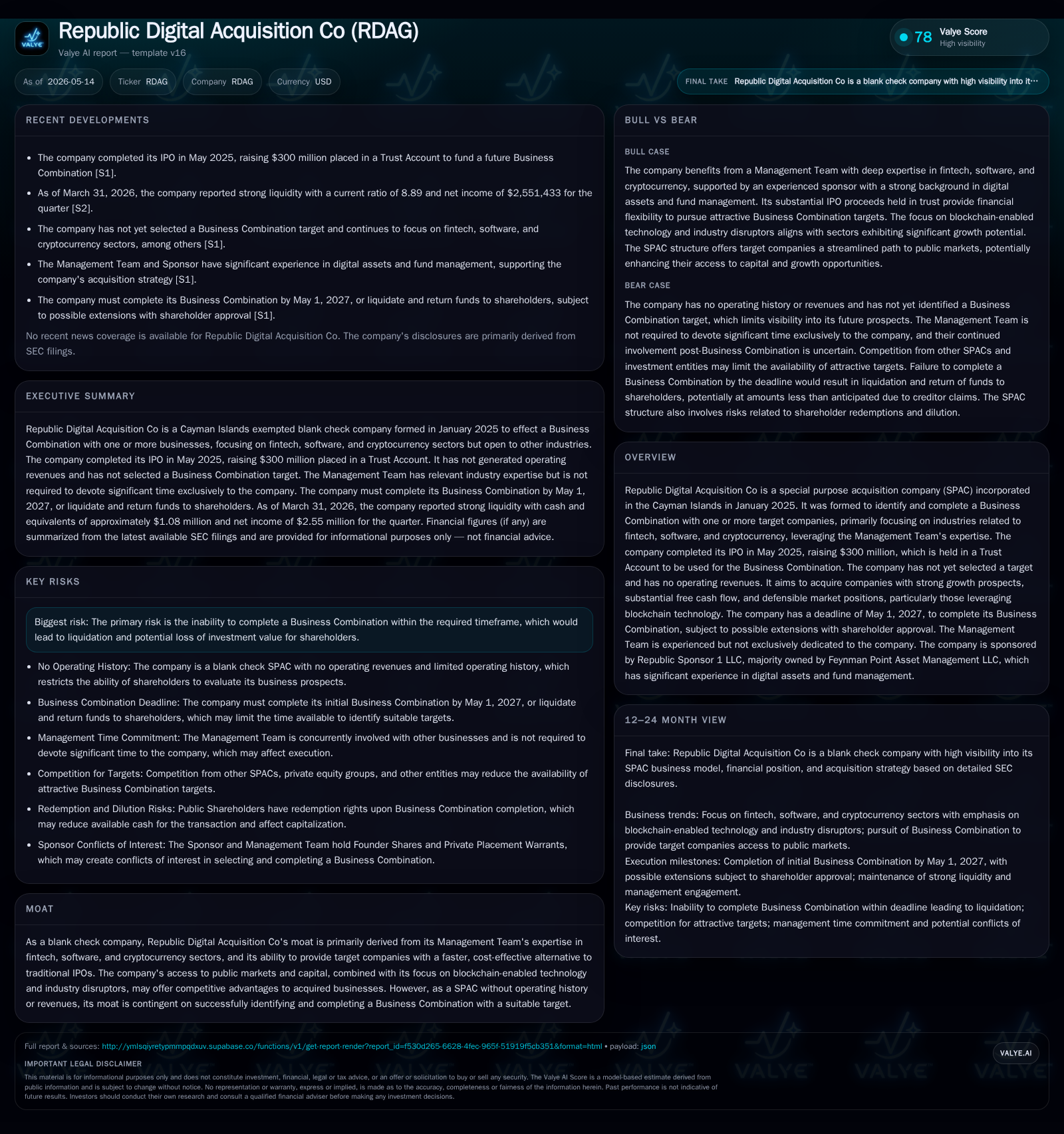
Republic Digital Acquisition Co (RDAG) filed its latest quarterly report on May 13, 2026, revealing no material change in risk factors or operational status since its IPO. The company, a Cayman Islands-based blank check entity, raised $300 million in May 2025 and continues focusing on a fintech, software, and cryptocurrency target leveraging blockchain technology. It has yet to identify a combination partner but benefits from strong cash reserves and a management team with deep digital asset expertise. The principal near-term challenge remains completing a business combination by the May 1, 2027 deadline amid competition and structural SPAC risks.
Recent Operating Update
Republic Digital Acquisition Co (RDAG) filed its latest quarterly report on May 13, 2026 [S2]. The filing reconfirms no material changes to previously disclosed risk factors and reflects that the company has not yet completed an initial business combination nor commenced commercial operations. With approximately $300 million initially placed in a trust account following its successful IPO in May 2025 [S1], RDAG remains well-capitalized but inactive operationally.
Notably, the company’s management has not announced any targeted acquisition candidate by the end of Q1 2026 [S2]. There is no reported revenue or operating income since inception as RDAG functions strictly as a special purpose acquisition company formed to acquire or merge with fintech- or blockchain-related businesses. No additional financing arrangements beyond the IPO proceeds have been disclosed at this time.
Business Model
RDAG exists solely as a vehicle to complete a "Business Combination" per its SPAC structure established under Cayman Islands jurisdiction [S1]. Its business model involves raising capital via IPO units—each comprising one public share and half warrant—and holding these funds in trust pending identification of an attractive target.
Upon consummation of an initial business combination, typically a merger or acquisition with a private operating company aligned with its sector focus (fintech/software/crypto), RDAG will transition from an empty shell into an operating public entity. Until then, it incurs administrative costs funded by underwriting fees and sponsor capital. RDAG's main revenue mechanics pivot on equity issuance or financial structuring during the Business Combination transaction rather than ongoing sales or services.
The strategic strength centers on leveraging the management team's expertise—primarily through Feynman Point Asset Management LLC—to identify targets within emerging digital asset ecosystems benefiting from blockchain innovation [S1][S11]. The management team’s domain knowledge provides sourcing advantages and operational insight post-merger.
Industry Structure and Competitive Position
SPACs targeting fintech and blockchain sectors compete intensely for promising private companies eager for liquidity alternatives to traditional IPOs. RDAG operates within this contested field marked by multiple similar vehicles vying for limited high-quality targets [S22]. Advantages include immediate access to about $300 million on hand plus sponsor commitment enhancing negotiation leverage versus startups seeking capital.
However, SPACs face reputational hurdles: certain market participants view SPAC mergers skeptically due to valuation mismatches or past deal failures. Additionally, competing entities such as established private equity firms also pursue these assets. The ability of RDAG's management to utilize their network and deep sector expertise remains critical to establishing differentiation.
Moreover, regulatory compliance under SEC and Nasdaq rules imposes additional obligations that may restrict deal timing or structuring flexibility. The company must navigate shareholder redemption rights intricately associated with business combinations that can materially impact financing capacity post-announcement [S21][S26].
Growth Drivers
Growth for RDAG inherently depends on identifying and closing a suitable business combination that meets criteria including:
- Exposure to blockchain-enabled technology offering defensible market positioning and potential disruptive advantages [S10].
- Companies exhibiting sustainable free cash flow generation trends with recurring revenue models enhancing valuation credibility.
- Teams with proven product-market fit looking for accelerated capital access via public markets facilitation.
- Potential synergies where RDAG's structure expedites time-to-public relative to traditional IPO paths while lowering costs.
- Cross-selling or expansion opportunities post-merger supported by strategic funding.
These indicators will clarify progress toward executing RDAG’s foundational objective: transitioning from shell to operating public company.
Financial Profile Snapshot
Latest financial snapshot
| Metric | Value | Period |
|---|---|---|
| Current assets | $1,010,646 | |
| 2026-03-31 | ||
| Current liabilities | $113,697 | |
| 2026-03-31 | ||
| Current ratio | 8.89x | |
| 2026-03-31 |
Source: SEC companyfacts cache [F1].
As of March 31, 2026 balance sheet metrics show healthy liquidity: current assets stood at approximately $1.01 million against current liabilities below $0.12 million yielding a current ratio near 8.9x indicating solid working capital coverage [F1]. Cash & equivalents were reported at over $1 million as of September 30, 2025 reflecting retention of IPO proceeds minus fees [F1]. Operating losses of roughly $359k recorded through December 31, 2025 align with pre-operating status typical for SPACs before business combinations [F1]. Net income gain shown largely reflects non-operating items rather than ongoing earnings.[F1]
FY Ending 2025| *Reflects non-operating gains (e.g., deferred fee recognition) [F1]
Conclusion
Republic Digital Acquisition Co stands poised at an interim stage typical for newly formed SPACs—with ample capital secured but date-certain pressure to identify compelling fintech/blockchain-related targets aligned with management experience. The evolving competitive environment underscores the importance of leveraging domain expertise coupled with streamlined execution capability. While financial footing is sound today, uncertainty persists around market receptivity toward SPAC mergers generally as well as RDAG’s ability to translate intent into definitive deal closure ahead of regulatory deadlines.
Investors should monitor announcements related to candidate selection progress closely alongside shifts in redemption interest from public shareholders when negotiating terms with potential merger partners.
This analysis is based exclusively on publicly disclosed information without speculative forecasts or investment recommendations. It aims to provide clarity on Republic Digital Acquisition Co’s structure and strategic outlook alongside industry context essential for informed assessment within the SPAC ecosystem.
Disclaimer: This is research-only, informational analysis and not investment advice. It may include AI-generated interpretation and general industry context. Always verify important details using primary sources.

Comments