
PepGen Faces Regulatory Hurdles and Clinical Hold Challenges as PGN-EDODM1 Progresses
PepGen's latest quarterly filing highlights ongoing clinical development complexities, regulatory scrutiny, and capital adequacy for its pioneering myotonic dystrophy therapy.
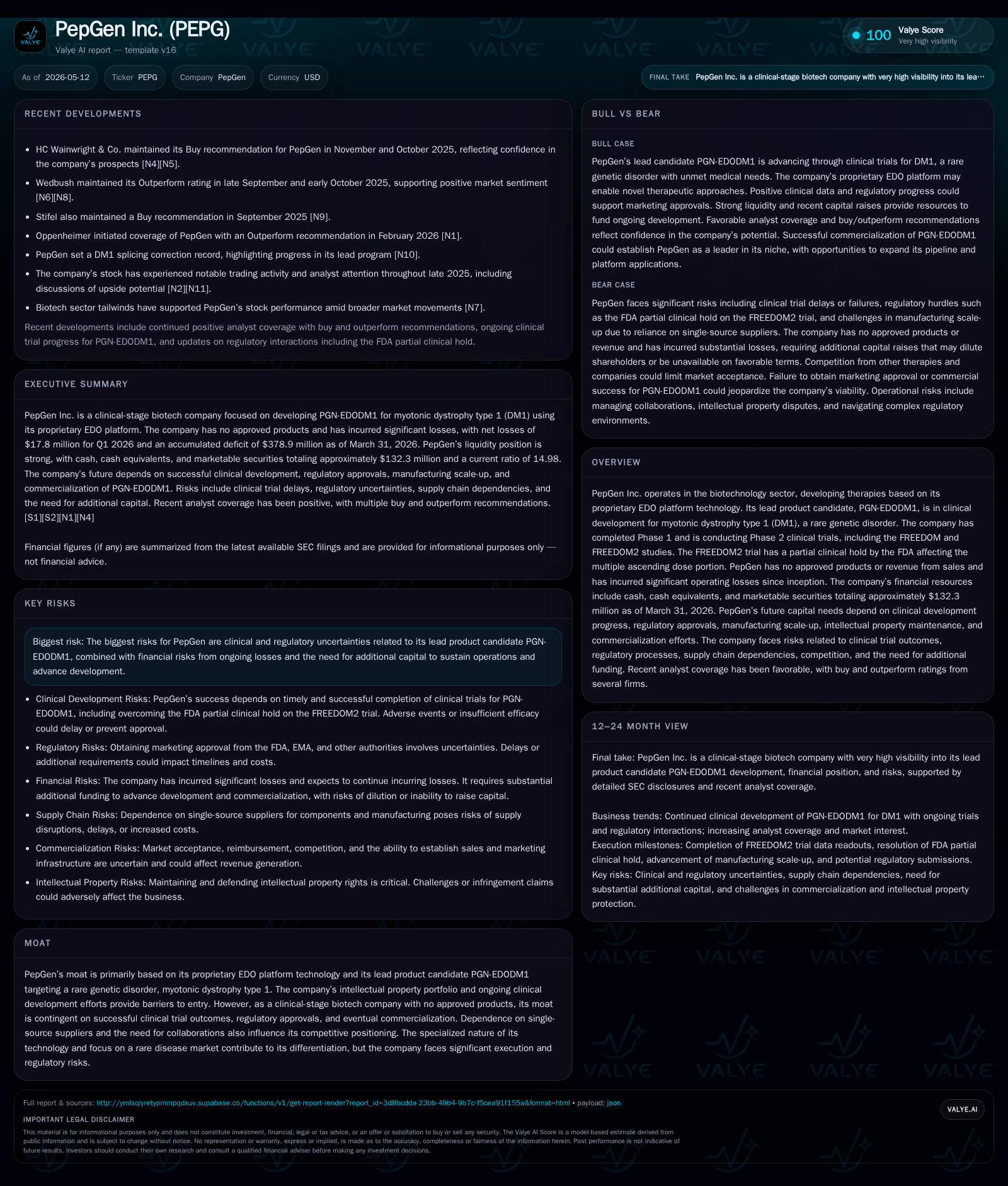
PepGen Inc. remains focused on advancing its lead candidate PGN-EDODM1 for myotonic dystrophy type 1 amidst a partial FDA clinical hold affecting its FREEDOM2 trial's multiple ascending dose segment. The company’s highly specialized EDO platform underpins a differentiated therapeutic approach but is contingent on clinical progress and regulatory clearance. Liquidity remains sufficient for near-term activities though capital needs depend heavily on navigating FDA requirements, trial outcomes, and manufacturing scale-up. Long-run prospects hinge on successful trial resolution and market acceptance within the rare genetic disorder space.
Recent Operating Update: Q1 2026 Filing Insights
PepGen’s latest Form 10-Q filed May 12, 2026, provides the most current operational snapshot anchored around its lead investigational asset PGN-EDODM1 for myotonic dystrophy type 1 (DM1) [S2]. Key developments include the acknowledgment of an FDA-imposed partial clinical hold specifically targeting the multiple ascending dose (MAD) portion of the FREEDOM2 Phase 2 study [S2]. This hold effectively delays U.S. site activations pending further agency dialogue [S2], raising timing uncertainty around patient enrollment and data generation. Despite this setback, global sites outside the U.S. continue enrollment under ongoing clinical plans.
In parallel with the operational update, an accompanying Form 8-K issued contemporaneously reiterated these points while emphasizing maintenance of robust liquidity—supported by approximately $132.3 million in cash, cash equivalents, and marketable securities as of March 31, 2026 [F1] [S3]. This financial cushion aligns with PepGen’s stated capital management strategy focused on funding pivotal-stage trials through at least late-stage development milestones.
Business Model and Product Relevance
PepGen operates as a pure-play biotechnology entity specializing in gene-targeted therapy development via its proprietary Engineered DNA Oligonucleotide (EDO) platform. The core revenue model is future-focused—dependent entirely on R&D progression from preclinical evaluation through to market approval and commercialization of novel nucleic acid therapeutics [S1]. Currently anchored by PGN-EDODM1 addressing DM1, a debilitating rare genetic neuromuscular disorder characterized by expanded CTG repeats causing multisystemic pathology.
The therapeutic rationale behind PGN-EDODM1 harnesses oligonucleotide technology to modulate gene expression related to disease mechanisms unique to DM1 [S1]. Success in demonstrating efficacy with acceptable safety will be essential to unlock commercialization pathways—monetizing via licensing deals, direct product sales post-market approval or strategic collaborations. The absence of any approved products means current operations are exclusively cost centers focused primarily on expensive clinical trials executed in collaboration with contract research organizations (CROs), regulatory consultants, and third-party manufacturers.
Notably, PepGen’s business model must address high fixed costs linked to specialized R&D activities alongside uncertain success rates typical of biotech startups focused on rare disorders. Pricing power upon potential product launch could be substantial due to limited competition in DM1; however, capturing this value hinges on efficacy demonstration across pivotal program endpoints coupled with payer reimbursement negotiations shaped by healthcare cost containment trends [S13].
Industry Structure and Competitive Positioning
Within biotech innovation targeting neuromuscular diseases—especially genetically defined rare conditions like DM1—the competitive landscape includes emerging oligonucleotide developers utilizing antisense oligonucleotides (ASOs), RNA interference (RNAi), and gene editing approaches. PepGen stakes differentiation in its patented EDO platform technology that claims improved target engagement or delivery profiles relative to conventional ASOs [S1].
The rarity of DM1 inherently limits patient populations which structurally constrains large-scale volume but amplifies unmet medical need severity—enhancing premium pricing prospects yet necessitating careful trial design complexity management. Competitors include both larger pharma entities with legacy muscle disease franchises transitioning into gene therapies and other biotech startups advancing alternative modalities targeting similar pathogenic mechanisms.
Barriers to entry stem principally from intangible assets such as intellectual property protections surrounding the EDO chemistry and platform know-how alongside cumulative clinical data accrued in specific patient subsets [S1]. However, the company’s moat remains provisional until regulatory approvals validate its approach clinically and commercially. Collaborations or licensing agreements may be critical strategic levers given single-source supplier dependencies and manufacturing intricacies.
Growth Drivers
Clinical Trial Advancement: The foremost catalyst resides in advancing FREEDOM and FREEDOM2 studies towards robust interim data releases illustrating safety and efficacy benchmarks acceptable to regulatory bodies [S2]. Resolution of the MAD cohort partial clinical hold through constructive FDA engagement could re-enable U.S. participation accelerating enrollment velocity.
Regulatory Pathway Milestones: Securing formal guidance or breakthrough designation from agencies like FDA or EMA would materially de-risk program trajectory while providing commercial uplift via expedited review processes.
Platform Expansion: Leveraging EDO technology into additional neuromuscular or genetic disorders could diversify pipeline breadth—potentially unlocking new indications based on mechanistic overlap or rare disease frameworks.
Collaborative Partnerships: Engaging pharmaceutical partners for co-development/commercialization arrangements can inject needed capital infusion alongside scaling expertise in manufacturing and distribution.
Manufacturing Scale-Up: Establishing reliable third-party contract manufacturing organizations capable of GMP-grade oligonucleotide production at scalable volumes is vital ahead of potential approval to meet forecasted demand.
Risks and Watchpoints
Regulatory Uncertainty and Clinical Hold Implications
The partial clinical hold imposed by FDA introduces acute execution risk delaying trial timelines and escalating costs due to halted MAD dosing segments [S2]. The multifactorial nature includes safety signal review or data adequacy concerns that are not uncommon but intensify risk profile for an early-stage biotechnology entity lacking commercial revenues.
Financial Sustainability Without Product Revenues
While PepGen holds healthy near-term liquidity ($132.3 million as of Q1 end) [F1], sustained development into late-stage pivotal trials typically requires sequential capital raises subject to market receptivity influenced by clinical news flow timing and quality [S10]. Cash burn rates remain elevated given costly outsourced R&D frameworks common across oligonucleotide development programs.
Competitive Dynamics within Rare Disease Therapeutics
Competition from other gene modulation therapies pursuing DM1 or analogous neuromuscular disorders sets high bars for differentiation not just technologically but also economically under tightening healthcare cost scrutiny globally [S13]. Market access hurdles driven by payor negotiations could suppress pricing or adoption despite medical need severity.
Compliance Risks and Operational Complexity
Governmental oversight encompassing anti-kickback statutes, fraud prevention laws across multiple jurisdictions potentially exposes PepGen to penalties requiring careful compliance monitoring especially regarding investigator payments during trials or later commercialization-related physician interactions [S5] [S20].
Manufacturing Dependencies
Heavy reliance on single-source suppliers for proprietary oligonucleotide manufacture creates vulnerability to supply disruptions impacting trial continuity or commercial launch readiness. Pharmaceutical-grade nucleic acid synthesis has limited qualified vendor pool complicating contingency planning.
What To Watch Next
- FDA Engagement Outcomes: Status updates regarding resolution plans or lifting of the partial clinical hold around MAD portions in FREEDOM2; any changes will directly affect enrollment schedules.
- Clinical Data Readouts: Interim safety/tolerability reports expected from active cohorts; positive signals would underpin regulatory discussions for advancement to Phase 3.
- Capital Raises / Partnerships: Strategic financing events aimed at extending runway beyond mid-2027 anticipated; partnership deal announcements could alter funding mix dynamics.
- Manufacturing Milestones: Progress towards GMP validation batches required as manufacturing readiness escalates closer toward commercial launch prerequisites.
- Regulatory Designations: Potential communications on orphan drug status extensions or accelerated approval pathways relevant for PGN-EDODM1 examined closely by investors.
Financial Profile - Current Snapshot Support
Latest financial snapshot
| Metric | Value | Period |
|---|---|---|
| Cash & equivalents | $42mm | |
| 2026-03-31 | ||
| Current assets | $134mm | |
| 2026-03-31 | ||
| Current liabilities | $9mm | |
| 2026-03-31 | ||
| Current ratio | 14.98x | |
| 2026-03-31 |
Source: SEC companyfacts cache [F1].
| Metric | Value (USD) | Period End |
|---|---|---|
| Cash & Equivalents | $42.15 million | |
| 2026-03-31 | ||
| Current Assets | $134.27 million | |
| 2026-03-31 | ||
| Current Liabilities | $8.96 million | |
| 2026-03-31 | ||
| Current Ratio | 14.98 | |
| 2026-03-31 |
PepGen's balance sheet demonstrates ample liquidity coverage with a current ratio close to 15x indicative of solid short-term financial health supporting ongoing operations without immediate solvency concerns [F1] [S2]. Nonetheless, absence of revenue generation necessitates external capital inflows aligned with pre-market biotech models emphasizing milestone-driven financing rounds.
Disclaimer: This analysis serves informational purposes reflecting public filings per SEC regulations as of May 12, 2026. It does not constitute investment advice or recommendations toward purchase or sale of securities. Readers should consider forward-looking uncertainty inherent in early-stage biopharmaceutical development when forming their own conclusions.
Disclaimer: This is research-only, informational analysis and not investment advice. It may include AI-generated interpretation and general industry context. Always verify important details using primary sources.

Comments