
Lucid Diagnostics Advances Early Esophageal Cancer Detection with EsoGuard Expansion
Lucid’s latest quarter showcases early revenue growth alongside strengthened liquidity from a recent convertible notes issuance, underscoring progress in commercializing its proprietary EsoGuard diagnostic platform.
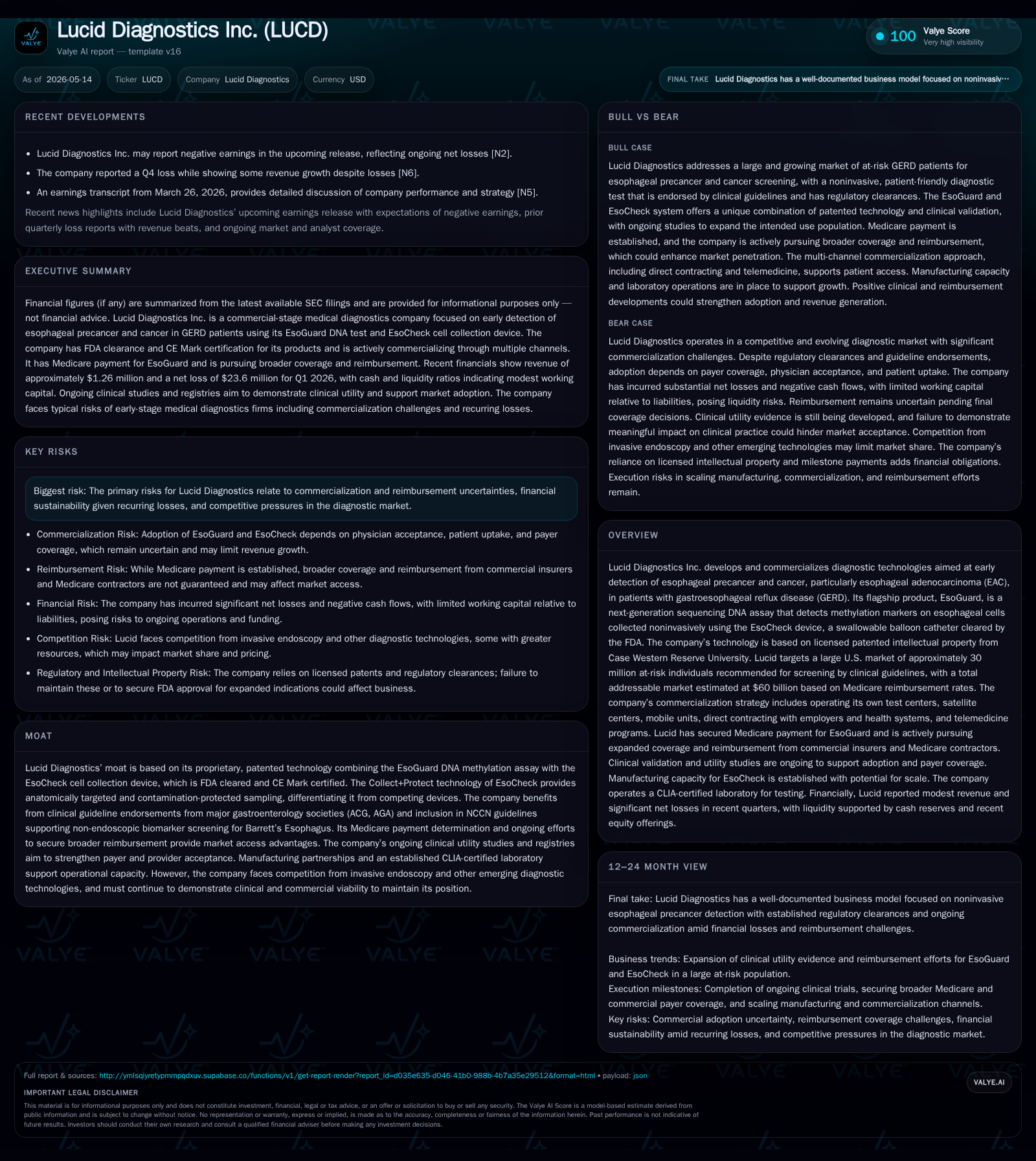
Lucid Diagnostics reported $1.3 million revenue in Q1 2026, reflecting nascent market traction of its patented EsoGuard assay paired with the FDA-cleared EsoCheck device for noninvasive early detection of esophageal adenocarcinoma among GERD patients. The November 2024 private placement of $21.975 million senior secured convertible notes underpins liquidity as the company intensifies commercialization and reimbursement efforts, critical for scaling adoption in a sizable at-risk U.S. population. While competitive technology advancements and reimbursement uncertainties persist, Lucid’s unique Collect+Protect sampling method and clinical guideline endorsements provide a defensible position in an emerging molecular diagnostics niche.
Quarterly Update: Progress and Financial Position
Lucid Diagnostics’ most recent quarterly report (Q1 2026) reveals key developments that anchor its current operational momentum. The company generated $1.3 million in revenue during the period [S2], marking incremental traction in commercializing its flagship diagnostic platform for early esophageal cancer detection. This positive revenue figure underscores initial market acceptance primarily within Medicare-covered populations and select payers.
Liquidity remains bolstered by the successful November 2024 private placement of $21.975 million senior secured convertible notes bearing a 12% interest rate and maturing five years from issuance [S2]. The issuance enhances cash resources underpinning ongoing commercialization investment while imposing customary covenants that limit certain financial and operational actions until maturity.
The company incurred a net loss of approximately $23.6 million during Q1 2026 and experienced negative cash flow from operations of around $12.1 million for the quarter [S2], indicative of capital-intensive commercialization phases typical for early-stage medical diagnostics firms.
Business Model: Proprietary Diagnostic Technology for Early Esophageal Cancer Detection
Lucid’s primary offering integrates two proprietary components: the EsoGuard Esophageal DNA Test and the EsoCheck Esophageal Cell Collection Device [S1]. EsoGuard is a bisulfite-converted targeted next-generation sequencing (NGS) assay that quantifies DNA methylation at 31 loci on two genes—VIM (Vimentin) and CCNA1 (Cyclin A1)—from surface esophageal cells collected with EsoCheck’s patented device.
The EsoCheck device employs an FDA 510(k) cleared swallowable balloon catheter designed for office-based sampling completed within approximately two minutes. Its Collect+Protect™ technology involves inflating a soft silicone balloon with textured ridges to swab surface esophageal cells precisely while protecting the specimen inside the capsule from contamination or dilution during withdrawal. This approach offers significant advantages over endoscopic biopsy and other less targeted noninvasive methods by enhancing anatomical precision and sample integrity.
Clinical validation includes two case-control studies plus two prospective cohort "screening" studies demonstrating approximately 97% analytical sensitivity and specificity near 95%, with a positive predictive value between 30-33% and a negative predictive value close to 99% for detecting Barrett’s Esophagus (BE) and early-stage esophageal adenocarcinoma (EAC) in GERD patients—providing strong evidence of diagnostic accuracy while facilitating patient-friendly test administration [S1].
Revenue mechanics primarily revolve around sales of the EsoCheck device to physician practices coupled with laboratory fees for performing the EsoGuard assay at Lucid’s CLIA-certified labs. Pricing is influenced by Medicare reimbursement rates—which set benchmarks—and contracted payments from private payers or direct consumer programs targeted at self-insured employers or concierge medicine providers.
Competitive Advantages and Industry Dynamics
Lucid’s competitive moat derives largely from its combined patented collection device plus DNA methylation assay platform anchored by licensed technology from Case Western Reserve University (CWRU). The FDA approval pathway secured through a Class II 510(k) clearance for EsoCheck's unique sampling mechanism differentiates it markedly from traditional endoscopic or saliva-based tests that lack anatomical targeting capability.
Simultaneously holding CE Mark certification enables potential expansion into European markets pending commercialization strategy execution.
Clinical guideline endorsements from reputable gastroenterology societies—the American College of Gastroenterology (ACG), American Gastroenterological Association (AGA), and inclusion in National Comprehensive Cancer Network (NCCN) guidelines—support nonendoscopic biomarker screening methods like Lucid's for Barrett's Esophagus detection among GERD patients. Such endorsements enhance physician adoption willingness and payor receptivity.
A favorable Medicare payment determination further establishes market access advantage within the public insurance sector; however, broader private payer coverage is still evolving and represents a pivotal step to expand volume-driven economics.
Manufacturing partnerships with Coastline International enable scalable production of EsoCheck devices—current capacity stands at roughly 25,000 units annually but holds room for exponential scaling as demand rises [S1]. Downstream testing operations leverage internal CLIA-certified labs providing quality control over assay processing timelines but may face capacity challenges as volumes grow.
Notably, Lucid operates within an increasingly crowded molecular diagnostics landscape where competing biotech entrants develop alternative biomarker platforms targeting esophageal cancer precursors. However, Lucid's combination of regulatory clearance, anatomical specificity via Collect+Protect technology, robust clinical validation data, and early reimbursement achievements collectively confer high switching costs for providers once integrated into practice workflows.
Growth Opportunities: Market Penetration and Reimbursement Developments
Approximately 30 million individuals in the U.S. suffer from chronic gastroesophageal reflux disease (GERD), composing Lucid's primary at-risk patient pool eligible under clinical guidelines for screening Barrett’s Esophagus—a known precursor to EAC—with an overall total addressable market often estimated near $60 billion using applicable Medicare fee schedules as valuation proxies.
Growth hinges crucially on expanding market penetration through multi-pronged initiatives:
- Securing broader third-party reimbursement including commercial insurers beyond the existing Medicare coverage band; this remains a critical enabler affecting test affordability and physician ordering behavior [S2].
- Enhancing physician awareness via direct sales efforts targeting gastroenterologists and primary care networks capable of referring GERD patients for screening.
- Leveraging clinical utility study data expected later this year to substantiate clinical benefit assertions influencing both payer policies and professional society recommendations.
- Scaling manufacturing throughput through Coastline International while potentially diversifying manufacturing base to mitigate supply chain risk and shorten delivery lead times.
- Expanding testing lab network footprint or augmenting internal CLIA capacity to reduce turnaround time sustainably as volume scales.
- Extending commercial contracts into self-insured employer groups or concierge care providers willing to offer cash-pay or bundled service models enhancing test accessibility amidst evolving reimbursement landscapes.
Risks and Challenges Impacting Commercialization
Lucid discloses several principal risk vectors manifested in its filings:
- Reimbursement Uncertainty: While Medicare covers EsoGuard testing currently, broadening coverage among commercial payers is neither guaranteed nor easily accelerated without compelling cost-effectiveness data or changes in payer policies—a systemic hurdle across innovative diagnostics.
- Financial Sustainability: Recurring operating losses driven by aggressive R&D investments and sales & marketing spending necessitate frequent capital raises, diluting existing shareholders; notably substantial doubt regarding ability to continue as going concern was flagged given liquidity constraints despite recent financing activity [S2,S13].
- Competitive Pressures: Emergent molecular diagnostic companies target similar market segments possibly deploying newer biomarker panels or cheaper alternatives which could erode market share or necessitate accelerated R&D investment cycles maintaining competitive edge.
- Manufacturing/Capacity Constraints: Current device production lines offer limited scale; disruption risks exist if manufacturing partners experience delays or logistic interruptions affecting supply continuity; similarly lab testing bottlenecks could degrade service levels impacting physician confidence.
- Regulatory/License Dependencies: The company relies heavily on license agreements with CWRU for core patented technology; termination or litigation could materially impair product offerings [S13].
Near-Term Catalysts and Performance Indicators
Investors should closely monitor several upcoming milestones:
- Evolution of payer coverage policies beyond Medicare including major commercial insurers signaling expanded acceptance would drive volumes materially.
- Quarterly revenue growth trajectory against targets provides a barometer of commercial execution success.
- Clinical utility study results anticipated later in 2026 that may validate effectiveness claims necessary to boost clinician uptake and influence guideline updates.
- Planned manufacturing capacity expansion announcements by Coastline International or new production arrangements to meet rising demand without supply interruptions.
- Development pipeline updates including enhancements or variants of the EsoGuard assay that might capture broader patient populations or improve diagnostic yield.
- Updates on any material amendments to debt covenants or equity raises affecting financial flexibility.
Latest Financial Overview
Latest financial snapshot
| Metric | Value | Period |
|---|---|---|
| Current assets | $31mm | |
| 2026-03-31 | ||
| Current liabilities | $29mm | |
| 2026-03-31 | ||
| Current ratio | 1.07x | |
| 2026-03-31 |
Source: SEC companyfacts cache [F1].
As of March 31, 2026, Lucid held approximately $27.9 million in cash with working capital around $2 million inclusive of current liabilities related to the convertible notes classified as current obligations totaling approximately $25.2 million [S2,F1]. Total debt principally comprises these senior secured convertible notes issued in November 2024 bearing a fixed interest rate of 12%, maturing five years post issuance with conversion price mechanisms linked to common stock price adjustments [S2]. The balance sheet reflects tight liquidity commensurate with ongoing net losses nearing $23.6 million in Q1 alone alongside operating cash burn exceeding $12 million quarterly—highlighting critical dependence upon successful revenue ramp-up coupled with prudent capital management to sustain solvency beyond one year horizon [S2,S13].
Disclaimer: This analysis is based solely on publicly available SEC filings through Q1 2026 plus validated industry data; it does not constitute investment advice or recommendations but aims to provide an informed perspective on Lucid Diagnostics’ business fundamentals and sector context.
Disclaimer: This is research-only, informational analysis and not investment advice. It may include AI-generated interpretation and general industry context. Always verify important details using primary sources.

Comments