
CXApp Advances AI-Driven Workplace Platform Amid Persistent Losses and Market Competition
Latest quarterly filing reveals steady product innovation and operational focus while net losses persist in a competitive employee experience SaaS market.
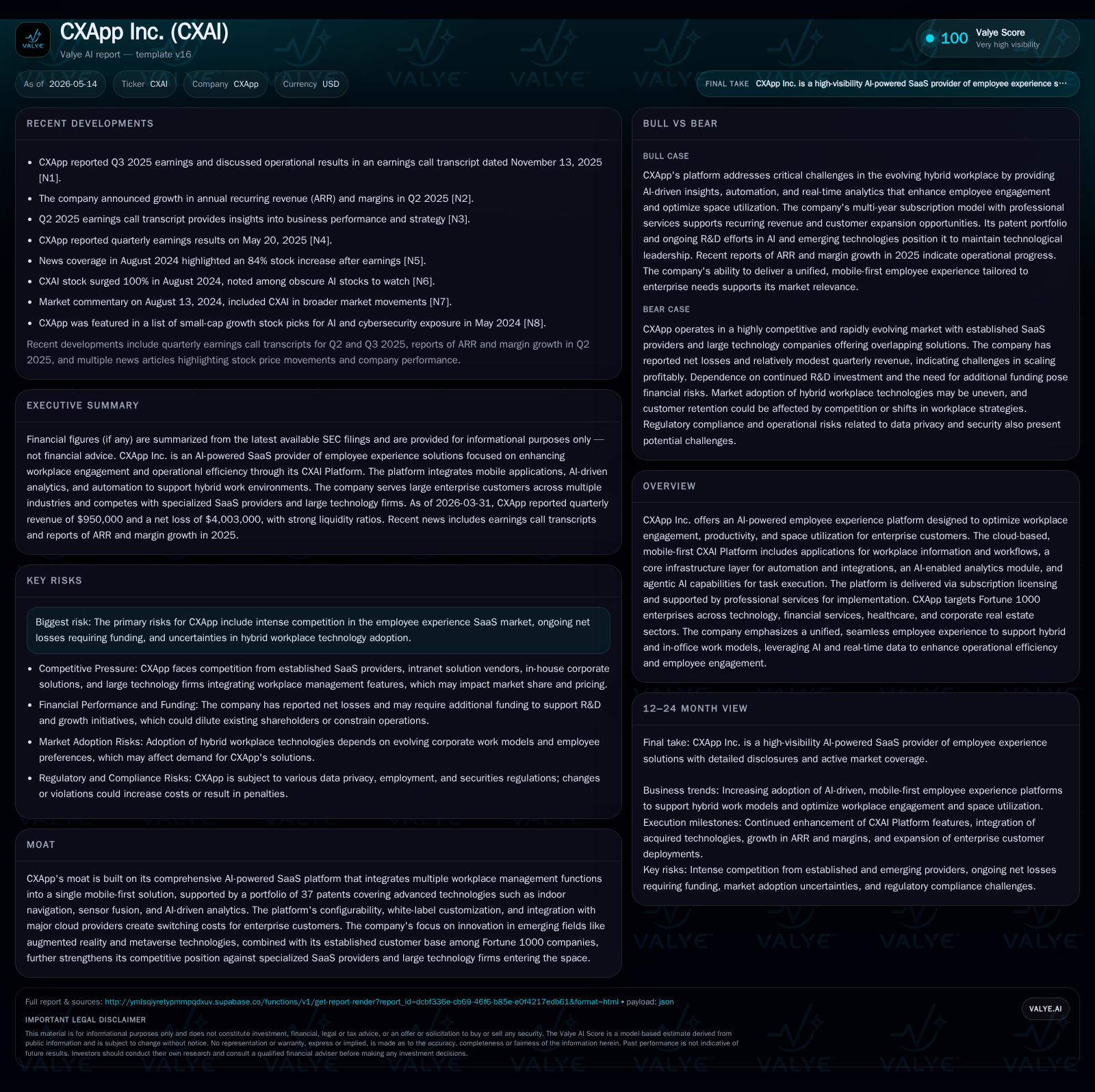
CXApp Inc. reported in its Q1 2026 filing continued progress in delivering its AI-powered employee experience platform aimed at hybrid workplaces. The company’s cloud-based CXAI platform integrates workplace apps, automation, analytics, and agentic AI capabilities to address productivity and space utilization challenges. Despite a clear value proposition and advancing technology footprint supported by a strong patent portfolio, CXApp remains unprofitable with ongoing net losses requiring careful cash management. Growth hinges on broader adoption in large enterprises navigating hybrid work complexities amid stiff competition from both specialized SaaS vendors and broader tech incumbents. Key risks include the company’s path to profitability, talent retention, and evolving customer demand. Monitoring subscription growth, implementation milestones, technology integration success, and capital adequacy will be critical signals going forward.
Recent Operating Update
CXApp Inc.'s latest quarterly report filed May 13, 2026 ([S2]) reiterates the company's commitment to advancing its AI-driven employee experience platform without material changes to its risk factors established in the March annual report ([S1], [S15]). This stability in disclosed risk suggests continuing operational challenges rather than new emergent ones. A contemporaneous event filing reporting first-quarter results ([S3], [S4], [S5]) confirms ongoing revenue generation alongside sustained net losses.
As of Q1 2026 end-of-March ([F1]), CXApp held approximately $12.3 million in cash and equivalents, balanced against current liabilities around $6.2 million resulting in a healthy current ratio of roughly 2.28—indicative of reasonable short-term liquidity. Total debt is minimal at roughly $0.6 million as of late 2024 ([F1]), reflecting low leverage but underscoring reliance on equity or other forms of financing for growth capital.
Financially however, operating losses remain significant with operating income negative at about -$17.6 million as of December 2025 year-end ([F1]), paralleled by a net loss of approximately -$13.5 million. This pattern highlights an ongoing investment phase typical for emerging SaaS companies targeting enterprise digital transformation.
Business Model
CXApp operates primarily on a subscription-based Software-as-a-Service (SaaS) model focused on delivering an integrated employee experience platform called CXAI (pronounced “Sky”). This cloud-native solution is tailored for enterprise customers seeking to optimize workforce productivity and manage the complexities introduced by hybrid working models.
Revenue arises mainly through recurring licenses that enable access to four intertwined platform components:
- CXAI Applications: Mobile and web interfaces providing employees seamless access to workplace communications, scheduling, spatial navigation, health compliance workflows across iOS/Android/kiosk/web environments.
- CXAI BTS (Behind the Scenes): Core infrastructure supporting content management, workflow automation via a configurable rules engine facilitating policy enforcement and administrative controls.
- CXAI-VU: A robust analytics layer embedding AI – including natural language querying – offering actionable insights on workspace usage patterns and engagement metrics.
- Agentic AI Modules: Advanced AI enabling task orchestration and self-service interaction automations reducing manual overhead.
These components combine to address key pain points such as “ghost bookings,” inefficient desk reservations in fluctuating occupancy scenarios common in hybrid-office contexts ([S1]). The platform's cloud delivery over major providers (AWS, GCP, Azure) ensures scalability while professional services complement implementation needs thus extending customer engagement beyond initial sale.
Strategically, CXApp leverages intellectual property protection with a portfolio of 37 patents spanning sensor fusion technologies integral to precise indoor location tracking—an essential capability for enhancing spatial analytics—and proprietary AI methodologies that embed unique competitive advantages difficult for rivals to replicate easily (). Together such differentiation aids customer retention through ecosystem lock-in via integration breadth and customizability.
Industry Structure and Competitive Position
The digital employee experience segment lies at the intersection of enterprise SaaS focused on workforce productivity tools and intelligent workplace management solutions—both fast-evolving domains driven by hybrid work adoption accelerants post-pandemic.
CXApp occupies a niche distinctly characterized by combining AI-powered spatial intelligence with employee-centric applications supported by robust automation layers. Its customer base mainly consists of Fortune 1000 corporations operating across technology services, financial institutions requiring stringent compliance mechanisms, healthcare entities adjusting workforce logistics dynamically, and corporate real estate operators managing costly physical assets efficiently.
Competitive threats come from several fronts:
- Pure-play SaaS startups specializing solely in workforce engagement or space management lacking multi-modal integration.
- Large cloud ecosystem players embedding workplace solutions into broader enterprise suites potentially commoditizing standalone offerings.
- Established workplace analytics vendors whose core strengths may lie more narrowly but who can rapidly innovate or partner horizontally.
CXApp addresses these risks via patent-protected innovations like augmented reality-enhanced navigation features enabling meta-layer overlays within premises—a frontier few direct competitors currently match—and through white-label customization options creating bespoke deployments aligned tightly with client environments ().
Growth Drivers
Adoption trends around hybrid working models remain structural drivers underpinning demand for CXApp's offerings. Corporations seek tools providing granular visibility into space utilization mitigating wasted real estate costs while supporting distributed teams’ need for coordination platforms integrated seamlessly into daily workflows.
Specific growth catalysts include:
- Hybrid Workspace Complexity: Increasing demand for intelligent desk booking systems combined with real-time occupancy sensing addressing inefficiencies caused by traditional static assignments.
- AI Enabled Insights Expansion: Deeper analytics derived from sensor data feeding strategic decision-making around facility planning boosted by natural language querying features expanding self-service usability beyond IT specialists.
- Augmented Reality & Metaverse Integration: Emerging initiatives utilizing AR overlays within workplaces enhance wayfinding and engagement potentials offering novel differentiators attractive to innovation-minded customers.
- Enterprise Sales Expansion: Scaling footprint within existing accounts complemented by penetration into adjacent verticals expanding TAM beyond initial sectors like tech or finance into healthcare or real estate owned properties where space efficiency yields substantial savings.
- Professional Services Upsell: Implementation complexity creates recurring revenue streams from configuration/custom support increasing average contract values over time.[S1]
Risks and Watchpoints
Material risks center on execution viability amid market dynamics noted in the latest filings ([S1], [S2]). Key concerns include:
- Profitability Path Ambiguity: Continuing net losses highlight challenges balancing growth investments against eventual margin expansion; cash sufficiency beyond near term warrants monitoring despite current liquidity buffers.[F1]
- Talent Acquisition & Retention: Specialized AI/software engineers critical for R&D efforts face intense external competition; turnover could slow innovation cadence or inflate labor costs.[S1]
- Competitive Disruption: Rapid advances from hyperscalers or niche startups may erode CXApp's market share absent continual reinvestment in IP and product evolution.
- Customer Adoption Rates: Hybrid work trends show variability; shifts back toward office concentration could dampen immediate demand for digital experience upgrades adversely affecting renewal rates.[S1]
- Intellectual Property Enforcement: Maintaining defensibility around patented technology requires vigilance; infringement legal actions could impose unexpected expenses or distract management focus.[S1]
What to Watch Next
Monitoring CXApp’s operational trajectory involves tracking specific indicators:
- Quarterly progression in subscription license count evidencing successful account expansion or retention stability post-delivery implementations.
- Enhancement rollouts particularly expanding AI-driven analytics depth or agentic workflows broadening automated use cases measurable through product release notes or client reference cases.
- Professional services revenue trends as proxy measures indicating upsell effectiveness and embeddedness within customer operations.
- Cash burn rates relative to evolving expense structure informing runway duration particularly given limited leverage illustrated with low debt figures.[F1]
- Any disclosures or announcements related to partnerships leveraging augmented reality/metaverse platforms potentially catalyzing new growth avenues beyond traditional workplace management.
Financial Profile Summary
Latest financial snapshot
This snapshot aligns with an early-stage SaaS growth profile: meaningful investment in R&D and sales leading to negative operating margins but preserved liquidity adequate for near-term operations. The modest debt level underscores reliance on equity financing or capital raises should additional funding be necessary.[F1]
Disclaimer: This analysis is based exclusively on publicly available regulatory filings as of May 2026 without speculative projections. It aims to illuminate key business model elements alongside industry context without constituting investment advice.
Disclaimer: This is research-only, informational analysis and not investment advice. It may include AI-generated interpretation and general industry context. Always verify important details using primary sources.

Comments