
StubHub’s Next Act: Expanding the Ticketing Marketplace with Direct Issuance Growth
StubHub’s latest quarterly results highlight a strategic pivot towards original ticket issuance, aiming to deepen marketplace liquidity and competitive moat amid regulatory and market challenges.
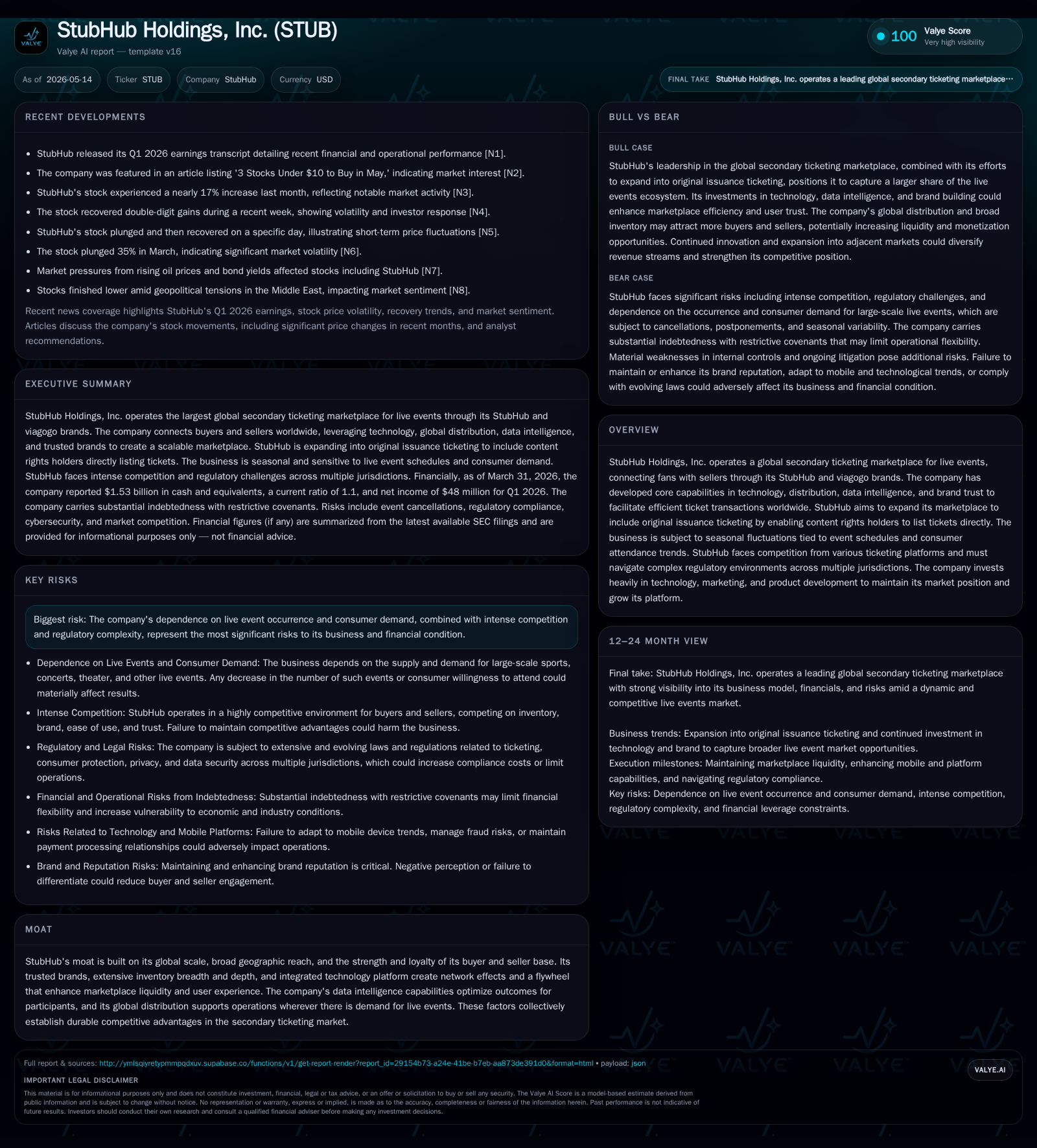
In Q1 2026, StubHub Holdings demonstrated stable engagement in its secondary ticket marketplace while advancing initiatives to incorporate direct issuance, enabling rights holders to list tickets on the platform. The company leverages its robust technology infrastructure, global distribution, and trusted brands to maintain leadership in a competitive market shaped by evolving regulation and seasonal demand fluctuations. Key risks include regulatory scrutiny, litigation exposures, and dependence on live event schedules. Monitoring adoption rates of direct issuance listings, regulatory outcomes, and execution of technology enhancements will be critical milestones.
Latest Quarterly Operating Performance: Trends and Implications
In its May 2026 filing for Q1 ended March 31, StubHub Holdings revealed an operational backdrop marked by sustained consumer engagement within its secondary ticketing marketplace [S2][S3]. While detailed revenue figures are not reiterated here explicitly, management commentary underscores steady activity from both buyers and sellers through its StubHub and viagogo brands. Notably, this quarter signals a critical inflection point where strategic resources increasingly align toward pioneering original ticket issuance capabilities—enabling content rights holders such as teams and promoters to list tickets directly on the platform [S2].
This initiative seeks to leverage StubHub's existing technology infrastructure and extensive user base to blend primary and secondary market liquidity seamlessly. Despite the seasonality inherent in live event scheduling affecting volume fluctuations quarter-to-quarter, the company’s focus on broadening inventory sources reflects an attempt to reduce cyclicality impact over time [N1]. Such efforts may also improve gross margins structurally by reducing reliance on third-party resellers.
Business Model and Core Capabilities: How StubHub Creates Value
StubHub operates a global online marketplace connecting ticket sellers with buyers for live events—including sports, concerts, theater, and other experiences—through its two main brands: StubHub (dominant in North America) and viagogo (focused internationally) [S1]. Revenue is primarily generated via transaction fees charged on ticket sales executed across these platforms.
The company’s value proposition rests heavily on four core capabilities:
- Technology: An end-to-end digital platform optimized for inventory breadth across event types worldwide.
- Distribution: Global reach supported by localized offerings in numerous geographic markets where live events attract consumers.
- Data Intelligence: Proprietary analytics help optimize pricing strategies for sellers while improving buyer experience through personalized recommendations.
- Brand Trust: Established recognition that assures safety, transparency, and customer service reliability—key determinants in buyer/seller retention.
By orchestrating these elements effectively, StubHub creates network effects that enhance marketplace liquidity—the more tickets listed attract more buyers, which encourages further listings in a virtuous cycle. The company is now targeting expansion into original issuance ticketing whereby rights holders can directly list primary tickets, broadening revenue sources beyond secondary resales [S1]. This strategic extension aims to capture a larger share of the overall live event ticket market.
Competitive Environment and Industry Dynamics
StubHub faces competition from multiple fronts: traditional secondary marketplaces (like SeatGeek), primary ticket issuers moving toward direct digital sales (Ticketmaster’s platform), emerging niche platforms focused on specific event types or regions, as well as offline box office channels [S1]. Competition also manifests through price sensitivity among buyers who wield tools to compare offers across channels.
Competitive differentiation stems largely from scale-related liquidity advantages—broad inventory attracts diverse buyers—and brand reputation built over years as a trusted platform [S1]. Switching costs for sellers are moderate as multi-listing across platforms is common; however, buyers favor marketplaces promising secure transactions backed by guarantees.
Regulatory pressures add complexity to the operating environment. Laws mandating "all-in pricing" — explicitly disclosing total prices inclusive of fees — require system modifications and have resulted in ongoing inquiries, including litigation relating to compliance with state statutes such as New York's all-in-pricing law [S15][S16]. Further scrutiny arises from evolving consumer protection regulations affecting refund policies introduced during pandemic disruptions.
Seasonality induced by live event calendars creates predictable revenue volatility; major sports seasons or concert tours drive peak volumes. However, diversification into multiple event types globally slightly mitigates such cyclicality [S1].
Growth Drivers: Expanding Marketplace Reach Through Innovation
The most salient growth initiative concerns expanding StubHub’s marketplace beyond secondary sales into original issuance ticketing [S1][S2][N1]. This entails onboarding content rights holders—such as sports franchises or concert promoters—to list tickets directly on the platform at scale. Success here could materially increase marketplace liquidity by enlarging inventory sources while strengthening relationships with rights holders.
Additional growth vectors include:
- Geographic expansion into emerging markets where digital penetration of live event ticket sales is nascent but growing rapidly.
- Broadening event categories beyond traditional sports/concerts into theater, esports, festivals, and experiential events.
- Continued investments in AI-driven data analytics enabling dynamic pricing algorithms that maximize seller revenues while maintaining market competitiveness.
- Marketing campaigns leveraging brand equity aimed at stimulating buyer traffic amid competitive incursions.
The recent quarter's disclosures indicate ongoing incremental adoption of direct issuance listings and pilot programs enhancing user interface functionality to support these new workflows [N1][S2]. These developments signal measured but deliberate progress toward capturing higher-margin primary transaction revenues.
Risks and Constraints: Regulatory Challenges and Demand Fluctuations
StubHub's dependency on the occurrence of live events exposes it to exogenous shocks such as cancellations due to public health crises or geopolitical disruptions. Consumer willingness to attend events directly influences transaction volume.
Regulatory risks remain foremost among downside considerations. Current litigation revolves around compliance with all-in-pricing legislation in multiple states including New York and Pennsylvania; unresolved complaints could lead to fines or forced alterations in business practices [S15][S16]. Increased enforcement scrutiny over refund policy transparency—especially lessons learned from COVID-era cancellations—may elevate compliance costs.
Intense competition might pressure fee structures or erode platform share if rivals successfully woo key buyers or sellers with superior incentives or technology features [S1]. Dependence on third-party search engines for web traffic poses a risk should algorithm changes reduce visibility or increase acquisition costs. Furthermore, technological reliability — including cybersecurity — remains critical given high-volume transaction processing demands; incidents here could affect brand trust critically.
Key Upcoming Milestones and Indicators to Monitor
Investors should focus on several near-term indicators:
- Volume metrics delineating how many tickets arise from direct issuance versus secondary resales offer insight into strategic traction beyond legacy marketplace segments.
- Updates on legal proceedings related to all-in-pricing compliance will clarify regulatory risk trajectory.
- Quarterly guidance adjustments reflecting shifts in live event schedules globally signal demand dynamics ahead.
- Rollout of advanced AI-driven pricing tools or security hardening upgrades demonstrates technological evolution supporting competitive positioning.
- Adoption rates across geographies or newly introduced event categories provide tangible signals of expansion efficacy [N1][S2][S3].
Monitoring these will inform whether StubHub successfully leverages its core moats while managing regulatory headwinds effectively.
Current Financial Position: Liquidity, Leverage, and Capital Structure
Latest financial snapshot
| Metric | Value | Period |
|---|---|---|
| Cash & equivalents | $1526mm | |
| 2026-03-31 | ||
| Total debt | $1523mm | |
| 2026-03-31 | ||
| Net debt | $-3mm | |
| 2026-03-31 | ||
| Current assets | $1623mm | |
| 2026-03-31 | ||
| Current liabilities | $1472mm | |
| 2026-03-31 | ||
| Current ratio | 1.1x | |
| 2026-03-31 |
Source: SEC companyfacts cache [F1].
As of March 31, 2026, StubHub held approximately $1.526 billion in cash and cash equivalents against total debt near $1.523 billion resulting in near-neutral net debt positioning ($-3.27 million) [F1]. Current assets stood at roughly $1.623 billion versus current liabilities of about $1.472 billion yielding a current ratio near 1.10x—indicating adequate short-term liquidity coverage [F1].
While historical operating income has been negative reflecting continued investment spend (operating loss recorded at -$1.344 billion as of end 2025), the strong liquidity profile supports ongoing capital allocation toward growth initiatives including technology platform enhancements and marketing programs without immediate refinancing pressure [F1]. This financial structure aligns with industry practice where scale leaders balance near-term profitability compression with network effect reinforcement through investment [S2][F1].
This analysis synthesizes public disclosures through May 14, 2026 including quarterly filings [S2], recent earnings releases [S3], annual SEC reports [S1], related legal/regulatory summaries, complemented by financial snapshot data [F1] and earnings call commentary [N1] without extrapolation beyond stated information.
Disclaimer: This report is prepared solely for informational purposes based on publicly available data at the indicated dates. It does not constitute investment advice or recommendation nor does it imply any forecast regarding future performance.
Disclaimer: This is research-only, informational analysis and not investment advice. It may include AI-generated interpretation and general industry context. Always verify important details using primary sources.

Comments