
PLAYSTUDIOS Refines Strategy Amid Q1 Financial Pressures
The latest quarter reveals PLAYSTUDIOS' intensifying cost realignment amid revenue headwinds in its loyalty-driven social gaming model.
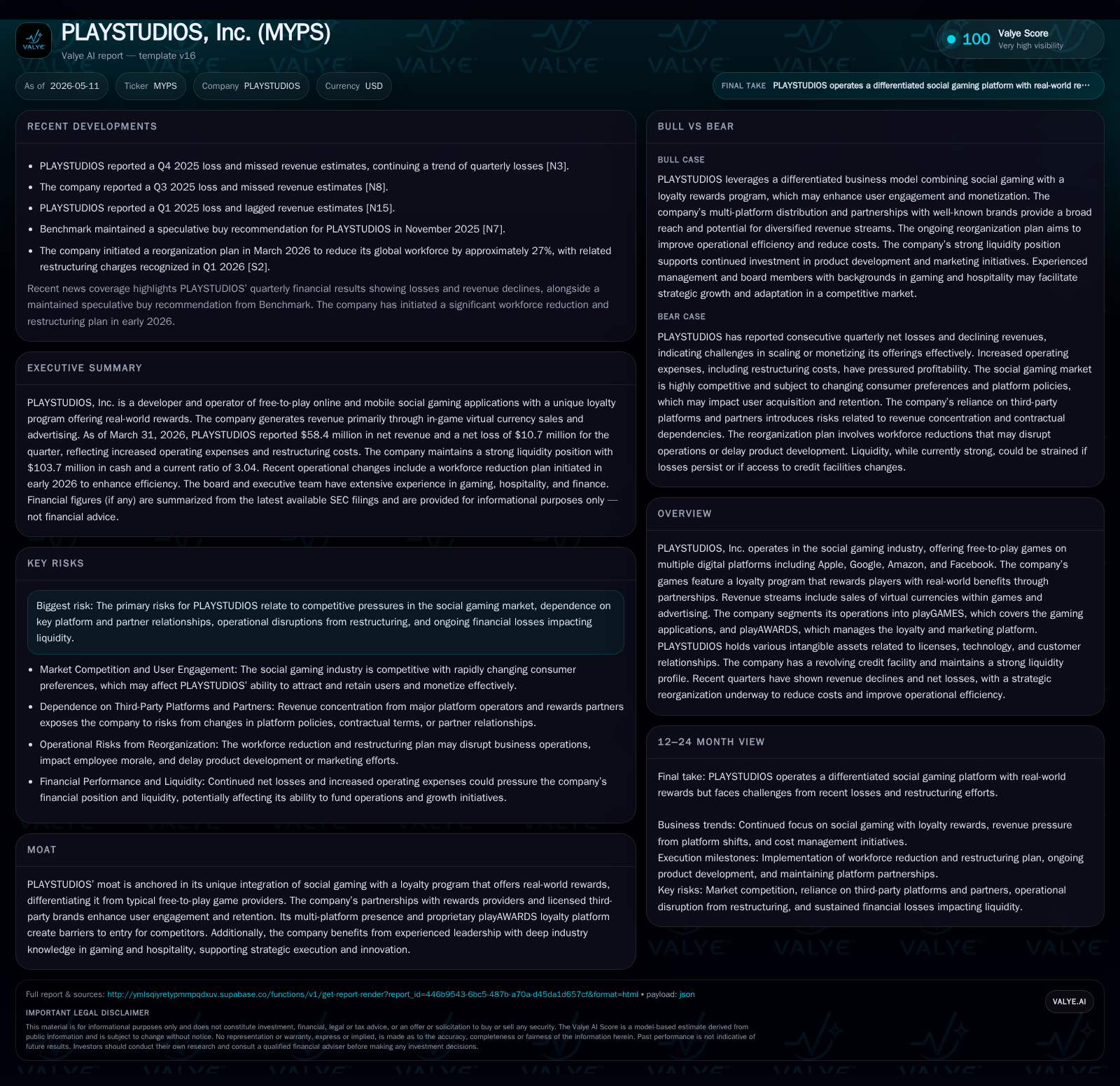
In Q1 2026, PLAYSTUDIOS recorded revenue declines alongside continuing net losses, prompting a strategic workforce reduction and operational restructuring to improve efficiency and cost structure. Its integrated playGAMES and playAWARDS segments, blending free-to-play games with a unique real-world rewards program, remain the core business pillars supported by multi-platform presence. Competition and platform dependence continue to challenge growth, but expansion opportunities exist through deeper user engagement and enriched partner rewards. The near-term trajectory will hinge on execution of restructuring and maintaining liquidity backed by a solid current ratio.
Latest Operational and Strategic Developments in Q1 2026
PLAYSTUDIOS’ Q1 2026 financial disclosures illustrate growing pressures as revenue trends declined alongside persistent net losses [S2]. In response, the company initiated an internal reorganization plan announced March 10, 2026 [S11], involving a substantial workforce reduction of approximately 27%, targeting completion by Q2 end [S2]. This effort aims to reduce operating expenses and improve efficiency during sustained challenges in scaling revenue streams.
The company’s two primary segments—playGAMES (gaming apps) and playAWARDS (loyalty marketing platform)—remain the foundation of operations [S1]. The latest quarter’s revenues suffered declines driven partially by softness in virtual currency sales volume and advertising demand; however, management emphasized ongoing strategic prioritization of user engagement improvements alongside cost realignment [S7]. Restructuring charges incurred in Q1 include severance payments, employee benefits adjustments, and some facility-related costs estimated between $4.5 million to $7 million [S11].
Despite headwinds, PLAYSTUDIOS continues to leverage its integrated model combining gaming with real-world reward incentives—a unique market position designed to enhance retention and monetization over time. The company’s commentary highlights that operational changes are focused not just on expense reduction but on retooling the business for sustainable profitability.
PLAYSTUDIOS' Business Model: Loyalty-Centric Social Gaming
PLAYSTUDIOS generates revenue principally through free-to-play mobile and desktop social games featuring virtual currency sales as well as advertising placements [S1],. Its proprietary loyalty program—the playAWARDS platform—rewards players with points redeemable for real-world goods and experiences through partnerships with third-party brands.
This dual-segment model integrates game engagement incentives with transactional monetization: players buy virtual currency used within games for enhanced experiences or perks while earning loyalty points credited via playAWARDS. The role of playAWARDS extends beyond rewards distribution into managing marketing campaigns that activate user participation while fueling advertising targeting.
Strategically, this creates a defensible ecosystem because users accumulate tangible value beyond digital gameplay alone. Partnerships with well-known brands bolster reward attractiveness, encouraging sustained user retention—a critical factor given typical volatility in free-to-play game engagement cycles. This ecosystem also establishes switching costs challenging for competitors lacking comparable loyalty infrastructure.
Monetization thus hinges on balancing virtual currency price points, gaming content quality, advertising load optimization without disrupting user experience, and reward value perception.
Competitive Positioning and Industry Context
Within the growing yet fragmented social gaming industry, PLAYSTUDIOS differentiates itself through the innovative combination of digital games augmented by a loyalty layer offering real-world benefits. This approach contrasts with many peers who rely solely on in-app purchases or ads without tangible rewards integration.
The multi-platform strategy spanning Apple App Store, Google Play Store, Amazon app channels, plus Facebook ensures broad market access but subjects the company to evolving platform policies affecting discoverability and monetization terms, [S1]. Moreover, licensing agreements underpinning branded content introduce minimum guarantees impacting cost structures [S27].
Competitive dynamics feature relentless pressure on user acquisition costs—particularly given the market’s sensitivity to novelty—and challenges sustaining elevated retention rates post-initial download. PLAYSTUDIOS’ proprietary playAWARDS ecosystem helps mitigate churn by extending lifetime value curves through reward-driven engagement.
However, regulatory scrutiny around game-types resembling gambling mechanics (notably state-level legal actions regarding their games) represents notable headwinds [S29]. These legal complexities could impact operating licenses or increase compliance costs going forward.
Growth Drivers: User Engagement, Partnerships, and Platform Expansion
Key growth levers lie in increasing the scale of engaged active users across existing platforms while deepening interaction per user via richer reward offerings. Expanding collaborations with recognizable retail brands can amplify reward diversity enhancing player motivation to spend more time or money within games.
Advertising revenue prospects appear linked closely to the loyalty program’s ability to deliver higher quality audience segments for marketers seeking targeted reach within millennial/digital-native profiles. Improved ad load management balancing monetization versus user experience also promises margin enhancement opportunities.
International expansion could represent a medium-term opportunity if regulatory environments permit; however no immediate evidence references this explicitly in filings.
Monitoring metrics such as average revenue per user (ARPU), daily/monthly active users (DAU/MAU), loyalty point redemption rates, virtual currency purchase frequencies provide vital barometers for assessing traction of these growth initiatives [S2],.
Risks and Constraints: Market Competition and Cost Restructuring Impact
PLAYSTUDIOS faces several structural risks including:
- Intense competition in social gaming driving elevated marketing spend to acquire/retain users;
- Dependence on platform providers (Apple/Google/Facebook) whose policy shifts can materially affect product discoverability or monetization terms;
- Legal risks tied to ongoing litigation alleging gambling statute violations with uncertain outcomes potentially leading to increased regulatory burdens or financial penalties [S29];
- Operational risks from restructuring execution such as potential loss of key personnel or temporary disruption of development/product updates impacting user satisfaction;
- Financial risk arising from consecutive quarterly losses threatening liquidity unless offset by effective cost containment or capital raises.
Execution discipline around these fronts will be paramount to stabilize operational momentum while safeguarding the company’s differentiated position.
Upcoming Milestones and Indicators to Monitor
Key near-term events include:
- Completion status of workforce reduction plan expected by end-Q2 2026 validating restructuring progress [S2], [S11];
- Quarterly reports evidencing stabilization or inflection points in revenue trends particularly within virtual currency sales or advertising segments;
- New brand partnership announcements enhancing reward portfolio breadth;
- Updates on litigation settlements or regulatory interactions clarifying risk exposures;
- Any forward guidance disclosures providing clearer financial expectations post-restructuring [S3]. Monitoring these markers will help gauge whether strategic efforts translate into sustainable operating improvements.
Current Financial Position and Liquidity Snapshot
Latest financial snapshot
| Metric | Value | Period |
|---|---|---|
| Cash & equivalents | $104mm | |
| 2026-03-31 | ||
| Current assets | $134mm | |
| 2026-03-31 | ||
| Current liabilities | $44mm | |
| 2026-03-31 | ||
| Current ratio | 3.04x | |
| 2026-03-31 |
Source: SEC companyfacts cache [F1].
As of March 31, 2026 PLAYSTUDIOS held cash & equivalents totaling approximately $103.7 million against current liabilities near $44.1 million yielding a strong current ratio around 3.04x — indicating solid short-term liquidity buffer [F1], [S2]. This cushion supports ongoing restructuring charges estimated at up to $7 million during early fiscal year quarters without immediate solvency concerns.
Other balance sheet highlights include total assets valued at about $282 million dominated by intangible assets related to software development licenses ($71.6 million) and goodwill ($52.2 million), reflecting investments in proprietary technology platforms integral to competitive positioning [F1]. Liabilities incorporate contingent consideration linked to past acquisitions as well as operating lease commitments typical for technology companies maintaining office/infrastructure footprints.
Overall financial health presents manageable risk if restructuring targets are met timely enabling efficiency gains necessary for profitable scale realization.
Disclaimer: This report is based exclusively on publicly available information including SEC filings dated through May 11, 2026. It does not offer investment advice but aims to provide an informed analysis grounded in disclosed data about PLAYSTUDIOS' recent operating developments and market context.
Disclaimer: This is research-only, informational analysis and not investment advice. It may include AI-generated interpretation and general industry context. Always verify important details using primary sources.

Comments