
Finwise Bancorp Expands Lending Reach Through Fintech Partnerships
Finwise Bancorp leverages fintech collaborations and strategic lending programs to grow nationwide loan originations beyond its localized branch footprint.
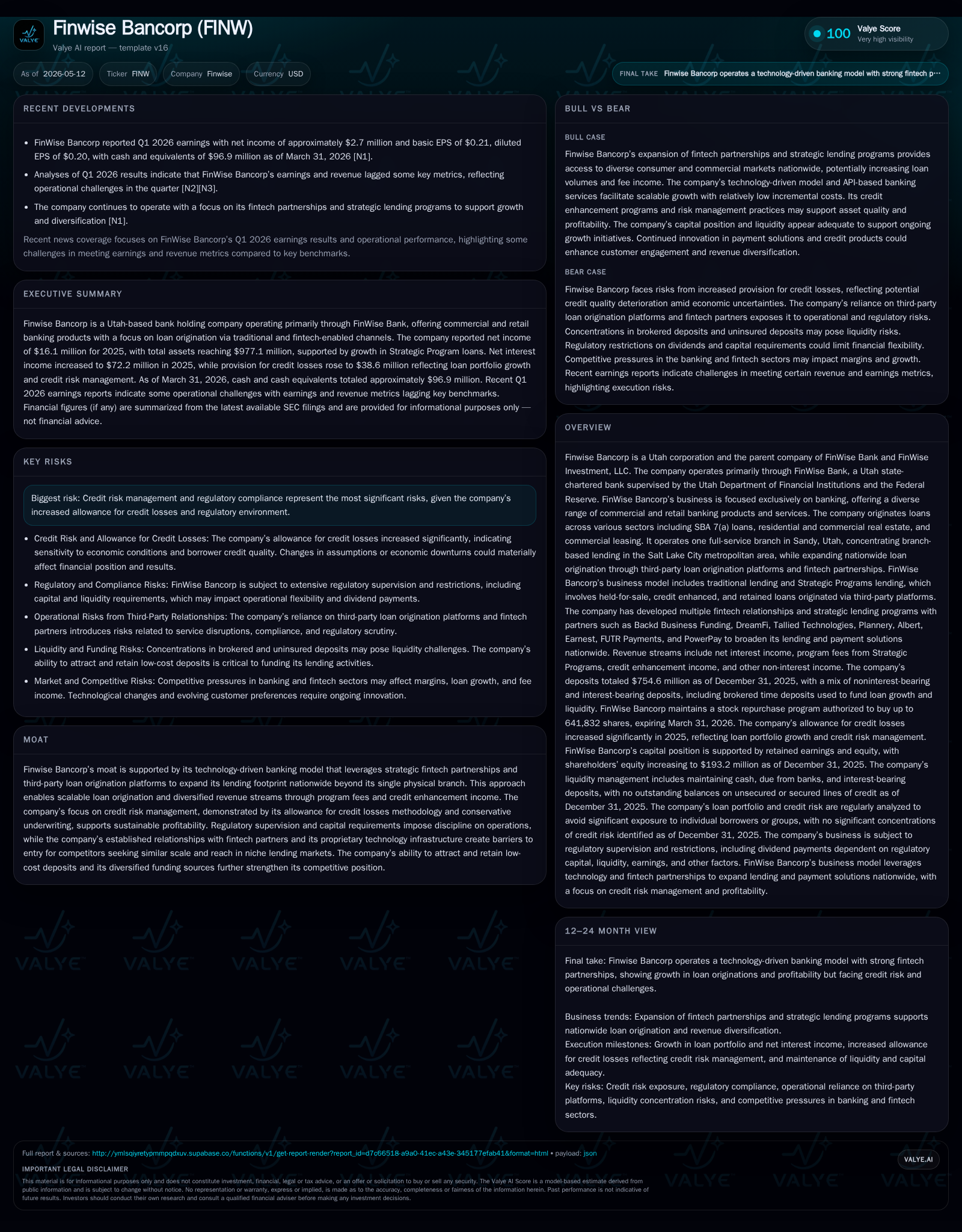
Finwise Bancorp's Q1 2026 results reveal continued expansion of its loan portfolio driven by enhanced fintech partnerships and strategic program growth, balanced against a rising allowance for credit losses. The company’s hybrid model—combining traditional branch-based banking in Utah with scalable third-party digital platforms—provides competitive advantages in SBA and commercial real estate lending nationwide. Regulatory oversight, credit risk management, and evolving fintech competition remain critical risk factors. Monitoring origination volumes, deposit trends, and credit quality will be key indicators of Finwise’s ability to sustain and accelerate growth.
Q1 2026 Operating Update: Growth and Credit Trends
In its latest quarterly filing dated May 12, 2026 ([S2]), Finwise Bancorp reported sustained growth in its loan portfolio driven predominantly by expanded origination through fintech partnerships and third-party platforms rather than physical branch activity. While the company operates a single full-service bank branch located in Sandy, Utah, loan origination has become increasingly nationwide due to these digital channels. The filing highlights a continued increase in loans subject to strategic program arrangements where Finwise partners with fintechs for origination and credit enhancement.
Notably, the allowance for credit losses (ACL) increased substantially in Q1 2026 relative to prior quarters ([S2], [S1]), signaling management's prudent approach amid evolving macroeconomic uncertainties impacting credit quality. This rise in ACL aligns with the company’s conservative underwriting practices. Deposit levels also showed growth but remained reliant on a mix of core deposits locally sourced alongside non-core brokered deposits fostered through digital channels. Therefore, deposit acquisition remains critical to finance ongoing loan volume expansion.
The recent April 30 event filing ([S3]) reiterates these themes and confirms no material deviation from Q1 performance trends. Market commentary ([N1]) further underscores cautious optimism about leveraging technology-driven growth while managing credit risk headwinds.
Business Model Nuances: Loan Origination and Technology Leveraging
At its core, Finwise Bancorp's revenue is generated through originating diverse loan products – including SBA 7(a) loans, residential and commercial real estate loans, and commercial leasing – primarily routed through FinWise Bank ([S1], valye_report_excerpt). While historically concentrated geographically around Utah’s Salt Lake City metro area via its physical branch network, Finwise has purposefully expanded nationally by partnering with fintech platforms that originate loans digitally.
This bifurcated business model consists of:
- Traditional banking: Branch-based lending focused on local real estate markets and small-to-medium businesses.
- Strategic programs: Loans originated via third-party fintech marketplaces under program agreements that include fee structures tied to origination volumes and credit enhancement income.
These strategic programs not only increase scale without branch expansion but also provide diversified revenue streams such as servicing fees and indemnifications related to credit loss protections ([S22]). Underwriting discipline is maintained consistently across both verticals with robust methodologies governing ACL calculations.
Technologically, Finwise boasts proprietary infrastructure enabling seamless integration with fintech partners scaling loan origination operations efficiently beyond regional confines. This technological competence contrasts with more traditional community banks dependent strictly on physical distribution networks ().
Competitive Positioning Within the Banking and Fintech Ecosystem
Finwise occupies a niche at the intersection of banking regulation oversight and agile technology deployment. Its status as a Utah state-chartered bank regulated by Utah’s Department of Financial Institutions alongside FDIC insurance offers trusted regulatory validation critical for both borrowers and deposits ([S1]). Unlike pure-play digital lenders lacking banking charters, Finwise enjoys broader product latitude but faces competitive pressure from emerging fintech firms pursuing such charters to expand their offerings.
Its competitive moat rests on:
- Longstanding fintech relationships providing access to high-quality loan pipelines nationwide.
- Proprietary loan origination technology facilitating scalable underwriting processes.
- Conservative credit risk posture supporting sustainable profitability over cycles.
- Regulatory capital discipline fostering confidence among investors and regulators alike.
Compared to regional players tethered tightly to geographic markets or nascent fintech banks lacking established balance sheets, Finwise manages a durable technological edge paired with operational prudence (, [N1]). However, increasing competition from digitizing banks mandates continuous innovation and operational excellence.
Growth Drivers: Nationwide Lending Expansion Via Strategic Programs
Concrete growth drivers identified include:
- Third-party platform volume: Increasing loan originations sourced from new and existing fintech partners outside Utah expands total addressable market significantly ([S2], [S3]).
- Fee income escalation: Credit enhancement arrangements produce non-interest income streams helping margin expansion beyond net interest margins constrained by high funding costs.
- Deposit mobilization: Enhanced digital channels enable accumulation of low-cost deposits crucial for funding organic loan growth.
- Product diversification: Introduction or scaling of student loans via strategic partners adds high-volume segments with predictable repayment profiles.
Key KPIs to track these drivers are loan originations quarterly volumes via third-party channels (especially SBA-backed), fee income trends related to credit enhancement programs, core versus non-core deposit ratios reflecting funding stability, and underwriting loss ratios as early warning signs ([S2], [N1]).
Technology lends cost efficiency benefits lowering client acquisition costs compared with traditional branch models thus improving economics as scale grows.
Risks and Constraints: Credit Risk, Compliance, and Market Dynamics
The foremost risks acknowledged relate to:
- Credit risk management: The sizable increase in allowance for credit losses exposes vulnerability if economic conditions deteriorate more rapidly or borrowers perform worse than modeled ([S2], [S1]). Stress testing scenarios impacting allowances have highlighted sensitivity primarily linked to unemployment rate projections.
- Regulatory environment: Heightened scrutiny over ‘true lender’ designations especially in marketplace-originated loans entails potential legal compliance challenges along with capital adequacy demands constraining dividend policies ([S1], [S8]).
- Operational dependencies: Reliance on third-party service providers introduces execution risks including cybersecurity breaches or system failures affecting customer experience or compliance (, [S1]).
- Market competition: Growing competition from digitally native fintech banks seeking charters intensifies pressure on pricing power, product innovation pace, and partnership retention strategies (, [S1]).
Mitigation depends on sustained underwriting discipline combined with vigilant regulatory engagement and resilience investments in proprietary technology safeguards.
Key Upcoming Milestones and Operational Watchpoints
Attention will focus on:
- Quarterly origination volume reports segmented by channel to assess whether nationwide digital lending expands steadily relative to prior periods ([S2], [N1]).
- Deposit inflow quality measurements indicating funding sustainability especially given interest rate cycle volatility impacting deposit behavior ([S2], [S3]).
- Updates from regulatory examinations addressing compliance with emerging rules affecting strategic program loans or capital adequacy levels ([S1], [N1]).
- Any guidance revisions articulated during earnings calls or investor presentations reflecting shifts in volume forecasts or risk outlooks ([N1]).
- Monitoring legal proceedings relating to compliance disputes remains important owing to potential financial or reputational impacts ([S20]).
These milestones collectively signal whether current growth strategies effectively balance scale ambitions against risk constraints.
Financial Snapshot: Liquidity, Capital, and Profitability Highlights
As of March 31, 2026 quarter-end ([F1]), Finwise held approximately $96.9 million in cash and equivalents underpinning near-term liquidity needs amid significant loan fundings. This robust liquidity position reflects effective balance sheet management optimizing between maintaining regulatory capital buffers while supporting asset growth initiatives ([S1], [S4]).
According to the latest annual report ending December 31, 2025 ([F1], [S1]):
No dividends have been paid recently consistent with stated policy favoring capital retention for organic growth support ([S5], [S6]). Overall financial condition aligns well with operating strategy emphasizing scalable lending with controlled risk exposure.
This analysis is based solely on publicly available filings as of May 12, 2026 including the latest Form 10-Q filed by Finwise Bancorp along with supporting SEC documents and recent investor disclosures. It does not constitute investment advice or an endorsement. Readers should conduct further due diligence before making any financial decisions.
Disclaimer: This is research-only, informational analysis and not investment advice. It may include AI-generated interpretation and general industry context. Always verify important details using primary sources.

Comments