
Septerna Advances Clinical Progress with SEP-631: Financial and Operational Insights
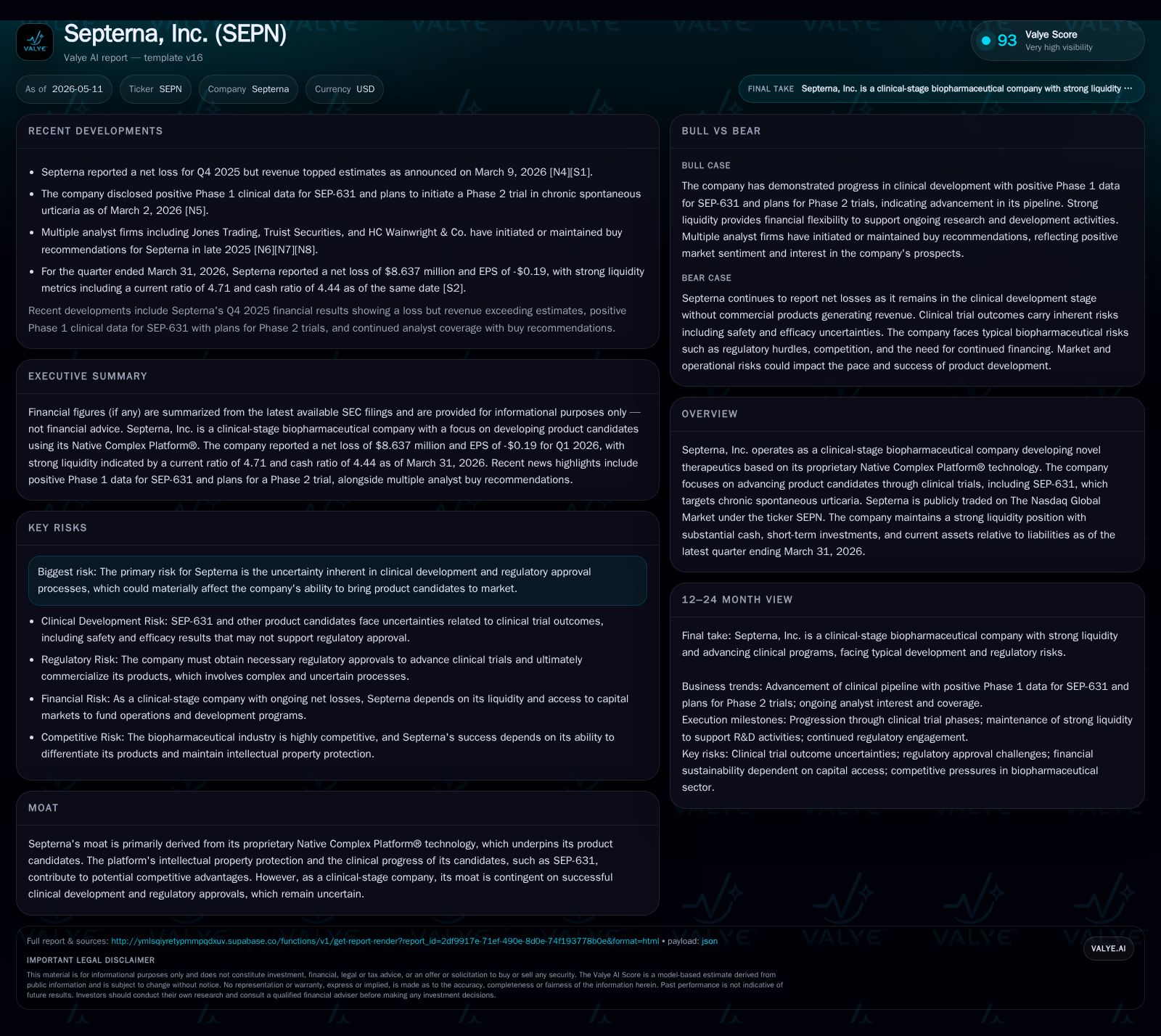
Septerna's Q1 2026 report highlights progress in clinical development of SEP-631 and reinforces its strong liquidity position, underpinning continued R&D execution.
In its latest quarterly filing dated May 11, 2026, Septerna disclosed positive momentum for its lead clinical candidate, SEP-631, an oral MRGPRX2 negative allosteric modulator targeting chronic spontaneous urticaria (CSU). The company confirmed robust balance sheet strength with a current ratio of 4.71 as of March 31, 2026, supporting ongoing clinical programs in the absence of commercial revenues. Septerna’s proprietary Native Complex Platform® serves as the foundation for its pipeline, emphasizing differentiated mechanism and future expansion potential. Upcoming catalysts include planned Phase 2b trials for SEP-631 alongside exploration into other mast cell-driven diseases.
Quarterly Operating Update: Clinical and Financial Highlights
Septerna’s May 11, 2026 quarterly filing (10-Q) reiterates the company’s focus on advancing SEP-631 through clinical stages while maintaining operational liquidity to execute multiple trials [S2,S3]. The lead asset SEP-631 demonstrated strong Phase 1 results earlier in March with favorable safety — no severe adverse events or significant lab abnormalities — and pharmacokinetics consistent with once-daily oral administration [S3,S26]. Pharmacodynamic evidence from suppression of icatibant-induced skin wheal formation showed potent target engagement of the MRGPRX2 receptor at doses as low as 10 mg daily, providing important clinical proof-of-mechanism [S3,S26]. Furthermore, Septerna announced plans to commence a randomized double-blind placebo-controlled Phase 2b trial in moderate-to-severe chronic spontaneous urticaria (CSU) patients during the second half of 2026 after completing long-term toxicology studies [S3,S26]. This trial will serve as a key near-term catalyst to validate efficacy in this underserved indication.
On the financial front, Septerna maintains a solid balance sheet with cash and equivalents totaling approximately $71.6 million as of March 31, 2026, supported by current assets exceeding current liabilities more than fourfold (current ratio of 4.71), reflecting strong liquidity to fund R&D activities ahead [F1]. Given the absence of commercial revenues typical for clinical-stage biotechnology firms, this healthy liquidity base is critical to sustaining ongoing development programs.
Septerna’s Business Model: Native Complex Platform and Product Pipeline
Septerna operates primarily as a clinical-stage biopharmaceutical company leveraging its proprietary Native Complex Platform® technology that enables discovery and development of novel therapeutics targeting mast cell-driven diseases [S1]. The flagship product candidate, SEP-631, functions as a negative allosteric modulator (NAM) of Mas-related G protein-coupled receptor X2 (MRGPRX2), a receptor implicated in mast cell activation pathways involved in certain allergic and inflammatory conditions such as CSU.
The business model centers on progressing lead and follow-on candidates through IND-enabling studies and phased clinical trials to establish safety and efficacy before eventual commercialization or partnering/licensing activities [S1]. Revenues are currently nonexistent; value creation hinges on successful clinical development milestones that could translate into licensing agreements or eventual direct market entry. Intellectual property protection around both the platform technology and individual molecules helps safeguard novel therapeutic approaches, creating an early moat contingent on successful regulatory outcomes.
Customer adoption will ultimately depend on approval by regulatory agencies followed by prescription by physicians treating diseases with limited effective oral therapeutics currently available. Payors’ acceptance will tie closely to demonstrated benefits over incumbent antihistamines or biologics.
Industry Context: Competitive Position in Biopharmaceuticals
Within the broader biopharmaceutical ecosystem targeting immune-mediated disorders, Septerna situates itself among other clinical-stage firms developing novel mechanisms addressing mast cell dysregulation [N1,N2,N3,S1]. Existing treatment paradigms rely heavily on antihistamines or monoclonal antibodies which can be limited by suboptimal efficacy, injection routes, or high costs.
SEP-631’s oral small molecule profile presents a potentially differentiated factor enhancing patient convenience and compliance while potentially offering novel efficacy by direct MRGPRX2 antagonism — an approach not yet served by approved agents [S1,N2]. Industry trends show shifting patient preference toward orally administered therapies if safety and efficacy profiles are comparable.
Manufacturing operates largely through contract development and manufacturing organizations (CDMOs), typical for early-stage biotech companies without integrated production capability; this outsourcing reduces fixed cost burdens while requiring robust supply chain management across trial sites.
Growth Catalysts: Clinical Development, Platform Expansion, and Market Opportunities
Key growth drivers for Septerna are centered on achieving pivotal clinical milestones. These include initiation and successful readout of the planned Phase 2b CSU study in H2 2026 for SEP-631, enabling further clinical validation across other mast cell-driven disease indications such as atopic dermatitis or asthma currently under evaluation based on evidence of MRGPRX2 expression [S13,S26].
The scalability of the Native Complex Platform® offers extension opportunities beyond SEP-631 to develop additional candidates targeting various immunological pathways leveraging similar mechanisms for unmet medical needs.
Strategic partnerships or licensing arrangements enabled by proprietary platform IP could drive non-dilutive capital inflows or risk-sharing collaborations accelerating pipeline growth timelines.
Risks and Constraints: Clinical, Regulatory, and Market Challenges
Septerna faces inherent risks reflective of all clinical-stage biopharmaceutical companies. Primary uncertainties lie in the unpredictable nature of clinical trial outcomes — efficacy signals may not translate from biomarker proof-of-concept to real-world patient benefit; safety signals could emerge unexpectedly during larger trials [S6,S21,S23].
Regulatory approval processes impose stringent requirements that must be met to progress candidates to market-ready status. Challenges here include timely completions of required toxicology studies preceding Phase 2 launch.
Market adoption risk involves overcoming incumbent therapies’ entrenched positions alongside demonstrating compelling advantages in safety/tolerability or ease-of-use necessary to capture prescribing physician preference.
Intellectual property enforcement remains vital; invalidation or circumvention could impair competitive positioning.
Upcoming Milestones: Trial Readouts, Regulatory Steps, and Strategic Initiatives
The immediate operational agenda focuses on commencing the Phase 2b randomized controlled trial for SEP-631 in CSU during H2 2026 following completion of requisite preclinical toxicology work [S3,S13]. This study’s enrollment pace, interim data releases and top-line results will serve as critical barometers for pipeline validation.
Additional exploratory trials evaluating efficacy in subtypes like chronic inducible urticaria are anticipated post-CSU study launch.
Regulatory interactions pertaining to IND approvals for future studies represent valuable checkpoints shedding light on developmental cadence.
Strategic initiatives including potential partnership discussions leveraging platform assets may also crystallize over coming quarters.
Financial Snapshot: Liquidity Strength Supports Strategic Execution
Latest financial snapshot
| Metric | Value | Period |
|---|---|---|
| Cash & equivalents | $71.6mm | |
| 2026-03-31 | ||
| Current assets | $368.1mm | |
| 2026-03-31 | ||
| Current liabilities | $78.2mm | |
| 2026-03-31 | ||
| Current ratio | 4.71x | |
| 2026-03-31 |
Source: SEC companyfacts cache [F1].
Septerna’s financial posture remains sound with cash reserves sufficient to sustain operations through multiple upcoming data-dependent inflection points absent revenue generation given its operating model focused on R&D investment [F1]. The strong liquidity reduces immediate refinancing pressures enabling management to concentrate capital deployment towards advancing clinical programs such as SEP-631’s pivotal Phase 2b study while maintaining optionality towards pipeline diversification or business development opportunities.
Disclaimer: This analysis is based solely on publicly available SEC filings and news disclosures as cited. It does not constitute investment advice or recommendations but aims to provide an informed operational perspective grounded in disclosed data.
Disclaimer: This is research-only, informational analysis and not investment advice. It may include AI-generated interpretation and general industry context. Always verify important details using primary sources.

Comments