
VisionSys AI Inc Advances Brain-Computer Interface Pivot Amid Financing and Commercialization Challenges
Recent quarterly filings highlight VisionSys AI's strategic shift to brain-computer interface technology and ongoing funding efforts.
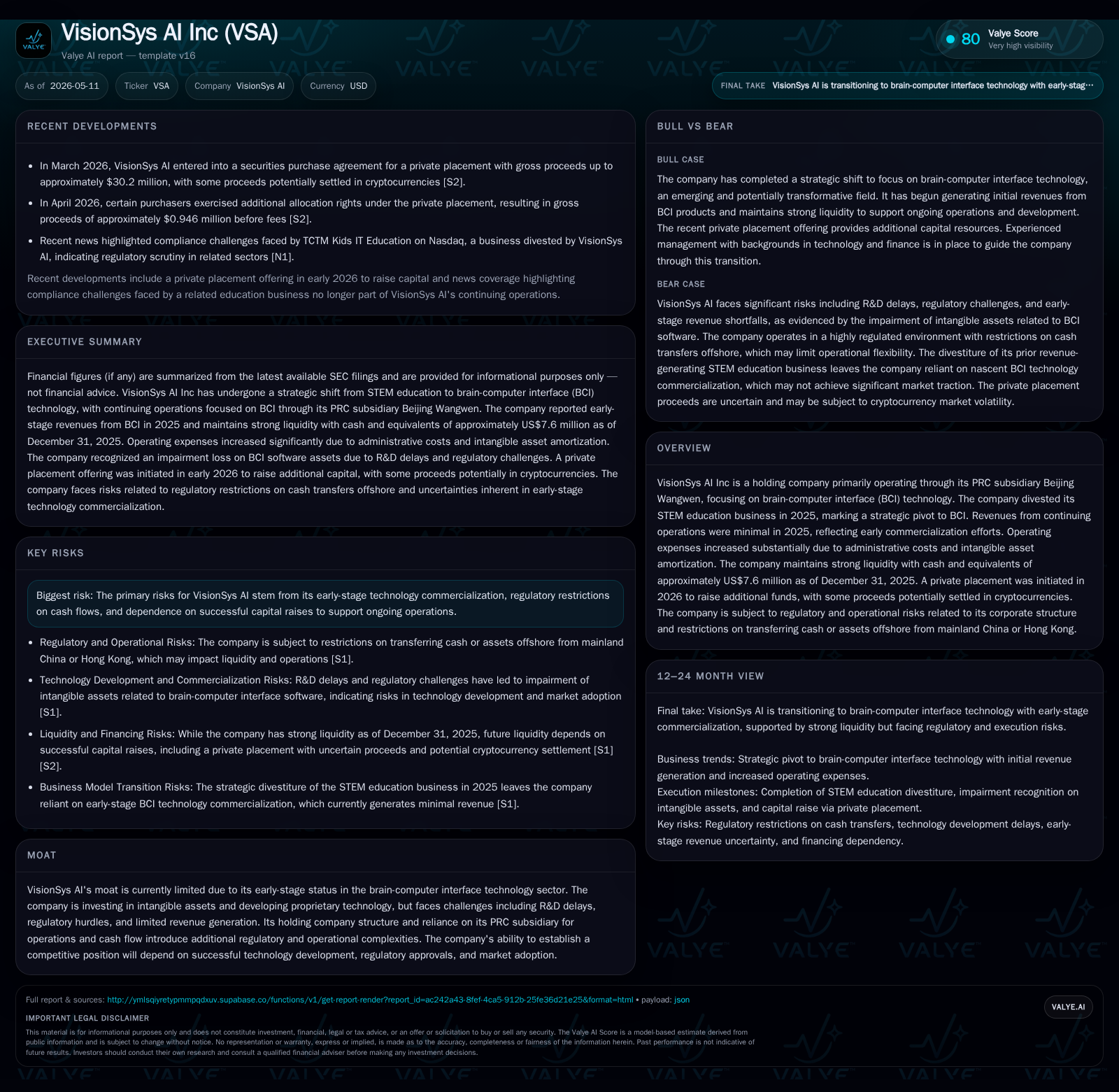
VisionSys AI Inc completed a major pivot in late 2025 by divesting its STEM education business to focus entirely on developing brain-computer interface (BCI) technologies. Revenues remain minimal as the BCI business is in early commercialization, with 2025 revenues just over $149,000. The company increased operating expenses significantly, driven by administrative costs and intangible asset amortization. Recent registered direct offerings and additional share issuances aim to bolster liquidity amid ongoing R&D and regulatory challenges. The holding company structure, operational concentration in China, and restrictions on offshore fund transfers pose risks. VisionSys’ path forward depends on successful technology development, regulatory approvals, and capital raise execution.
Recent Operating Update
VisionSys AI Inc’s latest material update comes from a series of SEC Form 6-Ks filed in April 2026 ([S2], [S3]). The company entered into a Purchase Agreement on March 27, 2026 with institutional investors for a registered direct offering that initially involved selling 250,000 ADSs and pre-funded warrants representing an additional 2.75 million underlying ADSs. This offering raised gross proceeds of approximately $3 million at $1.00 per share/warrant unit. Crucially, purchasers had rights for an Additional Allocation option exercisable within thirty days following the close—rights which were exercised in mid-April adding roughly $946,000 more in proceeds ([S2]).
These financings underline VisionSys AI’s continued need for capital infusion as it advances commercialization efforts in its pivoted brain-computer interface (BCI) business. The offering's pricing and lock-up agreements indicate management's attempt to balance quick capital access alongside some protection against immediate dilution or secondary selling.
Business Model
VisionSys AI is a holding company with no direct operations; it conducts business primarily through its PRC subsidiary Beijing Wangwen ([S1], [S7]). Post-October 2025 divestiture of STEM education subsidiaries (Kids IT Education Inc., Tarena Hong Kong Limited), VisionSys has concentrated nearly all resources into one emerging segment: brain-computer interfaces.
Revenue generation hinges currently on sales of BCI equipment and related hardware procurement. Cost of revenue predominantly includes these hardware procurement expenses necessary for deploying BCI solutions ([S1]). The company does not yet report significant service or recurring revenue streams tied to this technology; instead, it is still in an early commercialization phase as evidenced by first-time but modest revenue generation ($149,000 for full-year 2025) ([F1], [S10]). Gross profit margin reached about 22% during the initial launch period, which is encouraging but still pertains to minimal volumes.
Operating expenses increased substantially—by nearly 180% compared to prior year—to RMB40 million ($5.8 million), driven by Beijing Wangwen’s personnel-related expenses, general administrative overhead, and intangible asset amortization reflecting investments into IP development ([S9]). This dynamic reflects typical burn characteristics of deep-tech ventures shifting from R&D into initial go-to-market phases.
Capital expenditures surged to RMB76.3 million ($10.9 million) in software-related investments necessary for proprietary BCI tech development ([S15]). Meanwhile, an impairment charge of RMB21 million was posted related to delayed project timelines and regulatory complexities impacting anticipated cash flows from current intangible assets ([S11]).
Customer payments flow primarily through hardware sales contracts executed via Beijing Wangwen; volume remains constrained by early-stage demand and adoption hurdles associated with this advanced neurotechnology domain.
Industry Structure and Competitive Position
The brain-computer interface industry sits at the confluence of neuroscience, AI-enabled signal processing, advanced hardware manufacturing, and medical device regulation—a sector characterized by high innovation barriers but also substantial technical uncertainty.
VisionSys AI currently competes as an early entrant focusing on developing proprietary BCI equipment intended potentially for medical or connectivity applications within mainland China. Its moat is limited due to nascent product maturity, relatively low revenue base, regulatory navigation complexity, and R&D execution risks ().
Competitive pressures stem from both global neurotech startups backed by venture capital and established players such as Neuralink and other multinational medical device firms targeting various BCI use cases ranging from prosthetics control to therapeutic systems. Establishing differentiation will rely heavily on sustained innovation quality, intellectual property protection—and critically—regulatory clearances within China’s jurisdiction.
Growth Drivers
Significant growth catalysts include:
- Successful commercialization scale-up following initial product launches; incremental revenue growth beyond the recorded $149K in FY25 will be critical evidence.
- Technological breakthroughs enabling broader clinical or consumer application adoption—this could unlock higher margins or recurring revenue models.
- Regulatory approvals: Navigating PRC mandates effectively will allow expanded market reach domestically.
- Capital availability: Executing multiple financing rounds efficiently (as demonstrated by registered direct offerings) supports continued R&D investment.
- Strategic partnerships or licensing that could expand distribution channels or accelerate innovation cycles.
Risks / Watchpoints / Growth Constraints
Key risks include:
- Early-stage commercial risk: Revenue remains minimal; product-market fit is unproven at scale.
- R&D delays: Impairment charges reflect uncertainties around timing or success of technology developments ([S11]).
- Regulatory hurdles: Constraints on offshore cash transfer and required compliance with Chinese regulations may limit operational agility ([S7], [S20]).
- Funding dependence: Continuing losses (~$5.7 million operating loss FY25 [F1]) mean the company must secure timely capital; execution risk around private placement outcomes remains.
- Cryptocurrency proceeds risk: The willingness to accept crypto inflows adds volatility risk tied to currency price fluctuations and liquidity constraints ([S15]).
- Corporate structure complexity: As a Cayman Islands holding entity reliant on PRC subsidiaries for operations/cash flow, governance intricacies add legal risk layers.
What to Watch Next
- Updates on private placement proceeds: Timing/scale of funds raised beyond April 2026 impact runway [S15].
- Revenue traction signals: Sequential quarterly updates showing increasing BCI sales volumes or new customer contracts could validate commercialization progress.
- Regulatory milestones: Approvals or certifications announced would materially de-risk regulatory uncertainty.
- Impairment reversals or further charges: Changes here reflect progress or setbacks in core asset valuations.
- Product launch announcements or partnership deals: These could catalyze scaling beyond pilot stages.
- Financial guidance updates: Any explicit management commentary supporting forecasts would clarify growth trajectory.
Financial Profile (Latest Snapshot Emphasis)
Latest financial snapshot
| Metric | Value | Period |
|---|---|---|
| Cash & equivalents | $8mm | |
| 2025-12-31 | ||
| Current assets | $8mm | |
| 2025-12-31 | ||
| Current liabilities | $546000 | |
| 2025-12-31 | ||
| Current ratio | 14.44x | |
| 2025-12-31 |
Source: SEC companyfacts cache [F1].
The financial profile matches an early-stage tech company transitioning away from legacy educational services toward a specialized deep-tech model requiring substantial upfront investment with limited immediate returns. Cash reserves appear adequate near term but sustaining runway will depend on further equity raises given operating cash burn trends and capex commitments.
This analysis synthesizes recent filings and disclosures without providing investment recommendations or valuation views. VisionSys AI remains at an inflection point where operational execution amidst structural regulatory complexities will determine its ability to capitalize on cutting-edge brain-computer interface opportunities while managing substantial execution risks inherent in the business model shift.[S1][S2][S3][S7][F1]
Disclaimer: This is research-only, informational analysis and not investment advice. It may include AI-generated interpretation and general industry context. Always verify important details using primary sources.

Comments