
Graf Global Corp.: Delays Cloud SPAC Business Combination Timeline
Delayed SEC filings and regulatory notices pose significant challenges to Graf Global's path to completing a business combination.
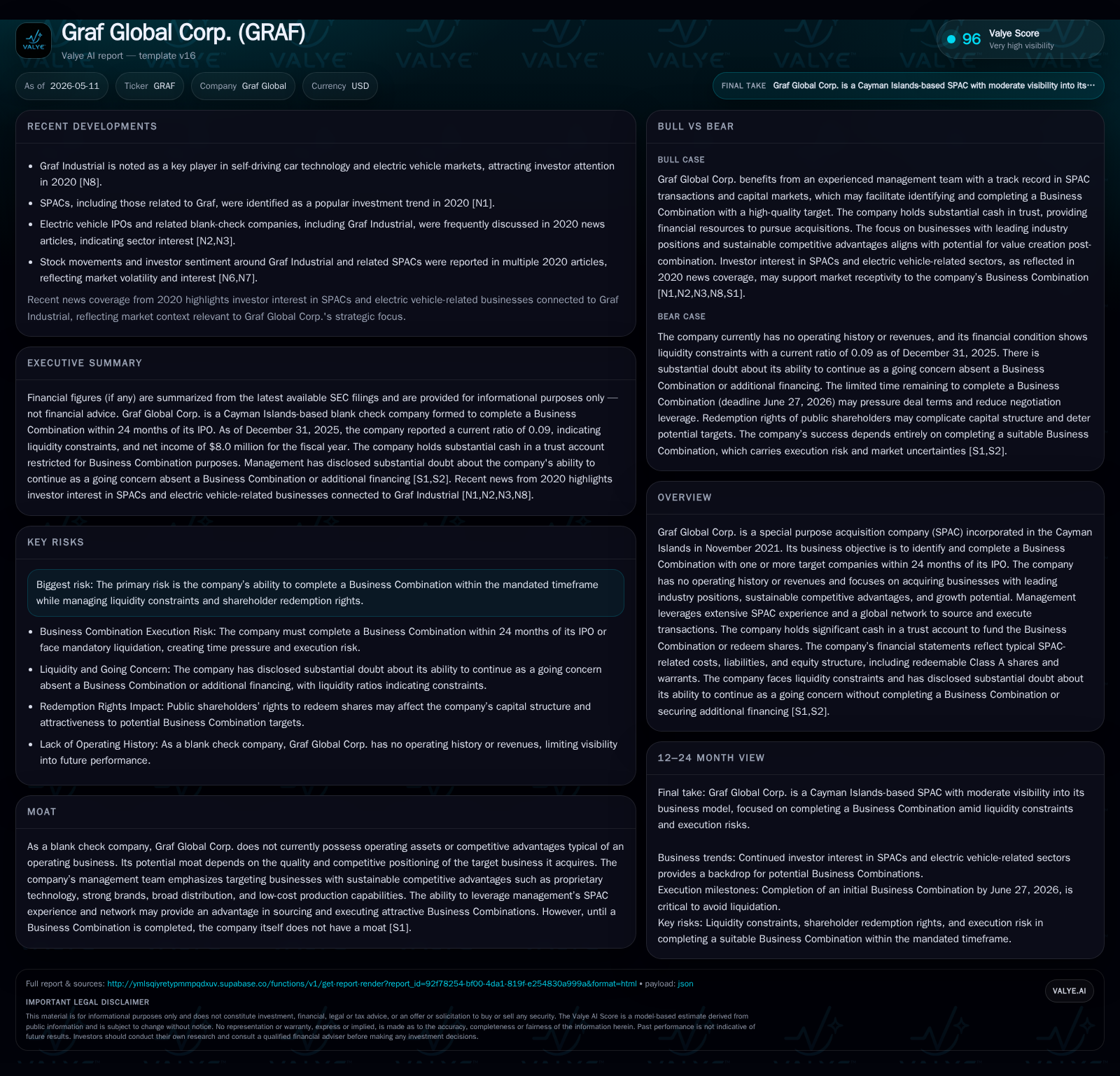
Graf Global Corp., a Cayman Islands-incorporated SPAC, faces mounting regulatory and liquidity pressures as it approaches the end of its initial business combination period. A delayed annual report filing triggered a NYSE notice in April 2026, granting a six-month cure period but raising compliance uncertainty. The company's operating model centers on deploying IPO proceeds held in trust to acquire a target with strong free cash flow potential and manageable leverage. However, tight working capital and shareholder redemption rights heighten execution risks. Success depends heavily on management's ability to secure an optimal transaction before mandated deadlines.
Regulatory Compliance Update: The NYSE Filing Notice and Its Implications
In April 2026, Graf Global received a notice from NYSE American LLC citing non-compliance with Section 1007 of the NYSE American Company Guide due to the company failing to timely file its annual report with the SEC [S3]. While this notice imposes no immediate trading suspension or delisting, it initiates an automatic six-month cure period during which Graf Global must file the delinquent report. Failure to comply may trigger further requests for extension, but these are subject to NYSE discretion, introducing uncertainty around the company’s continued listing on the exchange.
This development carries strategic significance because maintaining compliance is critical not just for market access but also investor confidence. Delay in filing can be interpreted as symptomatic of internal operational challenges or resource constraints—factors that matter acutely for a blank check company reliant on market goodwill pending its first acquisition.
The delay also compresses an already narrow timeline for Graf Global to close an initial Business Combination (BC), scheduled no later than June 27, 2026 [S2], underscoring execution urgency.
Business Model and Value Creation Approach of Graf Global Corp.
Graf Global operates as a Special Purpose Acquisition Company (SPAC) incorporated in the Cayman Islands in November 2021 with the singular objective to effectuate a Business Combination within two years following its IPO completion in June 2024 [S1][S2]. The IPO raised gross proceeds of $230 million (at $10 per unit), which are held in a segregated Trust Account invested conservatively according to SEC guidelines—primarily short-term U.S. Treasury obligations or approved money market funds [S2].
Revenue generation is non-existent until post-transaction; currently, income arises solely from interest on trust assets. Operating expenses primarily relate to sponsor reimbursements for due diligence efforts aiming at identifying viable acquisition targets [S2].
Key components of value creation include:
Target Profile: Management seeks companies demonstrating strong historical or potential sustainable free cash flow complemented by prudent balance sheet management (i.e., limited leverage). Targets are preferred where financial performance visibility extends roughly one year forward to reduce valuation uncertainty and exposure to cyclical downturns [S1][S4].
Transaction Flexibility: Consideration structures are flexible—cash from trust funds, equity issuance, bank debt financing, or combinations thereof—to tailor deals that optimize target incentives and shareholder returns [S1].
Operational Enhancement: Post-merger involvement by seasoned executives and possible operating partners is anticipated to enhance target growth trajectories through synergies or improved capital structure deleveraging [S4].
However, Graf Global remains an asset-light entity awaiting its foundational acquisition. Until consummation occurs, it lacks intrinsic economic moats commonly associated with operating businesses such as proprietary technology or entrenched customer relationships [S1].
Industry Positioning of Graf Global in the SPAC Ecosystem
Within the increasingly competitive SPAC arena—marked by proliferation over recent years—the prospect of sourcing proprietary deal flow has become critically important yet challenging given comparable targets available via auction processes. Graf Global’s stated advantage lies in leveraging management’s extensive transactional experience alongside broad professional networks designed to uncover differentiated acquisition opportunities not accessible to all peer SPACs [S1][S4].
Nonetheless, until it completes a Business Combination, Graf Global competes purely on sponsor credibility rather than product or service differentiation. This positions the company functionally closer to a financial vehicle than an operating enterprise during this interim phase.
A heightened number of contemporary SPACs intensifies competition for quality targets at attractive valuations—putting upward pressure on deal pricing and compressing prospective returns post-merger [S19]. Thus, management skillsets in negotiation and deal structuring are decisive competitive factors.
Growth Drivers: Potential Business Combinations and Management Capabilities
Growth prospects hinge exclusively on successfully closing one or more strategic acquisitions before the defined cutoff date. Cara points include:
Target Companies with Strong Cash Flow Metrics: Priority is placed on acquiring businesses with either demonstrated or projected free cash flow generating capacity providing both operational stability and distributable capital streams. This feature supports shareholder value accretion through earnings predictability post-combination [S4].
Clearly Defined Use of Proceeds and Catalysts: Investments will emphasize companies where injected capital yields visible milestones such as product rollouts, margin expansions from synergies or restructuring efficiencies, or deleveraging that fosters higher credit ratings/pricing power—each acting as valuation inflection points enhancing post-merger share performance [S4].
Management Team Alignment: Target selection favors organizations led by management closely aligned with public shareholders’ interests—a critical factor given governance quality ultimately influences execution effectiveness after going public through SPAC merger pathways [S4][S1].
Proprietary Deal Sourcing: Utilizing proprietary sources over competitive auction pools when feasible enables better pricing terms and enhances probability of winning transactions that fit tightly within Graf’s strategic criteria [S4].
Collectively, these drivers delineate a focused growth blueprint centered not just on deal quantity but on qualitative transaction excellence supported by governance and capital structure discipline.
Risks & Constraints: Timeline Pressure, Liquidity, and Redemption Rights
Several factors constrain execution flexibility:
Mandated Completion Deadline: The SPAC must finalize its initial Business Combination by June 27, 2026—or face mandatory dissolution—allotting less than one year from current date given delayed filings already incurred [S2][S15]. This truncated timeline intensifies pressure on target evaluation processes.
Liquidity Concerns: Working capital deficiencies illustrate tight near-term cash availability outside the Trust Account dedicated to acquisitions. As of December 31, 2025, current assets stood at approximately $116K against liabilities exceeding $1.28 million—a current ratio near 0.09 indicating notable shortfalls requiring either sponsor support or cost containment measures to sustain administrative operations until closing transactions [F1][S2].
Shareholder Redemption Risks: Public shareholders’ rights to redeem shares if dissatisfied with proposed combinations introduce dilution uncertainty posing challenges for structuring acceptable economics that satisfy all parties simultaneously. This factor can reduce net proceeds available for investment use post-combination [S1][S2].
Regulatory Uncertainty: In addition to ongoing SEC filing delays possibly prolonging scrutiny periods despite current NYSE leniency, any future adverse findings could threaten listing status or increase compliance costs further squeezing financial resources near deadline dates [S3][S15].
These constraints necessitate astute management prioritization balancing expedited execution while maintaining comprehensive due diligence standards.
Upcoming Milestones and Critical Events to Monitor
Key near-term markers signaling progress include:
Filing of overdue Annual Report within NYSE’s six-month grace window—deadline October 16, 2026—to restore full compliance standing without forced penalties or delisting risks [S3].
Public announcements related to identified acquisition targets such as letters of intent executed or exclusivity arrangements attained providing transparency into pipeline strength ahead of formal Business Combination proposals [S4].
Warrant exercise windows particularly involving Private Placement Warrants issued concurrently with IPO could affect capitalization dynamics moving forward post-deal closure impacting shareholder equity stakes and potential dilution factors [S3][S4].
Monitoring these events will clarify whether management can navigate operational hurdles toward successful transaction completion imminently.
Financial Snapshot: Liquidity Status and Capital Structure Overview
Latest financial snapshot
Graf Global’s balance sheet underscores tension between minimal liquid assets outside the Trust Account versus sizeable accrued liabilities primarily linked with sponsor reimbursements and administrative costs incurred during pre-acquisition phases [F1][S2].
Operating income reflects negative contributions consistent with administrative overhead in absence of revenues prior to business combination completion whereas net income figures incorporate accounting treatments related likely reflecting fair value adjustments or warrant-related impacts typical in SPAC structures rather than operational profitability gains per se.
Overall liquidity posture elevates execution risk requiring efficient expense controls combined with timely sponsor funding injections if necessary prior to transacting.
Disclaimer: This is research-only, informational analysis and not investment advice. It may include AI-generated interpretation and general industry context. Always verify important details using primary sources.

Comments