
KORE Group Holdings Faces Profitability and Integration Challenges While Pursuing IoT Connectivity Scale
Q1 2026 results highlight ongoing net losses amid strategic acquisitions and a competitive IoT market.
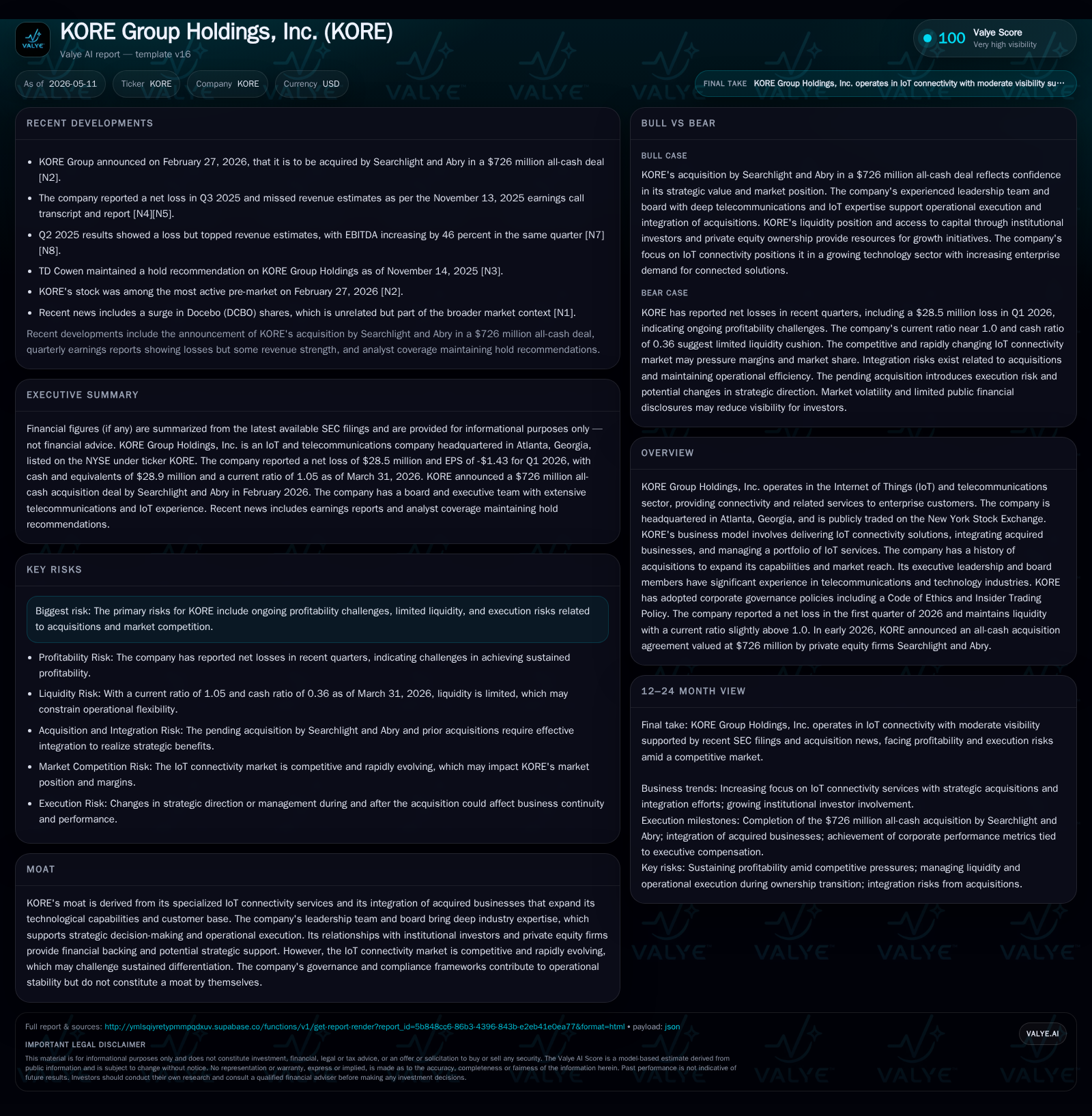
KORE Group Holdings, Inc., a player in the Internet of Things (IoT) connectivity space, reported continued net losses in Q1 2026 while maintaining liquidity slightly above parity. The company’s business model centers on providing IoT connectivity services through a layered portfolio of offerings extended by recent acquisitions. Its competitive position is challenged by rapid technological evolution and intense rivalry in the IoT sector. Growth relies on scaling IoT adoption across industries alongside successful integration of acquired entities. Key risks include profitability pressures, acquisition execution, and limited liquidity despite strategic backing from institutional investors.
Recent Operating Update
KORE Group Holdings reported its financial results for the first quarter ended March 31, 2026 [S2], [S3]. The company continues to operate at a net loss, reflecting ongoing challenges in turning its operational scale into sustainable profitability. Liquidity remains tight but positive; as of Q1-end, KORE reported $28.9 million in cash and equivalents against current liabilities totaling approximately $79.3 million, resulting in a current ratio of about 1.05 [F1]. Total debt stood around $301 million as of December 2025 indicating significant leverage [F1]. These figures depict a company managing working capital cautiously while funding operations largely through debt.
No material changes were announced regarding acquisitions or divestitures in this quarter beyond references to ongoing integration efforts consistent with past strategy disclosures [S2]. Management emphasized continued focus on controlling costs amid competitive pressures.
Business Model Overview
KORE operates primarily as an Internet of Things connectivity provider serving enterprise clients. Revenue stems from selling network connectivity services augmented by value-added software and managed services designed to simplify IoT device deployment and lifecycle management [S1]. Customers range across sectors like healthcare, logistics, manufacturing, utilities, and smart infrastructure.
The core revenue mechanics involve contractual arrangements where customers pay for data volume or device subscriptions. Pricing thus depends on usage levels (volume), mix of contract types (e.g., fixed vs variable), and service tiers including enhanced security or data analytics features. Achieving strong unit economics revolves around scaling subscriber numbers while leveraging operational efficiencies to lower per-device servicing costs.
KORE has actively broadened its service portfolio through acquisitions aimed at integrating complementary technologies and expanding addressable markets [S1]. This acquisition-driven model requires efficient post-merger integration capabilities to capture cross-selling opportunities and consolidate platforms without disproportionately inflating operating expenses.
Industry Structure and Competitive Position
The IoT connectivity space is fragmented yet competitive with players ranging from traditional telecom carriers offering cellular IoT services to software-centric platform providers delivering end-to-end device management solutions. Rapid technological change—such as the expansion of LPWAN (Low Power Wide Area Networks), 5G rollouts tailored for IoT use cases, and edge computing—demands continual investment.
KORE’s moat lies in its combination of specialized connectivity expertise tied with an integrated suite of acquired capabilities creating a more comprehensive offering than basic network providers. However, this moat is restrained by standardization trends and competitive pricing pressures especially from global telecom operators and cloud service companies entering the IoT arena.
Institutional investors such as Abry Partners hold significant stakes directing board composition which may bring strategic support but also highlights external influence over corporate governance matters [S12]. This may facilitate strategic partnerships but could also impose execution discipline.
Growth Drivers
- IoT Adoption Across Industries: The push towards digital transformation drives enterprises to connect fleets of devices for remote monitoring, predictive maintenance, asset tracking, healthcare monitoring, and smart city deployments. Expansion into these verticals underpins volume growth potential.
- Acquisition Synergies: Successfully integrating acquired firms widens KORE’s solution footprint allowing stronger penetration into existing customer bases while attracting new accounts requiring multi-faceted IoT solutions.
- Technological Enhancements: Adoption of newer network technologies (e.g., NB-IoT, LTE-M) enables addressing novel low-power or wide-area applications unfeasible before.
- Customer Retention & Contract Renewal: Emphasis on subscription-based contracts fosters predictable revenue streams; growth hinges on maintaining high retention levels amid competitive offers.
Risks and Constraints
- Persistent Unprofitability: Continued net losses strain capital resources limiting reinvestment without additional funding rounds or operational restructuring.
- Liquidity Limitations: With current assets barely covering current liabilities and substantial total debt on the balance sheet [F1], any economic downturn or capital market disruption could hamper operations.
- Integration Risks: Acquisitions add complexity requiring effective systems consolidation; failure here could inflate costs or dilute margins.
- Competitive Pressures: Larger telecom operators or cloud ecosystems can leverage scale advantages pressuring KORE’s pricing power.
- Technological Obsolescence: Rapid innovation cycles require sustained R&D investments; lagging behind could impair customer retention.
What to Watch Next
Key near-term indicators include:
- Evidence of margin improvement from operational efficiencies or cost control highlighted in upcoming quarterly reports.
- Updates on acquisition pipeline status or successful integrations accelerating revenue synergies.
- Metrics reflecting contract backlog growth or increased customer subscription counts supporting recurring revenue visibility.
- Any announcements relating to capital structure adjustments such as refinancing existing debt or equity raises that affect liquidity profile.
- Management commentary on navigating industry macro drivers including regulatory impacts around wireless spectrum allocation or data security mandates.
Financial Profile Summary
Latest financial snapshot
| Metric | Value | Period |
|---|---|---|
| Cash & equivalents | $29mm | |
| 2026-03-31 | ||
| Total debt | $301mm | |
| 2025-12-31 | ||
| Net debt | $272mm | |
| 2025-12-31 | ||
| Current assets | $83mm | |
| 2026-03-31 | ||
| Current liabilities | $79mm | |
| 2026-03-31 | ||
| Current ratio | 1.05x | |
| 2026-03-31 |
Source: SEC companyfacts cache [F1].
| Metric | Value | Period Ending |
|---|---|---|
| Cash & Equivalents | $28.9 million | |
| 2026-03-31 | ||
| Current Assets | $83.1 million | |
| 2026-03-31 | ||
| Current Liabilities | $79.3 million | |
| 2026-03-31 | ||
| Current Ratio | 1.05 | |
| 2026-03-31 | ||
| Total Debt | $301.3 million | |
| 2025-12-31 | ||
| Approximate Net Debt | $272.4 million | |
| 2025-12-31 |
These figures illustrate a leveraged balance sheet with thin liquidity buffers indicating tight working capital management is crucial going forward [F1].
Final Thoughts
KORE Group Holdings operates within an evolving high-growth segment driven by fundamental shifts towards connected devices across multiple sectors. Its acquisition-centered strategy provides breadth yet adds execution complexity amid narrowing margins. The recent quarterly update reflects persistent profitability challenges alongside manageable liquidity supported by institutional shareholder oversight. The company’s success hinges heavily on improving operational leverage while sustaining technology leadership against larger infrastructure providers poised for scale advantage. Stakeholders will want close visibility into integration progress, margin developments, contract renewals, and capital adequacy signals that collectively sketch the path toward viable commercial expansion beyond current losses.
This analysis is based solely on publicly available SEC filings up to May 11, 2026 and does not constitute investment advice.
Disclaimer: This is research-only, informational analysis and not investment advice. It may include AI-generated interpretation and general industry context. Always verify important details using primary sources.

Comments