
Heartland Express Faces Earnings Volatility Amid Self-Insurance Risks and Fleet Investment Challenges
The latest quarterly results reveal ongoing revenue pressure and narrowing net losses amid growing insurance cost volatility and capital deployment complexities.
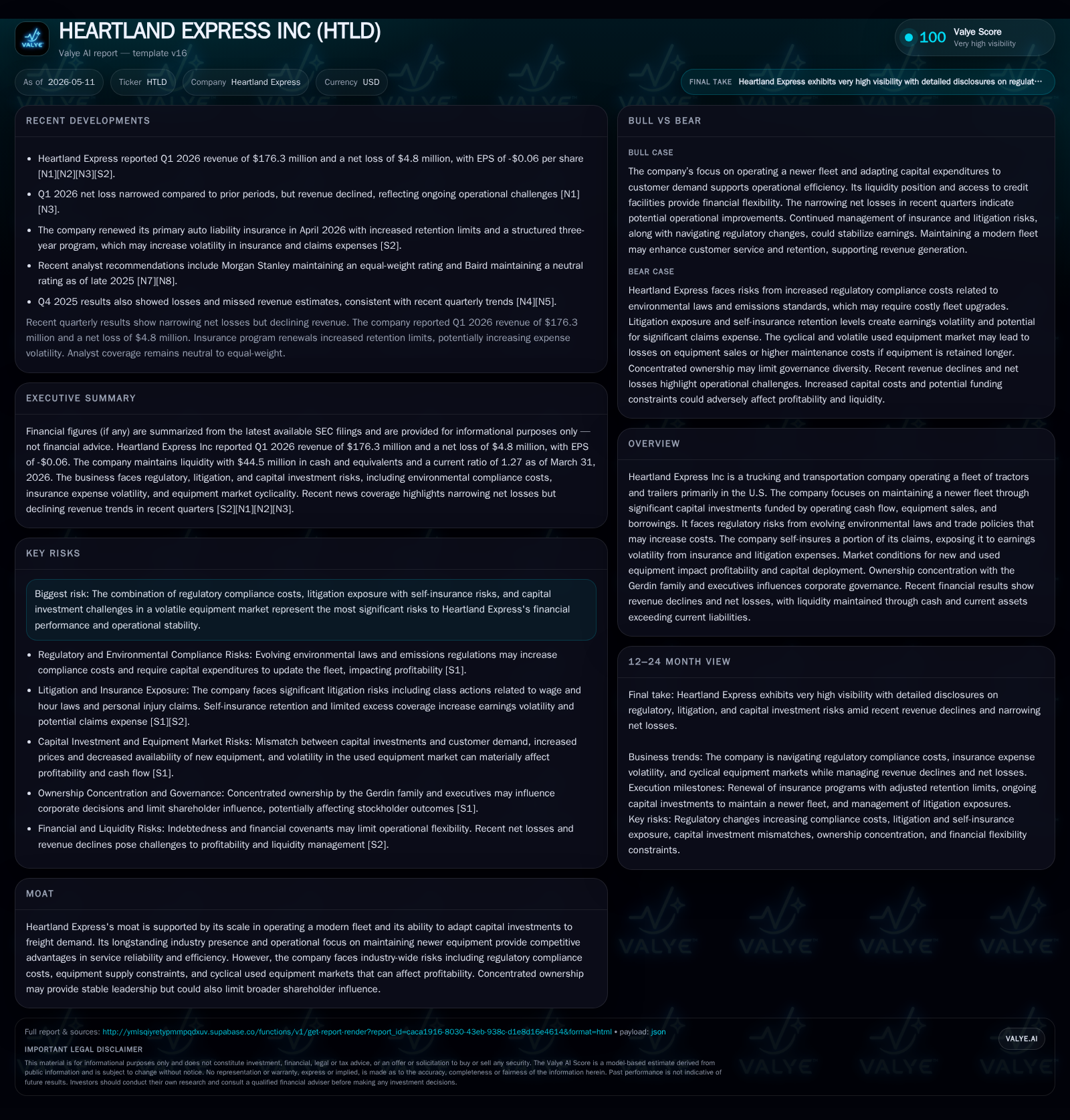
Heartland Express's Q1 2026 results showed a continued revenue decline but a reduction in net losses, driven largely by volatile self-insurance claims and challenging equipment market dynamics. The company's business model centers on maintaining a modern fleet through capital investments funded by operating cash flow and asset sales, which is increasingly tested by regulatory changes and used-equipment market softness. Industry pressures, including evolving environmental regulations and trade tariffs, affect cost structures, while the firm's scale and operational discipline provide competitive advantages. Key risks include earnings swings from self-insurance exposure, regulatory compliance costs, and equipment availability uncertainties. Monitoring forthcoming guidance, litigation developments, and capital spending patterns will be critical to assessing execution going forward.
Q1 2026 Operating Highlights and Their Significance
Heartland Express reported its first-quarter 2026 results showing a continuation of revenue declines alongside a narrowing net loss. While specific Q1 revenue figures are not detailed here, the trend aligns with recent industry softness. The company emphasized increased volatility in its reported earnings due to self-insurance claims exposure outside traditional insurance coverage limits [S2]. This volatility arises from fluctuations in workers' compensation, auto liability, cargo claims, personal injury litigation, and other claim categories linked directly to Heartland’s operations.
Management outlined that actual future claims expenses could exceed prior estimates due to inherent uncertainties in claim severity assessments and the potential for incurred-but-not-reported claims. Such claims activity has introduced amplified earnings swings quarter-to-quarter despite proactive accrual adjustments [S2]. This issue compounds earnings visibility challenges during persistent top-line pressure.
Simultaneously, management cited challenges balancing fleet capital expenditures with an environment characterized by softened used equipment values alongside steady-to-higher new equipment pricing attributable partly to tariffs and regulatory-driven design changes impacting engine efficiency costs [S2][N3][N2]. This dynamic compromises the company’s normally disciplined fleet renewal cadence that supports operating efficiency.
Though the narrowing net loss suggests improved operational cost control efforts relative to prior periods, the ongoing revenue falloff signals continued headwinds in freight volumes or pricing power amidst competitive pressures [N3]. This latest quarterly update sets the stage for a cautious near-term outlook emphasizing risk management around insurance volatility and capital investment execution.
Business Model Focused on Modern Fleet Operations and Customer Service Reliability
Heartland Express generates revenue primarily through long-haul trucking services leveraging a fleet of tractors and trailers across U.S. lanes. Revenue streams stem from contracts with shippers who pay for freight transport services based on factors such as mileage, freight type, rate per mile, fuel surcharges, and contract terms. Profitability depends heavily on managing fleet utilization rates, fuel efficiency linked to modern equipment standards, controlling maintenance costs, and mitigating downtime through reliable service delivery [S1].
A core strategic focus involves maintaining a relatively new revenue equipment fleet through significant annual capital investments financed by operating cash flow supplemented by asset sales (used equipment disposition) and debt when necessary [S1][S5]. New tractors are increasingly outfitted with aerodynamic improvements and safety features that add upfront costs but aim to generate long-term savings via fuel economy gains and accident risk reductions.
This newer average fleet age supports compliance with evolving environmental regulations that mandate lower emissions profiles but also entails higher acquisition costs compared to competitors with older fleets. Customers place premium value on reliability metrics tied to Heartland's stable service offering stemming from its operational scale and consistent equipment performance. These create switching-cost-like effects favoring retention over pure price competition.
However, the capital-intensive nature of continual fleet renewal constitutes a structural challenge; mistiming investments relative to freight demand cycles can result in suboptimal asset utilization or inventory write-downs if used equipment markets soften materially when disposal occurs [S5][S28].
Industry Dynamics: Competition, Regulation, and Equipment Market Nuances
The trucking industry exhibits moderate consolidation with several large players competing alongside numerous regional operators. Heartland’s scale places it among the mid-tier carriers capable of investing in newer fleets but still subject to pressures from large national competitors with potentially more diversified financial flexibility.
Regulatory developments critically shape competitive economics. Federal EPA rules targeting greenhouse gas emissions have increased compliance burdens by requiring newer engine technologies at additional cost [S1]. Recent proposals to repeal certain federal EPA regulations risk prompting states individually enacting their own possibly inconsistent emission standards, complicating planning efforts due to patchwork compliance requirements that may elevate capex demands over time; these added costs pressure margins through higher fleet turnover expenses or costly retrofits if fleets cannot be replaced swiftly [S1][S11].
Trade policy uncertainty surrounding tariffs since April 2025 has inflamed raw material prices impacting suppliers of tractors/trailers—these cost increases ultimately accrue to Heartland via higher purchase prices for new units or increased fuel expense pressures embedded in freight rates where surcharge pass-throughs can lag behind rapid cost changes [S1][S11][S28]. Additionally, truck manufacturers face capacity constraints from labor shortages or supply chain disruptions affecting timely delivery schedules for new assets needed in Heartland’s replacement cycles.
Used equipment markets exhibit cyclicality impacted by broader economic conditions influencing resale values; during downturns excess supply depresses prices forcing carriers like Heartland into potential losses or incremental retention of older less efficient trucks as an alternative—this erodes operating leverage advantages tied to modern fleets [S5][S28]. Thus managing this balance between capex outlays versus residual asset recovery proves critical amid ongoing industry cyclical fluctuations.
Key Growth Drivers Enabled by Capital Investment and Freight Demand Alignment
Structural growth relies on expanding freight volumes driven by general economic activity levels in key sectors served by Heartland's routes (e.g., retail goods distribution). Within this context, Heartland’s ability to flexibly adjust its fleet size allows it to align capacity efficiently with demand shifts given its capital investment programs combined with active used asset marketplace engagement [S1][S5].
Fleet modernization delivers incremental gains through improved fuel efficiency from aerodynamic designs coupled with lower maintenance downtime supporting better asset utilization rates—both contributing positively toward traction on freight yield metrics (revenue per mile after direct expense allocation) which drive margin expansion potential when effectively executed.
Emerging technology adoption remains a latent driver potentially achievable but not explicitly articulated here; however industry-wide trends point toward gradual integration of telematics systems optimizing routing efficiency along with compliance tech reducing penalties or enhancing safety records indirectly benefiting cost structures.
Overall growth is thus predicated on maintaining disciplined capital deployment cycles synchronized tightly with freight demand signals while leveraging operational scale advantages rooted in repeat customers tied closely to reliability outcomes rather than competing solely on price.
Risks Centered on Self-Insurance Exposure, Regulatory Costs, and Market Cyclicality
Heartland's large self-insurance retention exposes it uniquely within peers resulting in pronounced earnings volatility depending upon claim incidence variability related to workers' compensation injuries, vehicle accident liabilities, cargo damage disputes, employment law suits including wage-hour class actions—all leading sources for legal settlements or defense expense accruals beyond standard insurance coverage limits [S2][S18]. These factors create difficulty forecasting quarterly profitability given possible unanticipated claim frequency spikes or lawsuits requiring reserves exceeding historical baselines.
Environmental regulation changes increase not only direct capex in replacing or retrofitting engines compliant with varying state laws but also elevate indirect costs via reporting requirements or penalties arising from non-compliance risks under tightening emission frameworks. Patchwork state standards add complexity elevating administrative overhead burdens disproportionally affecting mid-sized operators like Heartland without multi-state regulatory harmonization [S1][S11].
Capital intensity risk arises from reliance on steady used-equipment market valuations enabling near-term proceeds for replacements; softness or sharp swings here can impair reinvestment strategies prompting longer truck service lives eroding operational efficiencies and increasing per-mile costs sharply impacting profitability at prevailing rate levels [S5].
Governance concentration —with approximately 45% ownership held by founding family members including CEO Michael Gerdin holding multiple leadership roles within both executive management and board chairmanship—may limit independent oversight perspectives potentially constraining strategic flexibility or broader shareholder influence over corporate decisions impacting long-term value creation dynamics [S23].
Upcoming Catalysts: Guidance, Litigation Updates, and Capital Deployment Metrics
Investors should monitor upcoming quarterly earnings publications expected according to standard SEC filing schedules bearing close attention to fluctuations in insurance claim expense trends relative to prior quarters signaling either normalization or worsening volatility [S2][N4].
Pending or active legal proceedings related especially to wage-hour class action lawsuits remain areas of uncertainty requiring disclosure updates capable of materially impacting financial results given substantial settlements historically seen among large trucking firms including Heartland itself [S18][S3].
Capital spending cadence remains crucial — tracking announced planned expenditures versus actual levels deployed toward tractor/trailer acquisitions will offer insights into management’s alignment with evolving market demand conditions; any deviations could serve as early indicators of either fleet optimization success or inventory misalignment challenges weighing on margins going forward [S2][N4].
Freight volume data from customer contracts or industry shipments reports also serve as external validation points corroborating internal utilization assumptions underpinning growth narratives.
Financial Position Snapshot Reflecting Liquidity and Leverage as of Q1
Latest financial snapshot
| Metric | Value | Period |
|---|---|---|
| Cash & equivalents | $44mm | |
| 2026-03-31 | ||
| Total debt | $154mm | |
| 2025-12-31 | ||
| Net debt | $110mm | |
| 2025-12-31 | ||
| Current assets | $143mm | |
| 2026-03-31 | ||
| Current liabilities | $113mm | |
| 2026-03-31 | ||
| Current ratio | 1.27x | |
| 2026-03-31 |
Source: SEC companyfacts cache [F1].
| Metric | Value (USD) |
|---|---|
| Cash & Equivalents | $44.49 million |
| Current Assets | $143.20 million |
| Current Liabilities | $112.56 million |
| Current Ratio | 1.27 |
| Total Debt | $154.06 million |
| Net Debt (approx.) | $109.57 million |
Heartland Express maintains liquidity headroom supported by a current ratio above unity (1.27), reflecting current assets exceeding short-term obligations as of March 31st, 2026 [F1]. Cash reserves stand at nearly $45 million providing reasonable short-term funding flexibility amidst reported losses. However the approximately $154 million aggregate debt imposes leverage considerations particularly with the company confronting episodic earnings volatility linked mainly to self-insurance exposures alongside capex intensity demands that absorb operational cash flows during fleet renewal cycles.
The balance sheet appears adequately structured for ongoing operations under prevailing conditions but underscores critical dependence on stable cash flow generation matched against unpredictable claims expenses plus sustained access to financing markets if required under less favorable economic scenarios.
This analysis is based strictly on documented company disclosures contained within SEC filings dated up to May 11th 2026 supplemented by public news sources noted accordingly. It does not constitute investment advice but seeks solely to elucidate operational dynamics and business model context relevant for informed stakeholder understanding.
Disclaimer: This is research-only, informational analysis and not investment advice. It may include AI-generated interpretation and general industry context. Always verify important details using primary sources.

Comments