
Dropbox's Strategy to Reignite Growth: Leveraging AI and Ecosystem Integration
Dropbox reports a revenue beat in Q1 2026 driven by strong user retention amid ongoing growth challenges.
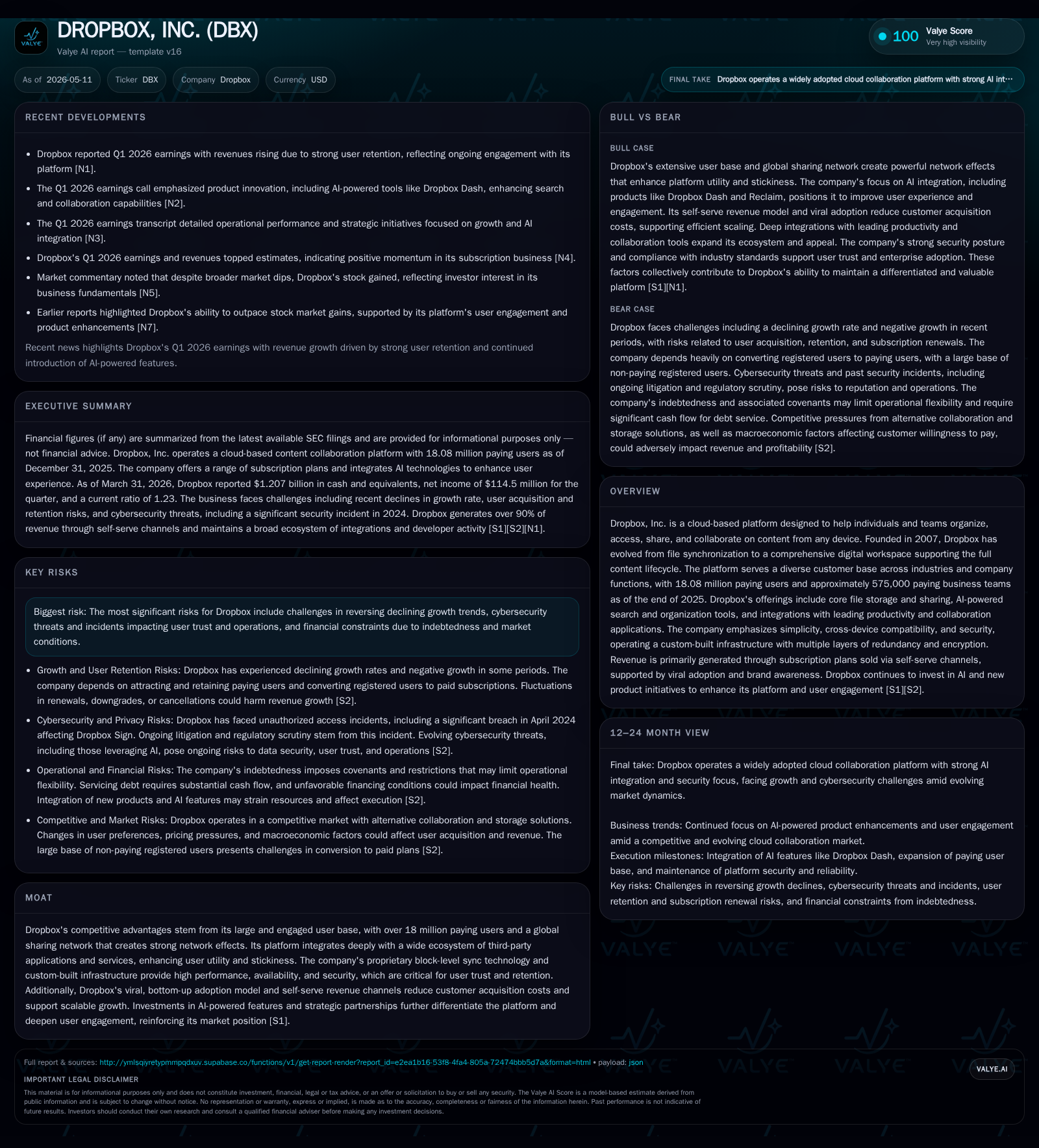
Dropbox's Q1 2026 earnings revealed higher-than-expected revenues supported by solid paying user retention, signaling incremental progress toward reversing prior growth declines. The company continues investing in AI-powered features and deepening ecosystem integrations to enhance platform stickiness and relevance for distributed work environments. While operational complexity and legal risks persist, Dropbox's foundational strengths in user scale, infrastructure, and self-serve adoption model position it for potential growth reacceleration if execution unfolds as planned.
Recent Operating Update: Q1 2026 Highlights and Implications
Dropbox's latest quarterly filing dated May 8, 2026 (10-Q) shows a revenue performance that exceeded analyst expectations driven largely by robust retention metrics among its paying customer base [S2][N1]. The company reported sustaining approximately 18.08 million paying users alongside about 575,000 paying business teams as of year-end December 31, 2025 [S1], indicating that despite prior periods of slowed or negative revenue growth trends flagged as a material risk [S2], Dropbox continues to maintain strong engagement within its core subscription cohorts.
Management’s discussion on the May 7 earnings call highlights that these retention dynamics are critical amid an overall deceleration in new user acquisition. The focus has shifted toward deepening monetization of existing subscribers while advancing AI compute investments designed to enhance user productivity tools embedded within the platform [N2][N3]. This update matters because it signals incremental progress: although growth challenges remain headline risks for Dropbox’s top line owing to competitive pressures and market saturation effects, stabilization via improved retention bodes well for near-term revenue visibility.
Business Model and Product Quality: From File Storage to Digital Workspace
Dropbox generates revenue predominantly through subscription fees paid by individual users and business teams purchasing its cloud content services via self-serve channels (>90% of revenue comes through direct app or website subscription sales) [S11]. Historically a pioneer in file-sync technology leveraging proprietary block-level sync methods delivering superior upload/download efficiency and minimized data transfer overhead, Dropbox now positions itself as a broader digital workspace provider tackling the entire content lifecycle — from storage to collaboration to workflow automation [S1][S19].
The platform emphasizes simplicity with intuitive design optimized for hybrid work scenarios where users access files and collaborative assets across desktops, mobile devices (iOS/Android), and third-party productivity suites [S19]. Seamless integration partnerships—including Microsoft Office tools, Slack/MS Teams (Salesforce), Zoom video conferencing, Atlassian products—enhance platform stickiness by making Dropbox a centralized hub for dispersed information residing outside traditional enterprise silos [S19]. Moreover, an open ecosystem approach reduces friction around device or application switching costs.
Security is engineered into the stack with multi-layer encryption during file transfer plus rest storage complemented by sophisticated network controls built atop their custom cloud infrastructure—a key differentiator trusted by enterprise customers needing auditability coupled with global availability guarantees [S19]. These attributes underpin durable margins tied to subscription renewals rather than transactional usage volatility common in public cloud commoditized storage alternatives.
Competitive Position within the Cloud Collaboration Industry
Dropbox sits firmly in the upper tier of cloud collaboration providers by virtue of its extensive paying user population (over 18 million) which generates substantial network effects through content sharing workflows embedded in personal-to-business communication channels [S1][S22]. Unlike many competitors focused solely on either cloud storage commoditization (Google Drive) or project management (Asana/Trello), Dropbox straddles both efficiently—offering seamless sync combined with embedded productivity enhancements that reduce 'work about work' time.
Its partnerships with dominant software ecosystems (Microsoft Office suite integrations being prominent) elevate Dropbox’s platform relevance within corporate workflows while promoting viral bottom-up adoption facilitated by end-user preference rather than centralized IT mandates [S22]. This self-serve pathway enables lower customer acquisition cost compared to traditional enterprise sales-heavy SaaS models.
However, competition intensifies: Box.com remains entrenched among large enterprises demanding specialized deployment options; Adobe & DocuSign compete in adjacent e-signature markets; emerging AI content indexing startups like Glean or Notion challenge aspects of Dropbox’s newer AI search features; and hyperscale clouds continually threaten pricing paradigms [S22]. Sustaining differentiation thus relies on continuous investment in user experience innovation plus leveraging its proprietary sync tech advantage.
Growth Drivers: AI Innovation, Ecosystem Partnerships, and User Expansion
The most promising future growth avenues identified centre around Dropbox’s AI-powered product enhancements unveiled recently including Dropbox Dash—an AI assistant designed to unify content discovery across multiple apps—and advanced organization/search capabilities aimed at reducing time spent locating files or contextual info across datasets [S2][S3]. While these innovations require upfront investment impacting near-term profitability per management commentary, they represent structurally significant upgrades linked to the rise of distributed workforces requiring more intelligent coordination tools beyond mere file hosting.
Strategic alliances with software platform incumbents such as Microsoft bolster distribution reach and integration depth—helping mitigate risks of feature overlap or disintermediation commonly seen when large vendors seek to internalize third-party platform functionalities [S1][S3]. This partnership breadth combined with reinforced security posture caters well to regulated industries increasing their cloud adoption.
User expansion potential hinges on penetrating more deeply into medium-enterprise segments utilizing team-based subscriptions offering richer analytics and admin controls. Retention improvements documented in Q1 hint at marketplace acceptance of recent feature sets aimed at converting free registered users into paid tiers while limiting churn earlier noted as detrimental to sustained topline growth [S2].
Risks and Constraints: Declining Growth, Security Challenges, and Operational Complexity
Despite positive momentum aspects detailed above, Dropbox candidly acknowledges ongoing headwinds disrupting growth acceleration. Past quarters evidenced negative revenue growth phases attributed partly to intensified competition but also execution challenges related to the introduction of increasingly complex product offerings including nascent AI features requiring organizational resourcing shifts under a 'Virtual First' remote employee model [S2].
This remote-first model imposes operational strain — complicating cross-functional alignment necessary for rapid iteration—potentially slowing customer experience refinements essential in maintaining easy-to-use platform reputation. Additionally, Dropbox faces patent infringement litigation risks notably an upcoming trial scheduled for September 2026 involving Entangled Media LLC; while prior litigation outcomes have favored Dropbox—in validation of non-infringement—the financial burden and distraction risk linger until resolution is final post potential appeals [S21][S23].
Regulatory compliance risks also loom given increased scrutiny over consumer protection laws related to subscription billing practices impacting self-serve revenue channels. Privacy regulations globally introduce cost burdens associated with maintaining market access especially given Dropbox’s handling of sensitive personal/business content requiring robust security certifications maintained at scale [S21][S24].
Upcoming Catalysts and Execution Milestones to Monitor
Investors and industry watchers should closely monitor how effectively Dropbox executes on its AI roadmap rollout throughout calendar year 2026 including key adoption metrics around new Dash functionalities plus measurable impacts on average revenue per paying user (ARPPU) drawn from enhanced upsell capabilities detailed during recent investor communications [N2][N3][S3]. Q2 guidance updates will provide further clarity on management confidence regarding sustained user retention gains amid competitive pressures.
Partnership expansions or novel integrations announced later this year could serve as additional demand indicators validating out-of-the-box utility claims promising workplace simplification benefits. Operational efficiency progress in adapting Virtual First culture towards streamlined decision-making also remains critical undercurrent influencing cadence of product delivery effectiveness.
Finally judicial developments arising from patent litigation trials expected late summer may impose episodic volatility but also confirm IP moat durability if outcomes favor Dropbox conclusively.
Latest Financial Snapshot Supporting Strategic Evaluation
Latest financial snapshot
| Metric | Value | Period |
|---|---|---|
| Cash & equivalents | $1207mm | |
| 2026-03-31 | ||
| Current assets | $1448mm | |
| 2026-03-31 | ||
| Current liabilities | $1176mm | |
| 2026-03-31 | ||
| Current ratio | 1.23x | |
| 2026-03-31 |
Source: SEC companyfacts cache [F1].
| Metric | Value (USD) | Period End |
|---|---|---|
| Cash & Equivalents | 1,207,400,000 | |
| 2026-03-31 | ||
| Total Debt | 1,389,100,000 | |
| 2024-09-30 | ||
| Current Assets | 1,448,400,000 | |
| 2026-03-31 | ||
| Current Liabilities | 1,175,700,000 | |
| 2026-03-31 |
Dropbox retains substantial liquidity cushions with over $1.2 billion cash reserves offsetting gross debt near $1.39 billion measured historically as of September 2024; net leverage stands reasonably low around $182 million based on latest available data [F1]. Current ratio approximates a healthy 1.23 threshold indicating reasonable short-term financial flexibility supporting continued innovation investments without jeopardizing operational funding stability [F1].
Disclaimer: This analysis is for informational purposes only based on publicly available filings as of May 2026. It does not constitute investment advice or recommendations regarding Dropbox securities or any other financial instruments. Readers should conduct independent due diligence considering their own objectives before forming conclusions.
Disclaimer: This is research-only, informational analysis and not investment advice. It may include AI-generated interpretation and general industry context. Always verify important details using primary sources.

Comments