
Union Bankshares Strengthens Core Lending with Enhanced Liquidity Access
Q1 2026 filings reveal Union Bankshares’ prudent liquidity management and steady credit quality underpinning regional banking resilience.
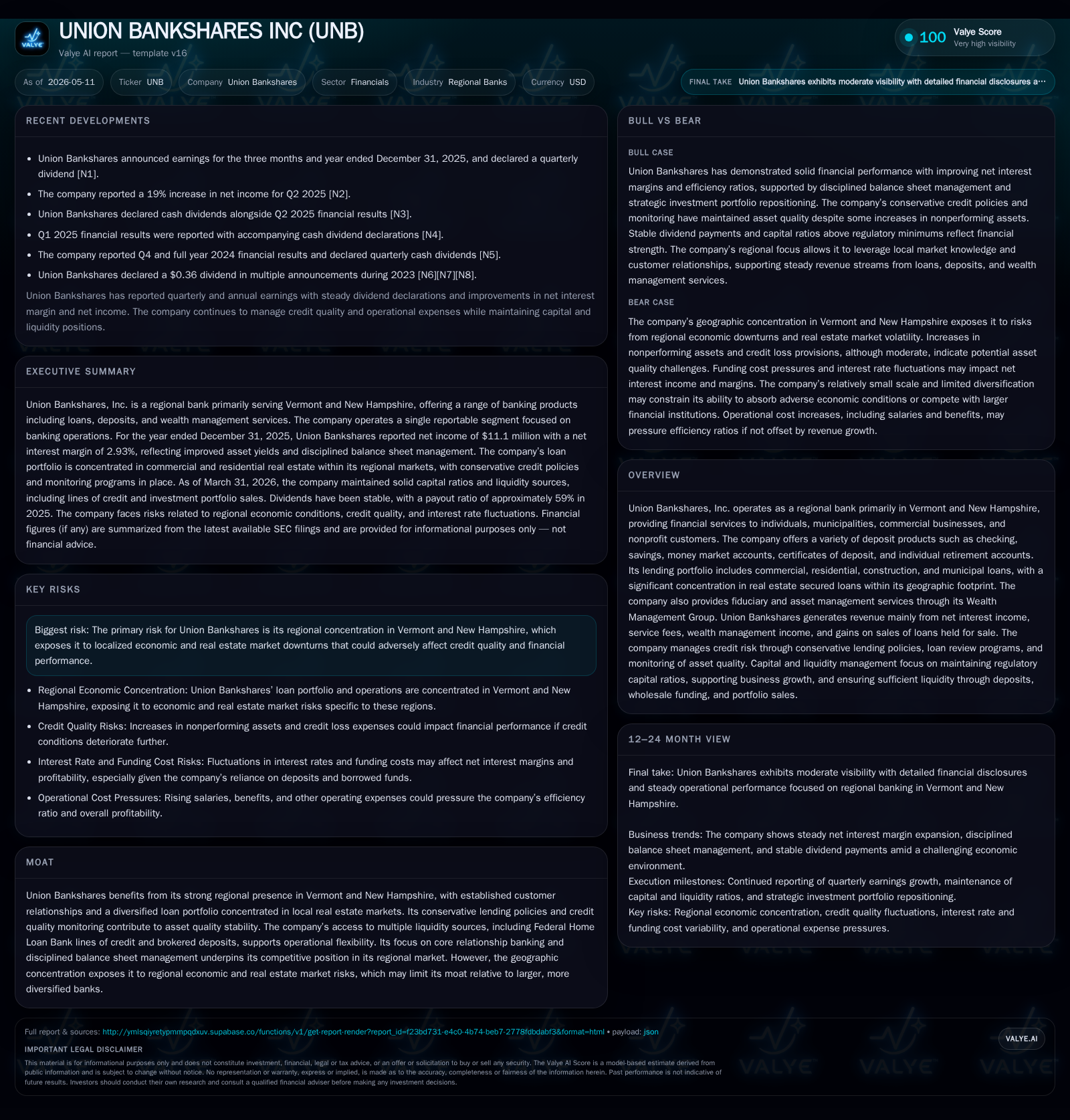
Union Bankshares, Inc. reported in its Q1 2026 filing continued disciplined liquidity management with unused access to $11.4 million in Federal Home Loan Bank credit lines, and participation in FDIC reciprocal deposit programs enhancing funding flexibility. The bank’s core business model centers on relationship banking in Vermont and New Hampshire, with a loan portfolio concentrated heavily in real estate secured lending complemented by wealth management services. While geographic concentration exposes it to local market downturns, Union maintains stable asset quality and improving net interest margins. Near-term focus includes monitoring deposit retention through CDARS/ICS programs and loan demand trends amid competitive regional conditions.
Q1 2026 Operational Performance Updates
Union Bankshares' latest quarterly filing dated May 8, 2026 ([S2]) highlights its robust liquidity profile as a cornerstone of operational stability. The bank maintains substantial unused borrowing capacity of $11.4 million from the Federal Home Loan Bank (FHLB) on top of $357.8 million already drawn, providing ready access to short- or long-term funds as needed. Moreover, Union supplements its funding mix via participation in industry-standard reciprocal deposit programs including Certificate of Deposit Account Registry Service (CDARS) and Insured Cash Sweep (ICS), which collectively enable customers to access unlimited FDIC insurance through reciprocal deposits across other member banks.
As of March 31, 2026, time deposits under $250,000 exchanged via CDARS totaled $10.5 million—statistically flat compared to $11.3 million at the end of December 2025 ([S2]).
Asset quality metrics continue to reflect prudent underwriting aligned with regional economic conditions. Nonperforming assets accounted for about 0.82% of total assets during the quarter, an improvement over the prior-year period ([S11]). The allowance for credit losses on loans held steady near 0.69% of loans not held for sale. Overall, the disciplined approach minimizes credit risk within its predominantly real-estate secured loan book.
The company did not engage in repurchases under its quarterly authorized repurchase program during Q1 but sustained active dividend distribution practices via its Dividend Reinvestment Plan (DRIP), issuing shares from treasury stock to participating investors ([S2]).
Core Business Model and Product Offering Analysis
Union Bankshares’ revenue model primarily revolves around generating net interest income from its diversified lending portfolio concentrated geographically in Vermont and New Hampshire (, [S1]). Key deposit products offered include checking accounts, savings vehicles, money market accounts, certificates of deposit, and IRAs, catering to individual clients alongside municipalities, commercial enterprises, and nonprofits.
The lending mix covers commercial loans—from working capital to real estate—a sizable portion secured by local residential properties as well as construction loans supporting regional development projects (). Conservative loan origination policies emphasize collateral value and borrower creditworthiness to preserve asset quality.
Complementary fee-based income arises from fiduciary activities managed by Union’s Wealth Management Group that oversees asset management services tailored to high-net-worth clients residing within its footprint. Additionally, gains from loan sales contribute sporadically to noninterest income streams.
The symbiotic balance between interest income on loans/investments and fee income enhances overall earnings stability while supporting client retention through comprehensive financial service offerings.
Competitive Position within the Northeast Regional Banking Sector
Operating as a relatively small regional player compared with national banks or large multi-state institutions, Union Bankshares carves out competitive advantages rooted in deep localized client relationships and an intimate understanding of market dynamics specific to Vermont and New Hampshire (, [S1]).
While scale limits broader diversification benefits—which presents vulnerability to region-specific economic downturns—the bank’s focus on relationship banking fosters loyalty that mitigates attrition risks even as digital competition intensifies.
This positioning secures moderate pricing power within core lending segments but concurrently constrains volumetric growth opportunities given demographic density limitations inherent to its territorial scope.
Key Growth Drivers and Market Opportunities
Union Bankshares stands poised to capitalize on several growth vectors anchored by steady improvements in net interest margins—reported at roughly 2.99% annualized for Q1 2026 versus 2.88% a year ago ([S11]). Incremental yield expansion derives from portfolio rebalancing favoring higher-return securities acquired during late 2024 into early 2025 ([S1]), alongside calibrated loan pricing adaptations responding to monetary policy shifts.
Enhancements in deposit gathering are supported by scalable ICS/CDARS offerings that attract balances through federally insured sweep capabilities absent costly wholesale brokered deposits reliance ([S2], ). This strengthens liability franchise durability amid competitive local funding markets.
Growth prospects also reside in modest expansion of the loan book focused on construction financing spurred by regional economic development initiatives plus municipal borrowing needs within the operating territory (). Wealth management revenues offer incremental diversification through cross-selling opportunities leveraging existing banking relationships.
Risks and Constraints: Geographic Concentration and Credit Sensitivity
The primary structural vulnerability is Union’s geographic concentration exclusively within Vermont and New Hampshire markets (, [S1]). This exposes the portfolio substantially to localized economic cycles and real estate market volatility which can amplify credit risk during downturns.
Although conservative underwriting guidelines mitigate default probability presently reflected by low net charge-offs (~0%), allowance for credit loss trajectories remain sensitive to shifts in macroeconomic forecasts under CECL accounting standards (ASU No.2016-13). Unexpected economic shocks or property value deterioration could depress collateral coverage ratios affecting provisioning levels.
Such concentration risk underscores the importance of continuous vigilant asset quality monitoring as disclosed regularly by management ([S2]).
Near-Term Watchpoints: Deposits, Loan Demand, and Capital Actions
Key indicators for subsequent periods include:
- Deposit volume dynamics within FDIC reciprocal programs (ICS/CDARS) revealing client confidence or flight-to-safety movements;
- Loan origination pipeline strength particularly across commercial real estate development projects;
- Utilization patterns on authorized credit lines signaling emerging liquidity needs;
- Quarterly evolution of efficiency ratios reflecting operational leverage amidst expense control efforts;
- Execution pace under share repurchase authorizations versus ongoing dividend policy signalling shareholder return strategy refinement ([S2], [S3]).
Tracking these metrics will elucidate trajectory toward sustained earnings growth balanced against cost management disciplines.
Supportive Financial Profile from Latest Quarterly Results
For Q1 ended March 31, 2026, Union posted annualized returns on average assets (ROA) of approximately 0.74% and return on equity (ROE) near 14.5%, effectively consistent with prior periods despite wage inflation pressures ([S11]). The net interest margin improved modestly by roughly 11 basis points year-over-year owing chiefly to tactical yield gains across earning assets.
Asset quality remained sound evidenced by nonperforming assets holding steady below one percent of total assets alongside robust allowance coverage near 0.69%. Regulatory capital ratios remain comfortably above minimums: total capital to risk-weighted assets stood close to 13%, providing cushion for strategic initiatives or potential stress scenarios.
Efficiency ratios hovered near mid-70s percentage range reflecting controlled noninterest expenses relative to combined interest income plus fee revenue streams—a point meriting ongoing managerial focus given sector-wide pressure on operational leverage.
Dividend payouts reflect disciplined cash deployment aligned with profitability trends while share issuance under DRIP mechanisms supports equity base without diluting per-share metrics materially.
Disclaimer: This analysis is prepared based solely on publicly available SEC filings and company disclosures without investment recommendations or price targets.
Disclaimer: This is research-only, informational analysis and not investment advice. It may include AI-generated interpretation and general industry context. Always verify important details using primary sources.

Comments