
Target Hospitality’s Modular Workforce Housing Faces Capital Constraints on 2026 Growth Path
Latest quarterly results highlight capital challenges impacting expansion despite a robust contract backlog and integrated service offering.
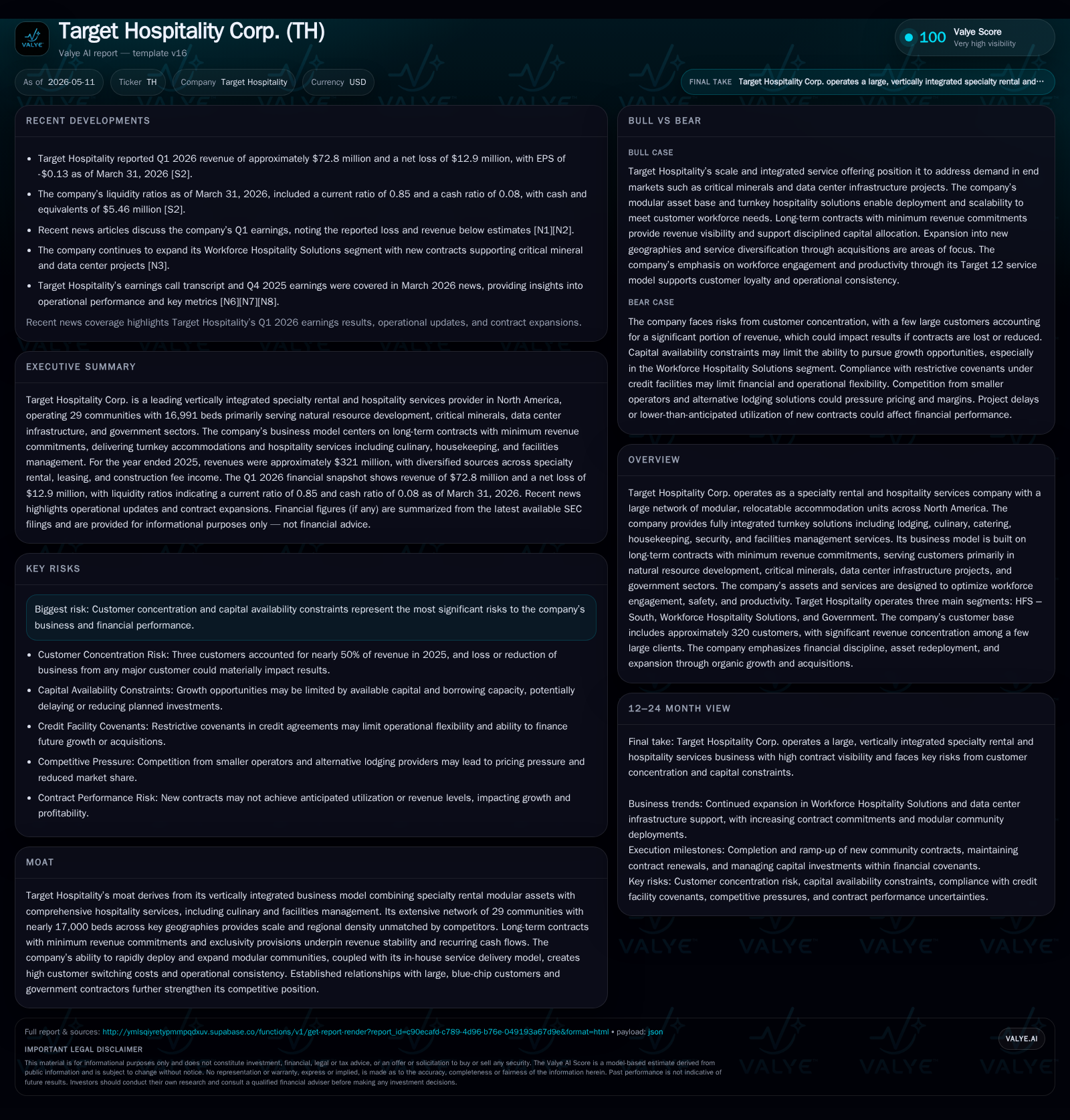
Target Hospitality Corp. reported mixed first-quarter 2026 performance with pressure from capital availability that could delay planned growth investments in its Workforce Hospitality Solutions segment. The company’s vertically integrated business model, combining modular lodging assets with comprehensive hospitality services, underpins stable recurring revenue from long-term contracts with blue-chip clients in natural resources, data centers, and government sectors. However, customer concentration and financing constraints remain key risks that could limit Target’s scalability and margin expansion. Monitoring new contract ramp-up, capital deployment progress, and liquidity developments will be critical for understanding the company’s near-term outlook.
Recent Operating Update
Target Hospitality Corp.'s latest quarterly filing on May 11, 2026 ([S2]) underscores a critical constraint emerging in the company's operating model: limited capital availability is inhibiting the pace of growth investments, particularly within its Workforce Hospitality Solutions (WHS) segment. The company disclosed that despite a strong pipeline of opportunities supported by long-term contracted minimum revenues, if required capital exceeds both operating cash flows and available asset-based lending (ABL) facility capacity, investments may need to be delayed or scaled back.
No additional unsecured borrowings or equity offerings were reported during Q1 2026 ([S9]), signaling a reliance on existing liquidity sources and ABL capacity. This cautious capital stance comes amidst ongoing plans to expand modular accommodations designed to support workforce engagement for natural resource development and critical infrastructure projects.
Alongside this capital update, the company reaffirmed its contractual footing: nearly all revenues are contract-backed with minimum revenue commitments comprising about 16% of total revenues in fiscal 2025 ([S1]). Client retention remains strong with over 90% renewal rates maintained over five years, reflecting high switching costs tied to Target's integrated lodging-hospitality solutions.
Business Model Overview
Target Hospitality operates as a vertically integrated specialty rental and hospitality services provider focusing primarily on modular workforce accommodations strategically located across North America. Its core offering combines relocatable lodging units—totaling nearly 17,000 beds in 29 communities—with an end-to-end hospitality suite that includes culinary services, housekeeping, security, facilities management, and more ([S1], [S23]). These offerings cater predominantly to sectors requiring large temporary labor forces proximate to remote project sites where local housing is insufficient or unavailable.
Revenue generation mechanisms rest largely on multi-year contracts featuring exclusivity provisions and minimum revenue guarantees; operators pay for turnkey accommodations bundled with ancillary services. Pricing derives from negotiated agreements often reflecting project scale, occupancy levels based on workforce size, duration of deployment timelines tied to project lifecycle phases, and service complexity.
Margins are influenced by volume utilization of modular beds, wage inflation in service delivery personnel (e.g., culinary staff), raw materials for hospitality services, and efficiency gains linked to redeployment of assets across locations rather than new construction. The redeployable nature of modular units offers flexibility to optimize return on invested capital while limiting upfront expenditures when compared to permanent housing builds.
Specialty rental income complemented by fee income from construction-related activities diversifies revenue streams alongside hospitality services. Notably, the Government segment encompasses a key long-standing subcontractor role providing residential center operations under GSA schedule contract terms facilitating federal procurement ([S23], [S24]).
Industry Structure and Competitive Position
The workforce accommodations industry targeted by Target Hospitality is characterized by a mix of small independent players serving localized or niche segments and larger vertically integrated providers like Target itself that offer full-service solutions at scale. Across key geographies such as Texas-New Mexico’s Permian Basin region—which is among the most economically viable natural resource basins in the U.S.—Target commands significant regional density unmatched by competitors ([S23], [S21]).
Fragmentation among smaller competitors presents an advantage for Target as its scale enables economies in logistics management, modular construction speed, service standardization (including health & safety compliance), and ability to secure multi-year contract exclusivities. These factors create embedded switching costs for customers reliant on reliable turnkey solutions supporting large workforces requiring consistent housing quality and ancillary amenities.
Government contracts typically involve shorter seasonal engagements or tent providers without comprehensive hospitality services; Target’s ability to deliver full suites under GSA schedules enhances its competitive moat ([S21]).
However, competition may intensify if specialized modular rental providers seek to expand offerings or if natural resource market downturns reduce overall demand volumes.
Growth Drivers
Fundamental demand drivers stem from structural trends: exploration & production activity in natural resources remains linked to commodity pricing cycles but also benefits from sustained investment in critical mineral extraction essential for clean energy transitions. Likewise, data center infrastructure expansions fuel demand for temporary workforce lodging proximate to development sites.[S23]
Target's key growth engine is extending its WHS segment by leveraging redeployable modular assets allowing bespoke configurations tailored to new project geographies without incurring full build-outs—a differentiator versus traditional static accommodation models.[S9]
Additionally:
- Contract renewals with top-tier clients ensure recurring revenues allowing reinvestment into asset upgrades.
- Diversification into emerging sectors such as data centers provides exposure beyond cyclical energy markets.
- Expanding Government segment relationships through GSA schedule contracts facilitates smoother federal procurement access.[S23]
- Modular unit redeployment optimizes asset utilization rates improving cash conversion metrics.
- Strategic geographic targeting of high-demand regions minimizes vacancy risks associated with project shutdowns.[S21]
Risks / Watchpoints / Growth Constraints
Key risks include:
- Capital Availability: Ongoing constraints restrict timely execution of WHS growth opportunities; inability to access financing on favorable terms could force spending cuts impacting topline scalability ([S2], [S9]).
- Customer Concentration: Despite diversification efforts following termination of a major contract (PCC), three clients still represent nearly half of total revenues; loss or downsizing would materially affect earnings ([S7], [S21]).
- Operational Costs: Rising raw material prices or labor shortages threaten margin stability given labor-intensive hospitality services required for seamless delivery ([S18]).
- Contractual Risks: Government contracts carry termination-at-will clauses imposing downside risk; regulatory compliance failures could lead to penalties or disqualifications from federal programs ([S11], [S20]).
- Market Cyclicality: Natural resource spending volatility due to commodity price swings influences workforce housing demand.
- Liquidity Pressures: Quarterly figures indicate low cash reserves ($5.46 million) relative to current liabilities (~$69 million), limiting buffer against adverse shocks without additional financing ([F1]).
- Competition: Emergence of larger competitors replicating bundled service models could erode market share.
What To Watch Next
Investors should closely monitor:
- Contract renewal announcements or expansions within both WHS and Government segments reflecting sustained client trust.
- Progress updates on WHS community expansions or re-deployments indicating effective use of capital amidst financing constraints.
- Financial disclosures detailing liquidity trends including ABL facility usage or equity financing initiatives addressing cash flow tightness.
- Operational metrics such as occupancy rates maintaining target thresholds above industry norms underpinning margin forecasts.
- Regulatory developments impacting federal contracting terms affecting Government segment stability.
Financial Profile Snapshot (Q1 2026)
Latest financial snapshot
| Metric | Value | Period |
|---|---|---|
| Cash & equivalents | $5mm | |
| 2026-03-31 | ||
| Current assets | $59mm | |
| 2026-03-31 | ||
| Current liabilities | $69mm | |
| 2026-03-31 | ||
| Current ratio | 0.85x | |
| 2026-03-31 |
Source: SEC companyfacts cache [F1].
| Metric | Value | Period End |
|---|---|---|
| Cash & Equivalents | $5.46 million | |
| 2026-03-31 | ||
| Current Assets | $58.61 million | |
| 2026-03-31 | ||
| Current Liabilities | $69.23 million | |
| 2026-03-31 | ||
| Current Ratio | 0.85 | |
| 2026-03-31 | ||
| Total Debt* | $181.45 million | |
| 2024-03-31** | ||
| Net Debt* | $176.00 million | |
| 2024-03-31** |
- Total debt figures reflect best-effort estimates as more recent debt information was not explicitly disclosed in the latest quarter; net debt calculated accordingly [F1]. ** Debt data lagging actual period but considered indicative given no contradictory disclosures in recent filings.[F1]
Operating results for fiscal year ending December 31, 2025 showed operating losses ($34.75 million) and net losses ($37.12 million), reflecting ongoing investments towards growth initiatives which continue into current periods.[F1]
This analysis reflects information publicly filed through May 11, 2026. It does not constitute investment advice but aims to provide a grounded understanding of Target Hospitality Corp.'s business operations within its industry context based on official company disclosures.
Disclaimer: This is research-only, informational analysis and not investment advice. It may include AI-generated interpretation and general industry context. Always verify important details using primary sources.

Comments