
Inogen’s Strategic Moves and Operational Shifts in Q1 2026
Inogen introduces inventory valuation adjustments and a new share repurchase plan amid ongoing execution challenges in portable respiratory devices.
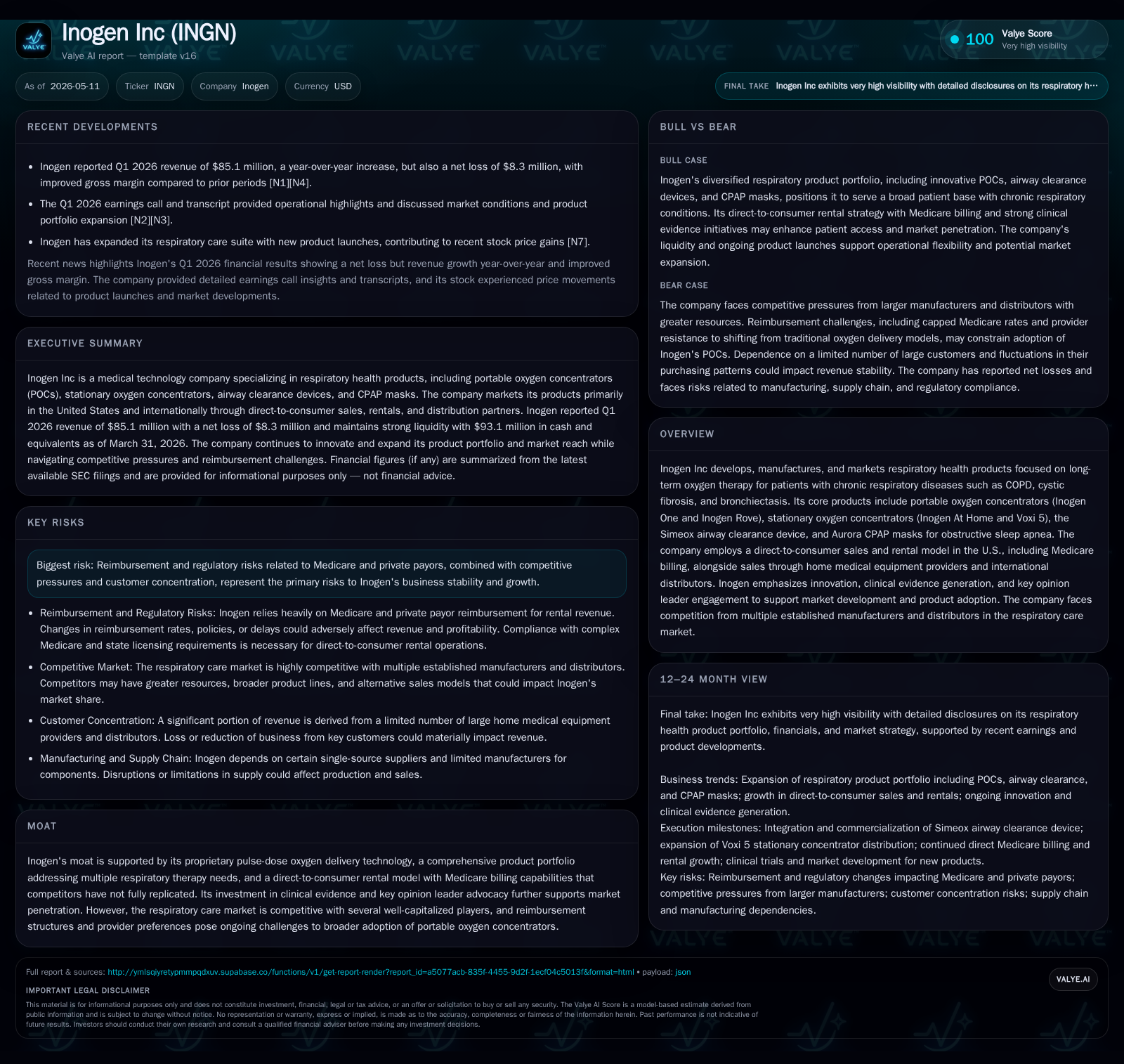
Inogen's Q1 2026 report reveals changes in inventory management practices affecting cost of sales reporting alongside the announcement of a $30 million share repurchase authorization, signaling a strategic pivot in capital allocation. The company maintains its core focus on portable and stationary oxygen concentrators, airway clearance devices, and CPAP masks, leveraging a direct-to-consumer rental model with Medicare reimbursement to sustain competitive advantage. Growth is supported by innovation investments and channel expansions, while reimbursement uncertainties and competitive pressures remain key challenges. Near-term monitoring should track revenue trends under Medicare policies, execution of the buyback program, and progress on product pipeline expansions.
Updated Operating Overview: Q1 2026 Developments
The company’s latest 10-Q filing dated May 8, 2026 ([S2]) details significant operational shifts that bear directly on near-term financial interpretation. Inogen transitioned its inventory valuation method to first-in, first-out (FIFO), accompanied by recorded impairments for slow-moving or excess stock components. This change affects the reported cost of sales as inventory adjustments related to obsolescence are recognized within gross margins. The presence of noncurrent inventory totaling approximately $1.9 million at March 31, 2026 indicates some longer-duration stock holdings beyond the typical turnover window.
Alongside operational items, Inogen announced a $30 million share repurchase program authorized by the Board in February 2026 ([S2]). This buyback initiative sets an upper dollar limit expiring at year-end 2027 or upon full usage and symbolizes a calibrated capital allocation response aimed at reinforcing shareholder value amid a backdrop of reported net losses and mixed earnings performance ([N1], [N4]). Repurchases will comply with SEC Rule 10b-18 provisions including systematic approaches under Rule 10b5-1.
These developments suggest management’s intent to streamline working capital (inventory) accounting for better margin clarity while utilizing excess liquidity strategically through buybacks rather than debt reduction or dividends given balance sheet strength.
Inogen’s Business Model: Product Portfolio and Revenue Streams
Founded in Delaware in 2001 and trading publicly since February 2014 ([S1]), Inogen’s business model centers around developing and commercializing medical respiratory devices targeting chronic respiratory disease patients requiring supplemental oxygen therapy. Its flagship offerings include:
- Portable Oxygen Concentrators (POCs): Inogen One® and Inogen Rove® systems provide battery-powered oxygen concentration allowing patient mobility without reliance on static tanks or fixed concentrators.
- Stationary Oxygen Concentrators: The Voxi® 5 delivers continuous oxygen therapy at home or clinical settings complementing POCs.
- Airway Clearance Device: Simeox®, targeting mucus management for bronchiectasis patients variously affected by COPD or cystic fibrosis.
- CPAP Masks: Aurora® masks for treating obstructive sleep apnea delivered through separate CPAP machines.
Revenue generation primarily arises from a direct-to-consumer rental model, featuring Medicare billing that constitutes a majority of receiving party reimbursements. This setup ensures consistent cash flows over multi-year patient utilization periods while locking customers into Inogen's ecosystem through regulatory complexity and device integration. Complementary channels include home medical equipment providers domestically and distributors internationally — notably expanding into China via collaboration with Jiangsu Yuyue Medical Equipment & Supply Co., Ltd. (Yuwell) ([S1]).
The company's innovation cycle is reinforced by ongoing R&D efforts deploying both internal specialists (29 engineers across multidisciplinary specialties like pneumatics and embedded software) and third-party partnerships ([S1]). Product breadth allows cross-category penetration enhancing overall patient addressable market.
Competitive Context and Industry Positioning
Within the broader respiratory health technology sector, Inogen competes with multiple established manufacturers offering supplemental oxygen solutions as well as adjacent devices targeted at airway clearance and sleep apnea management ().
Its competitive moat derives primarily from:
- Proprietary pulse-dose oxygen delivery technology enabling efficient oxygen dosing with smaller device footprints.
- Comprehensive product suite spanning portable to stationary therapy needs plus complementary pathologies.
- Direct-to-consumer rental model backed by Medicare billing capabilities unique among many competitors who rely solely on HME providers or distributors.
- Sustained investment in clinical evidence generation providing KOL advocacy critical for prescriber confidence and payer acceptance.
Nonetheless, this sector's competitive dynamics remain fierce as larger incumbents with integrated supply chains press margins aggressively. Also challenging is the regulatory-payer environment where Medicare policy shifts or audits can materially disrupt revenue continuity ([S22]). This creates ongoing vulnerability despite technological differentiation.
Growth Catalysts: Innovation, Market Expansion, and Channel Strategy
Growth catalysts for Inogen are multi-pronged:
Product Innovation: Continuously refining POC technology for enhanced battery life, reduced size/weight (e.g., Inogen Rove), plus expanding functional categories into airway clearance devices such as Simeox® addresses adjacent respiratory care needs attracting broader patient cohorts ([S1], ).
Market Expansion: The strategic partnership with Yuwell opens access to Chinese healthcare markets both through reciprocal product distribution rights and joint R&D collaboration accelerating brand recognition overseas ([S1], ). Expansion within existing U.S. markets benefits from demographic tailwinds linked to aging populations requiring long-term oxygen therapy.
Channel Diversification: While direct sales focus on rentals with Medicare reimbursement underpins volumes domestically, growing relationships with home medical equipment providers plus international distributors diversifies customer reach reducing over-dependence on single channels.
Clinical Advocacy & Education: Investment in clinical studies supporting efficacy substantiates reimbursement claims while fostering prescriber endorsements necessary where switching costs inhibit free market adoption.
Measurable indicators include increasing device activations under expanded Medicare coverage announcements and progressive uptake of newly launched products helping margin improvement trends acknowledged in recent earnings calls ([N2],[N3]).
Risks and Challenges: Reimbursement, Competition, and Supply Chain
Inogen’s operational landscape is heavily influenced by external risks:
Reimbursement Uncertainty: Changes in Medicare policies regarding payment rates or eligibility criteria present material risk disrupting revenue streams derived from direct-to-consumer rentals ([S22],). Private payor contracts are less stable adding further variability.
Intense Competition: Entrenched players wield pricing power threatening margin compression; market saturation may limit rapid organic growth without differentiated innovation.
Supply Chain Reliance: Dependency on limited suppliers or contract manufacturers carries logistical risk impacting manufacturing lead times amidst global supply volatility ([S1]).
Order Flexibility Limits Backlog Predictability: Customers can cancel or alter orders without penalties close to shipment date due to just-in-time manufacturing approach reducing backlog visibility as a KPI ([S1]).
Regulatory & Compliance Exposures: FDA approvals must be maintained; audits or enforcement actions relating to billing practices could impose fines or suspend participation in government programs ([S22]).
Mitigating these requires vigilant regulation tracking, diversified customer channels, risk management in procurement processes, along with strong clinical advocacy underpinning payer negotiations.
Key Milestones and What to Monitor Next
Investors should monitor:
- Quarterly revenue trajectory specifically within the portable oxygen concentrator segment reflecting Medicare coverage changes impact ([N2],[N3],[S2]).
- Progression of the $30 million share repurchase plan execution as a signal of management confidence versus opportunistic capital deployment ([S2]).
- Margin trends tied to inventory accounting changes balancing cost recognition against sales volumes.
- Regulatory updates particularly any Medicare coverage revisions or audits pertaining to direct-to-consumer rental billings.
- New product launches especially enhancements in airway clearance devices like Simeox® potentially broadening market share beyond oxygen therapy alone.
- International expansion milestones notably Yuwell partnership outcomes impacting top-line diversification ahead.
Financial Snapshot: Liquidity, Capital Allocation, and Profitability
Latest financial snapshot
| Metric | Value | Period |
|---|---|---|
| Cash & equivalents | $93mm | |
| 2026-03-31 | ||
| Current assets | $191mm | |
| 2026-03-31 | ||
| Current liabilities | $61mm | |
| 2026-03-31 | ||
| Current ratio | 3.1x | |
| 2026-03-31 |
Source: SEC companyfacts cache [F1].
A concise snapshot drawn from latest quarter end March 31, 2026 data provides context supporting operating narratives:
| Metric | Value | Period End |
|---|---|---|
| Cash & Equivalents | $93.1 million | |
| 2026-03-31 | ||
| Total Debt | $80 thousand | Approx. Current |
| Current Ratio | 3.1 | |
| 2026-03-31 | ||
| Net Income | Negative | Latest Period |
The company shows a robust liquidity position with over $93 million cash on hand against minimal debt obligations confirming no immediate refinancing pressure ([F1], [S2]). Despite recent net losses attributed partly to elevated operating expenses amid investments in innovation and marketing capacity building ([N1]), liquidity supports runway for further R&D spending aligned with growth strategy. The newly authorized share repurchase program signals confident use of excess capital aiming to offset dilution or enhance shareholder returns without burdening leverage metrics.
This analysis is based exclusively on published company filings and confirmed disclosures as cited; it contains no investment recommendations.
Disclaimer: This is research-only, informational analysis and not investment advice. It may include AI-generated interpretation and general industry context. Always verify important details using primary sources.

Comments