
Metropolitan Bank's Relationship Focus and Tailored Lending Sustain Growth in Competitive Markets
The recent quarterly filing highlights Metropolitan Bank's stable deposit base, ongoing credit discipline, and strategic regional expansion as key factors underpinning its performance.
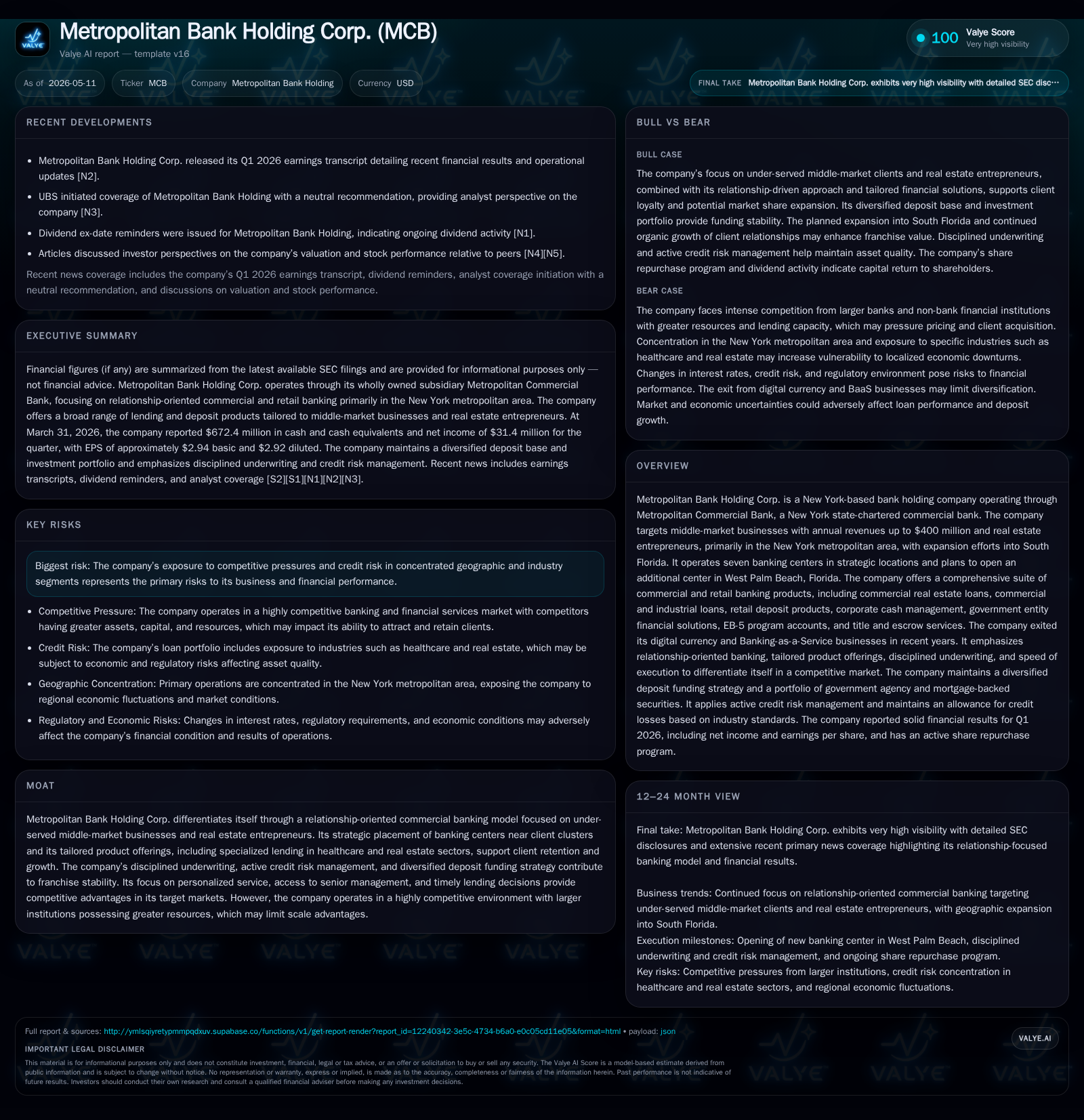
Metropolitan Bank Holding Corp.'s latest 10-Q filing for Q1 2026 confirms continued stability in deposits and loan portfolio quality amid intense competition. The bank's business model centers on relationship-driven lending to middle-market companies and real estate entrepreneurs, predominantly in New York metro with emerging activity in South Florida. Its competitive positioning benefits from specialized underwriting, personalized service, and a diversified deposit funding strategy. Growth is primarily fueled by geographic expansion, healthcare sector expertise, and tailored commercial real estate loans, while risks stem from concentrated credit exposures and competitive pressures. Upcoming milestones include the West Palm Beach branch opening and monitoring credit trends in successive filings.
Latest Quarterly Operating Update
Metropolitan Bank Holding Corp.’s Q1 2026 Form 10-Q, filed May 8, 2026, underscores an operationally steady quarter with no new material risk factors altering the company’s outlook since its last annual report. Crucially, the bank advanced its stock repurchase plan, completing acquisitions of approximately 123,061 shares for $17.5 million during Q1 under an ongoing $100 million board authorization initiated in March 2025, signaling confidence in capital deployment without compromising liquidity [S2].
Regarding balance sheet dynamics reflected through reported financial data as of March-end 2026, cash and equivalents maintain robust levels at approximately $672 million [F1], providing a liquidity buffer to support lending activities aligned with strategic growth objectives.
The company also reaffirmed plans for regional footprint expansion with a new branch scheduled to open in West Palm Beach, Florida—an initiative spotlighted during the April 29 Annual Meeting where executive compensation proposals received strong shareholder approval without dissent [S3]. This move represents Metropolitan’s intent to replicate its proven New York metropolitan success into a geographically proximate but underserved market.
Metropolitan Bank’s Business Model and Product Suite
At its core, Metropolitan Bank deploys a relationship-centric commercial banking model targeting middle-market businesses generating up to $400 million in annual revenue along with real estate entrepreneurs focused on commercial property ventures. Concentrated heavily within the New York metropolitan statistical area—with four locations concentrated in Manhattan complemented by centers in Brooklyn, Great Neck (Long Island), and Lakewood (New Jersey)—the bank’s service network is finely positioned near client clusters to facilitate convenient engagement [S1]. The South Florida expansion signifies an effort to leverage migration patterns and real estate development activity into a new growth corridor.
Revenue generation stems principally from interest income on a spectrum of lending products coupled with fee-based services anchored around deposits and cash management. Loan products include commercial real estate loans spanning acquisition financing, renovations, refinancing of income properties, owner-occupied property loans, construction loans as well as diverse asset classes such as multifamily housing, skilled nursing facilities, offices, hospitality venues, retail outlets, mixed-use developments, and warehouses. This breadth accommodates variability in market cycles while maintaining underwriting discipline focused on long-term cash flow stability and collateral quality metrics including Loan-to-Value ratios typically between 50%-75%, with debt coverage ratios targeted above 1.20x except for select higher-risk property types like hospitality [S1], [S14].
The bank’s commercial and industrial loan book is similarly selective—targeting mid-sized enterprises ranging across healthcare providers (notably skilled nursing homes), wholesalers, manufacturers, importers/exporters, auto leasing firms among others—where loans are secured by business assets such as receivables or equipment backed frequently by personal guarantees from principals. Healthcare exposure represents approximately one-third of C&I loans ($302.9 million), emphasizing a sectoral specialization supported by an experienced lending team adept at navigating regulatory complexity inherent in this space [S5].
Deposit gathering strategies constitute another pillar supporting operational stability. Metropolitan blends traditional retail deposits with corporate cash management accounts servicing property managers or public institutions alongside specialized accounts such as EB-5 investor escrow funds catering to foreign capital interested in qualifying U.S. projects. Such diversification reduces dependency on any single deposit vertical or locality thereby moderating liquidity risk while reinforcing predictable funding for loan growth objectives [S4], [S10].
In sum, Metropolitan balances product depth across CRE and C&I sectors with concentrated geographic targeting driven by personalized banking relationships that emphasize swift lending decisions facilitated by accessible senior management—a competitive feature not readily replicated by larger regional peers constrained by bureaucratic processes [S13].
Competitive Landscape and Industry Positioning
Metropolitan operates within a densely populated banking ecosystem dominated by large national banks boasting superior scale advantages but frequently less flexibility or specialized relationship focus. Its competitive advantage lies in deep sectoral understanding—particularly healthcare lending niche—and proximity to clients which reduces frictional costs associated with acquiring high-quality borrowers.
Despite scale limitations compared with institutions managing billions more in assets nationally or regionally, Metropolitan’s seven banking centers strategically situated allow penetration into concentrated client sectors such as Manhattan’s corporate corridor or Brooklyn's mixed-use neighborhoods known for entrepreneurship. Recent third-party equity research coverage notes that while larger competitors can exert pricing pressure on standardized consumer products due to size or technology investments ([N3]), Metropolitan’s tailored solutions enhance customer stickiness via onboarding integrated banking services as companies grow within their lifecycle stages.
Regulatory oversight arises primarily from New York Department of Financial Services (NYDFS) alongside Federal Reserve System supervision due to its status as a bank holding company—mandating compliance strategies that limit undue risk-taking yet enabling opportunities through prudent innovation chiefly focused away from volatile segments like digital currencies or banking-as-a-service platforms exited recently by management to preserve credit quality focus [S1].
Switching costs remain moderate; however, extensive interpersonal banking relationships combined with custom-tailored loan covenants create meaningful barriers against rapid attrition amid heightened competition. The funding mix featuring both commercial borrowers converted into deposit clients alongside non-lending retail customers further diversifies liability risks boosting overall franchise resilience.
Key Growth Drivers
Metropolitan’s growth trajectory revolves around several strategically aligned levers:
Geographic Expansion: The pending opening of the West Palm Beach branch marks initial penetration into the South Florida market characterized by increasing inflows of residents from the Northeast including New York—the company intends this foothold as a platform for incremental regional acquisition of middle-market clients engaged particularly in CRE development projects [N1], [S3].
Sector Specialization: Leveraging deep expertise in healthcare-related C&I lending sustains pipeline strength amid demographic trends favoring long-term care infrastructure investments; similarly multifamily residential properties continue attracting financing demand given tight housing markets.
Tailored Product Offerings: Continuing refinement of services such as commercial escrow/title processing for complex real estate transactions coupled with EB-5 program account facilitation supports customer retention while augmenting fee income streams enhancing overall profitability.
Disciplined Credit Risk Management: Robust underwriting protocols reinforced by independent loan reviews minimize impairment risks despite concentrated exposure profiles. Early identification frameworks assist proactive resolution preventing credit deterioration; maintenance of adequate allowance reserves aligns conservatively against potential losses over loan lives mitigating downside shocks [S8], [S22].
Digital Infrastructure Post-Digital Currency Exit: While exitting digital currency-related operations reduces short-term revenue avenues potentially forfeited due to elevated risk profiles associated with crypto businesses; reallocating resources toward strengthening conventional online/mobile banking platforms serves broad customer bases thus supporting deposit gathering efficiency without compromising risk appetite.
These factors collectively act as growth rate ceilings requiring judicious balance between expansion ambitions versus conservative risk appetite maintaining franchise health satisfactory to regulators and stakeholders alike.
Upcoming Milestones and Investor Watchpoints
Investors following Metropolitan should track:
Execution progress regarding West Palm Beach branch opening—the timing adherence will be pivotal in delivering early signals on geographic scalability potentials amidst nascent market presence outside core NYC area.
Subsequent quarterly earnings releases will provide updated insights about credit trends particularly within healthcare-related exposures where regulatory/labor environment shifts may influence borrower resilience.
Monitoring any evolution following April 29 stockholder meeting outcomes related to executive compensation structures reflective of alignment incentive frameworks potentially impacting long term management focus areas [S3].
Whether future capital allocation strategies extend beyond current repurchase authorizations incorporating initiatives like increased dividend payouts or potential acquisitions amplifying scale remains a strategic topic for scrutiny.
These milestones offer measurable inflection points signaling either affirmation or reconsideration of growth strategies emphasized currently across filings/narratives.
Financial Overview: Recent Performance Highlights
Financially at quarter-end March 31, 2026, Metropolitan held approximately $672 million in cash and equivalents serving as ample liquidity supporting active lending programs—including CRE and C&I portfolios—and other banking operations without immediate funding stress signals evident thus far [F1]. Last full-year results indicated net income totaled roughly $71 million for fiscal 2025 demonstrating profitability consistency underpinning dividend continuity potential alongside prudent capital returns through share buybacks executed progressively since mid-2025 under board-approved limits [F1], [S2].
The company maintains a stable asset quality profile consistent with stringent underwriting practices emphasizing personal guarantees adjunctive to collateral backing enhancing recovery outlooks under potential distress scenarios [S2]. Balance-sheet composition prioritizes deposit-driven funding supplemented selectively by borrowings allowing agile adaptation without incurring undue leverage risks characteristic of more aggressive regional lenders.
Overall financial posture complements the bank’s operating model centered on medium-sized client relations fostering growth via mutually reinforcing credit discipline and service excellence rather than volume-driven risk-taking.
This analysis discusses facts derived solely from public SEC filings and related sources as specified; it should not be construed as investment advice or recommendations regarding Metropolitan Bank Holding Corp.'s securities.
Disclaimer: This is research-only, informational analysis and not investment advice. It may include AI-generated interpretation and general industry context. Always verify important details using primary sources.

Comments