
Capital Bancorp Reinforces Regional Presence Amid Q1 Headwinds
The latest quarter reveals revenue and earnings pressures but highlights SBA lending strength within Capital Bancorp’s Washington-Baltimore core.
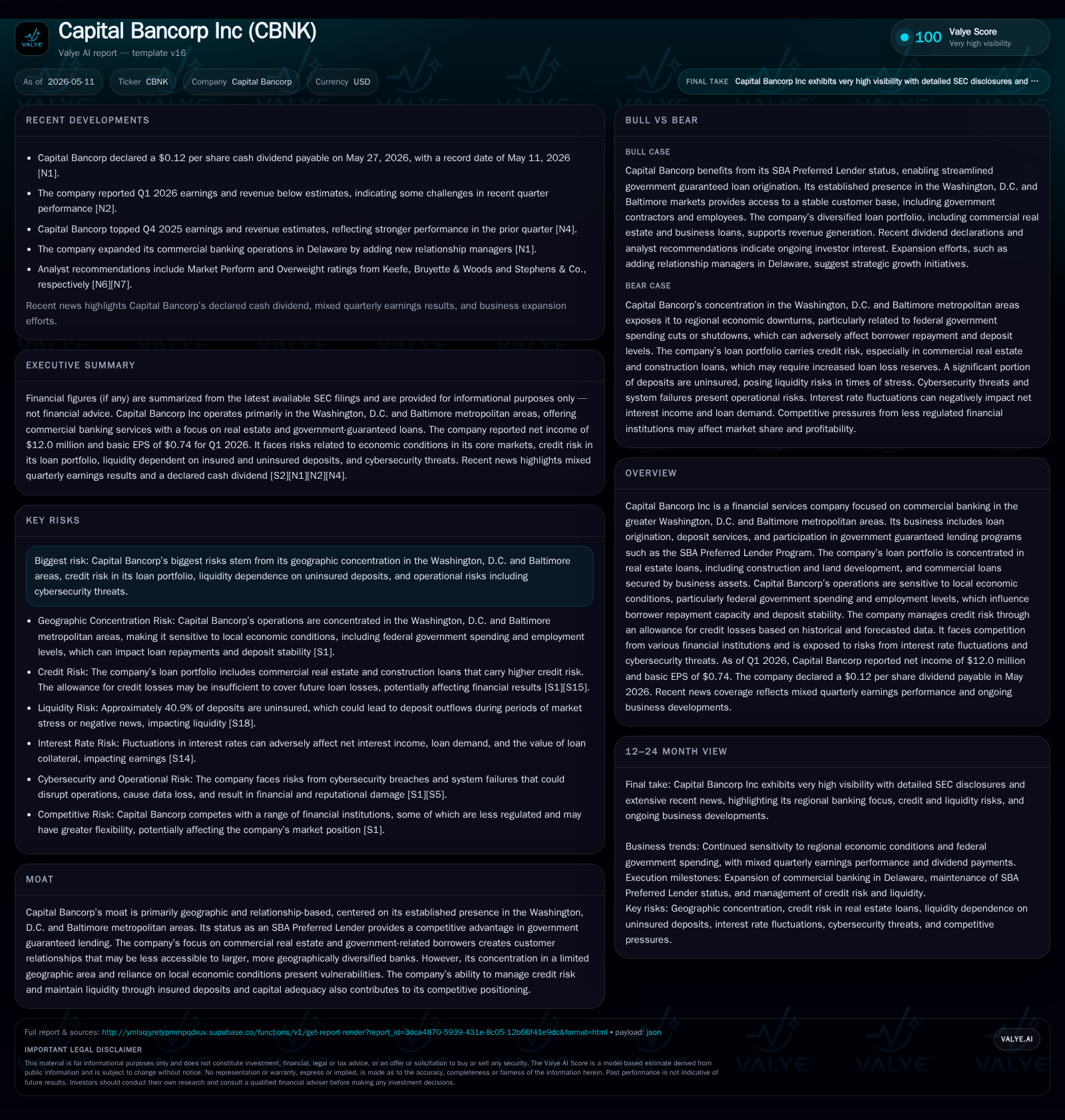
Capital Bancorp’s Q1 2026 results showed a miss on earnings and revenue, underscoring margin challenges linked to its concentrated commercial real estate loan portfolio amid local economic fluctuations. The company’s business model centers on commercial banking services, with a strategic moat leveraging its SBA Preferred Lender status and deep regional ties in the greater Washington, D.C., and Baltimore markets. Growth opportunities hinge on expanding SBA loan originations and capitalizing on local economic recoveries, though credit concentration risks and deposit liquidity remain key vulnerabilities.
Q1 2026 Results Highlighted by Revenue and Earnings Challenges
In its latest quarterly filing dated May 8, 2026 [S2], Capital Bancorp disclosed results for Q1 2026 that fell short of analyst expectations on both revenue and net income. Revenue softness primarily stems from net interest margin compression during continued pressure on commercial real estate (CRE) loan yields within its concentrated Washington, D.C., and Baltimore markets. According to the April 27 event filing and associated press release [S3], the company faced headwinds in loan growth pacing as well as competitive pricing pressures that limited net interest income expansion. These developments come against a backdrop of heightened local economic uncertainty exacerbated by federal government spending restraint.
This earnings miss matters because Capital Bancorp’s financial performance is closely tied to the health of its regional economy and its ability to maintain stable spreads on CRE loans. Margin pressure reduces operating leverage benefits while potentially weighing on investor sentiment given the bank’s community-focused profile.
Business Model Anchored in Commercial Banking and SBA Lending
Capital Bancorp operates as a commercial bank with core activities including loan origination across construction, land development, and other CRE segments as well as commercial loans secured by business assets [S1]. An important component is its participation in government guaranteed lending programs — notably as an SBA Preferred Lender — which grants expedited approval processes for small business loans backed by the Small Business Administration.
This SBA designation enhances pricing stability and volume potential via government guarantees that mitigate credit risk for these loans. Deposits form another critical part of the franchise economics; customers typically deposit primary operating accounts here due to strong local branching presence.
Revenue is mechanically driven by loan volume growth combined with interest spread management over funding costs. Deposit service fees contribute ancillary revenue while regulatory capital adequacy dictates capacity constraints for credit expansion. The company applies allowance for credit losses reflecting both historical performance and forward-looking economic forecasts to safeguard asset quality.
Competitive Positioning within Washington, D.C. and Baltimore Markets
Capital Bancorp’s moat arises primarily from geographic concentration coupled with established customer relationships embedded in the Washington-Baltimore metroplex [S27]. Its SBA Preferred Lender status offers enhanced credibility among small business borrowers relative to generalist banks without such designation. This confers a competitive advantage in accessibility to certain borrower segments reliant on government-backed support.
However, competition remains intense from regional community banks, larger diversified institutions, credit unions, and fintechs offering overlapping services [S24]. Pricing power appears constrained given competitive pressures exacerbated by macroeconomic trends impacting primary borrowers—many connected directly or indirectly to federal government contracting activities.
Furthermore, federal government employment levels influence both borrower repayment capacity and deposits stability since public sector workers constitute a significant share of local populations.
Growth Catalysts: Leveraging SBA Status and Loan Portfolio Expansion
Looking forward, Capital Bancorp plans to capitalize on its SBA Preferred Lender status by expanding volumes within this less commoditized lending channel where government guarantees provide downside credit protection [S3]. Incremental loan originations focused on commercial real estate subsegments with higher underwriting returns also represent tactical opportunities.
The deposit base quality is targeted for enhancement through relationship banking deepening — increasing low-cost core deposits that improve net interest margin resilience. Margins could further benefit if product mix shifts toward higher yielding loans or fee-based SBA products in response to evolving market demand dynamics.
Additionally, pronounced economic recovery signals regionally will support credit demand activation from businesses servicing federal contractors or those benefiting from normalized public spending patterns [N1]. This structural dependence creates cyclical exposure in borrower cash flows and deposits.
Credit risk is heightened due to large concentrations in CRE lending where regulatory guidelines mark thresholds breached by Capital Bancorp’s ratios (e.g., non-owner-occupied CRE loans exceeding 300% of total capital) requiring elevated capital buffers [S26]. This constrains leverage capacity affecting growth pace.
Operational risks persist around cybersecurity threats which could disrupt digital banking services or compromise sensitive data undermining customer trust [S24]. Regulatory compliance costs continue increasing amid evolving rules addressing risk management frameworks especially concerning AI integration trials mentioned in filings [S11].
Key Near-Term Milestones and Execution Watchpoints
Investors should monitor several upcoming indicators including next quarter's loan origination volumes particularly within SBA products; deposit base composition shifts toward insured versus uninsured balances; updates on nonperforming asset trends signaling credit quality trajectory; plus management commentary during Q2 earnings calls providing guidance clarity issuing dividends which have recently been declared at $0.12 per share indicative of capital allocation priorities [N1, S29].
Additionally, any federal government policy changes affecting contractor spending would materially affect localized demand conditions warranting attention.
Concise Financial Overview Reflecting Current Operating Conditions
Cash reserves remain consistent with conservative banking practices but no specific liquidity details were revealed suggesting stable but monitored funding sources consistent with regional peer mid-tier banks [F1]. Overall financial performance underscores near-term challenges tied primarily to external economic influences rather than internal operational failures.
This analysis synthesizes information available through SEC filings up to May 2026 as well as relevant news disclosures. It emphasizes operational dynamics over historical performance snapshots per policy guidelines. As with any bank focused geographically and sectorally like Capital Bancorp Inc., macroeconomic conditions intertwined with regulatory landscapes shape the medium-term outlook alongside strategic execution effectiveness.
This report does not provide investment advice but aims to elucidate corporate fundamentals based strictly on disclosed data.
Disclaimer: This is research-only, informational analysis and not investment advice. It may include AI-generated interpretation and general industry context. Always verify important details using primary sources.

Comments