
Modiv Industrial Accelerates Scale with Global Net Lease Merger
The recent $535 million all-stock merger with Global Net Lease marks a pivotal growth step for Modiv Industrial, enhancing scale and operational reach within industrial REITs.
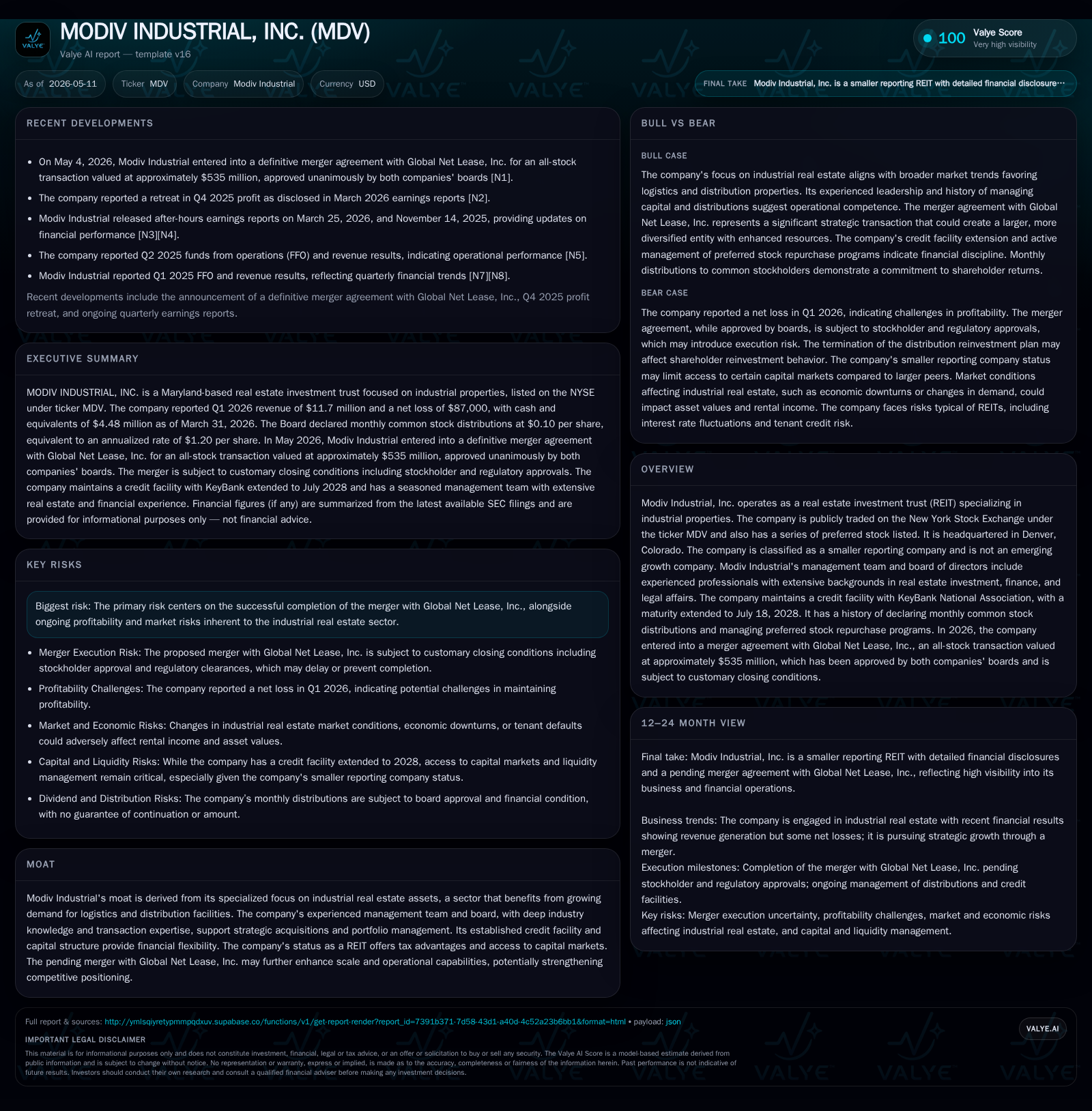
Modiv Industrial’s latest quarterly filing reveals steady liquidity and leverage positioning ahead of a transformative merger agreement announced in early May 2026. Operating as a specialized industrial REIT focused on logistics and distribution real estate, Modiv leverages long-term leases and an experienced management team to generate stable cash flows. The pending merger with Global Net Lease, approved unanimously by both boards, promises scale synergies, expanded geographic footprint, and improved capital market access, reinforcing Modiv's competitive moat in a sector supported by structural demand from e-commerce and supply chain reconfiguration. Risks include merger execution uncertainties and sector cyclicality amid moderate leverage levels.
Quarterly Operating Highlights and Merger Update
In its most recent 10-Q filing dated May 8, 2026, Modiv Industrial disclosed maintaining cash and equivalents of approximately $4.48 million at quarter-end March 31 while carrying total debt of about $274 million, resulting in net debt close to $269.5 million [S2][F1]. This leverage position sits alongside an amended credit facility maturing July 18, 2028, providing reasonable medium-term refinancing flexibility. The company reported stable operating income signals consistent with its established portfolio of industrial assets.
Crucially, on May 3, 2026, Modiv executed a definitive merger agreement with Global Net Lease (GNL), structured as an all-stock transaction valued at roughly $535 million [S3][N1]. Both companies’ boards approved the transaction unanimously. This strategic move is designed to accelerate Modiv’s scale within the industrial REIT landscape by combining their complementary asset bases through a merger of their operating partnerships. The deal sets an anticipated closing window before February 3, 2027, subject to customary regulatory and shareholder approvals [S3].
Modiv Industrial’s Business Model and Asset Quality
Modiv Industrial operates as a real estate investment trust specializing exclusively in industrial properties tailored towards logistics and distribution uses—a segment showing strong structural tailwinds. Revenue generation primarily comes from leasing these assets under long-duration contracts to sizable tenants involved in e-commerce fulfillment or manufacturing supply chains [S1]. This lease profile supports predictable rental streams underpinning operating income stability.
The company emphasizes high-quality asset selection with geographic diversity across major U.S. logistical hubs. Its business model leverages the tax efficiency afforded by REIT status alongside access to capital markets through listed common stock and a cumulative redeemable preferred stock series [S1]. Furthermore, Modiv actively manages distributions to common stockholders on a monthly cadence while maintaining preferred stock repurchase programs funded from equity issuance proceeds or asset dispositions.
Leadership depth is notable: executive officers possess extensive backgrounds in real estate finance, legal affairs, and fund accounting oversight—bolstering acquisition discipline and portfolio optimization capabilities that are critical within specialized industrial property management [S1].
Competitive Positioning in the Industrial REIT Sector
Within the broader industrial REIT arena—dominated by large players like Prologis alongside regional specialists—Modiv situates itself as a niche operator with focused expertise in distributing centrally located warehouse assets aligned with supply chain evolution. This concentration affords certain pricing power advantages amid constrained new build supply frequently experienced in key logistics corridors.
The demand environment driving this sector is largely structural: persistent growth in online retail necessitates expanded fulfillment capacity while geopolitical shifts encourage nearshoring strategies—both strengthening tenant demand fundamentals for modern industrial space [N1][S1]. However, competition remains intense among landlords for premium locations with cutting-edge infrastructure.
Modiv’s moat stems from its specialized asset class focus coupled with disciplined capital deployment backed by seasoned management adept at navigating transactional complexity. Its smaller size relative to industry giants can be both limiting in scale but enabling in agility for targeted acquisitions or disposition decisions.
Growth Catalysts: Merger Synergies and Market Dynamics
The announced merger with Global Net Lease is positioned as a critical inflection point enabling modest yet meaningful scale benefits for Modiv. Combining operations promises enhanced geographic breadth beyond existing hubs alongside streamlined management layers yielding potential cost efficiencies.
Moreover, expanded asset diversification could reduce individual property concentration risks while presenting opportunities for cross-leasing arrangements or tenant sharing initiatives post-close [S3]. The enlarged platform may command improved capital market terms due to increased flotation size and credit profile diversification.
Macro tailwinds complement these internal drivers; resilient industrial demand rooted in secular e-commerce penetration and adjusted supply chains limit vacancy incidence over the mid-term horizon. The integration timeline anticipates consummation well before February 2027’s Outside Date if all conditions are met without significant regulatory or shareholder impediments [N1][S3].
Risks and Uncertainties to Monitor
Execution risk related to the merger remains paramount: both parties must navigate routine regulatory scrutiny plus requisite shareholder consents without material adverse discovery or market disruption delaying completion [S2][S3]. Failure scenarios entail a termination fee of $15 million payable by the breaching party subject to REIT operational limits—a non-negligible cost affecting near-term cash flow plans [S3].
Sector inherent risks also persist such as cyclical shifts impacting tenant creditworthiness potentially influencing occupancy rates or rent escalations. Rising interest rates pose refinancing pressure given current gross leverage levels around $274 million total debt against modest cash buffers [F1][S2]. Tenant concentration commonality within specialized portfolios amplifies downside sensitivity if large lessees encounter financial stress.
Finally, integration challenges post-merger including cultural alignment and systems consolidation must be managed carefully to realize forecasted synergies fully without losing operational momentum.
Upcoming Milestones and Investor Considerations
Stakeholders should focus on several key upcoming events: formal shareholder votes expected following proxy filings related to the transaction; ongoing regulatory review outcomes notably from antitrust authorities; progress reports on integrating back-office functions; plus quarterly earnings announcements pre- and post-close that may reveal initial accretion effects or margin improvements stemming from combined operations.
Distributions represent another watchpoint—whether issued monthly pre-merger distributions continue unchanged post-merger or adjust reflecting altered capital structure or cash flow profiles will materially influence investment valuation considerations [S2][S3].
Current Financial Position and Capital Structure
Latest financial snapshot
| Metric | Value | Period |
|---|---|---|
| Cash & equivalents | $4mm | |
| 2026-03-31 | ||
| Total debt | $274mm | |
| 2026-03-31 | ||
| Net debt | $269mm | |
| 2026-03-31 |
Source: SEC companyfacts cache [F1].
As of March 31, 2026 end of Q1 reporting period:
| Metric | Value (USD Millions) | Date |
|---|---|---|
| Cash & Equivalents | 4.48 | |
| 2026-03-31 | ||
| Total Debt | 273.97 | |
| 2026-03-31 | ||
| Net Debt | 269.50 | |
| 2026-03-31 |
This snapshot evidences modest liquidity positioning adequate for near-term operational requirements alongside stable but material indebtedness consistent with typical mid-sized REIT structures leveraging relatively fixed-rate credit facilities maturing mid-2028. Preferred stock repurchase allowances provide some optionality to adjust capital base funded by equity raises or disposals if strategic need arises. Overall financial stewardship appears conservative enough to balance growth ambitions with manageable refinancing risk concluded from the limited available data points [F1][S2].
This analysis focuses strictly on publicly filed disclosures through early May 2026 without projecting beyond documented facts or forward-looking statements except where explicitly quoted from company filings or press releases. It aims to provide detailed context on corporate strategy execution dynamics for informed readers within real estate investment sectors.
Disclaimer: This is research-only, informational analysis and not investment advice. It may include AI-generated interpretation and general industry context. Always verify important details using primary sources.

Comments