
Cohen Circle Acquisition II Progresses Toward Strategic Fintech Combination
Cohen Circle Acquisition Corp. II upholds strong liquidity and operational readiness as it advances its search for a fintech-focused business combination.
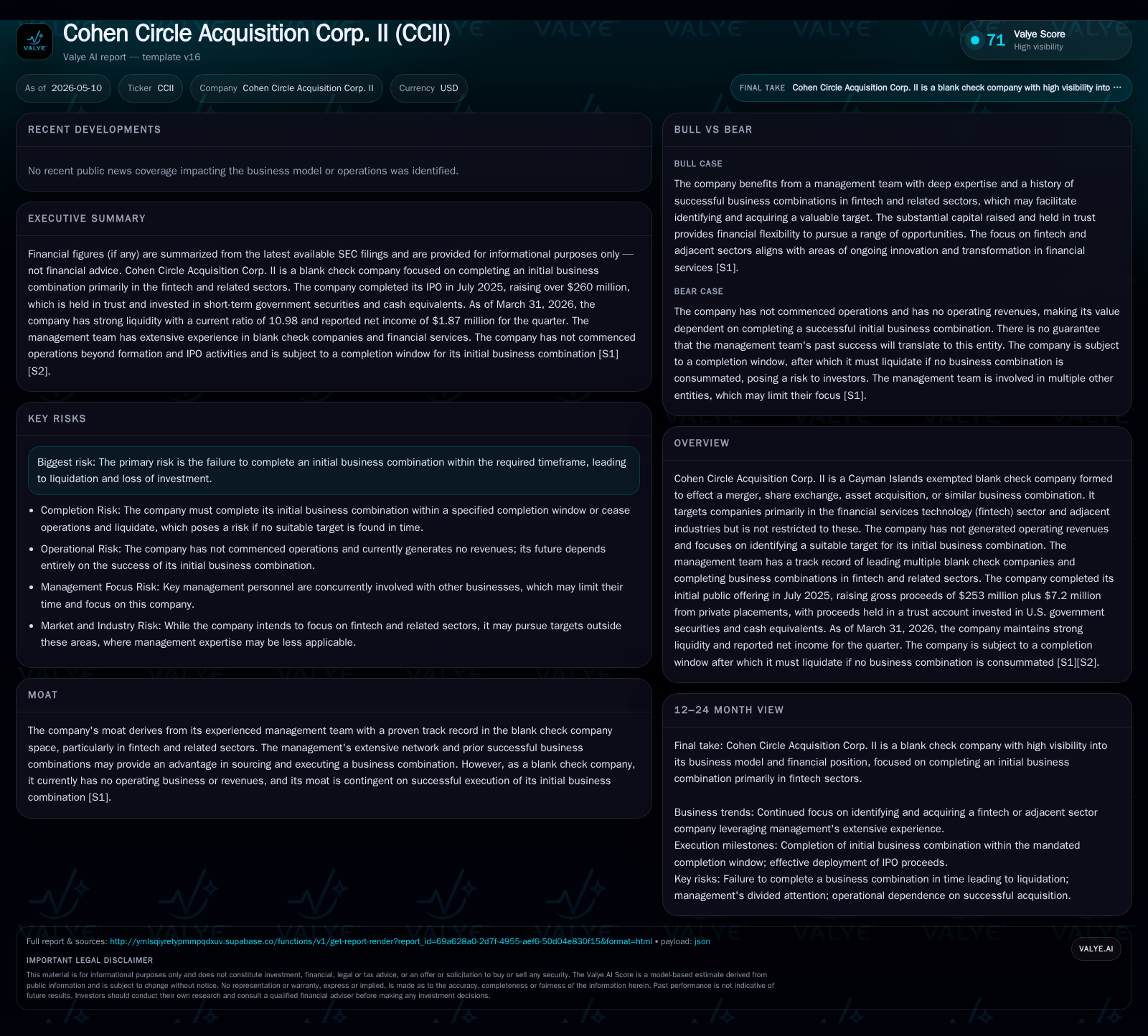
The latest 10-Q filing dated May 8, 2026, shows Cohen Circle Acquisition Corp. II maintaining solid liquidity and reaffirming risk factors as it pursues an initial business combination primarily in the fintech sector. Being a blank check company, its business model hinges on identifying and completing a strategic merger or acquisition, leveraging a management team with proven fintech experience. Growth prospects depend on successfully closing a target deal, while key risks include timeline constraints and rising insurance costs. The company’s financial snapshot confirms ample cash reserves to fund operational costs during this search phase.
Latest Quarterly Update Highlights
Cohen Circle Acquisition Corp. II’s most recent Form 10-Q filed on May 8, 2026, reaffirms the stability of its operating status as it advances toward identifying an initial business combination target primarily in the fintech sector [S2]. Importantly, the filing highlights no material changes to previously disclosed risk factors noted in the preceding annual report dated March 25, 2026 [S1][S2]. This underscores that while operational risks linked to timing and market dynamics remain relevant, no new adverse developments have emerged.
During this period, CCII continues to expend resources primarily associated with due diligence activities, legal, accounting compliance, and other costs endemic to public companies searching for acquisition targets. With no operating revenues generated yet—a standard profile for blank check companies—the company relies on interest income from funds held in trust and sponsor contributions to cover expenses.
Blank Check Company Business Model and Management Edge
CCII operates as a special purpose acquisition company (SPAC), incorporated in the Cayman Islands expressly for effecting an initial business combination through merger or acquisition [S1]. It raised gross proceeds of approximately $253 million through its initial public offering (IPO) in July 2025 supplemented by a $7.2 million private placement, with these funds placed in a trust account invested in U.S. government securities to preserve capital until deployment toward qualifying targets [S1].
The revenue model is void of traditional income streams prior to consummation of an initial business combination; instead, value accrues via successful identification and transactional completion of an acquisition that can generate future operating profits post-merger. Interest income on trust assets provides some non-operating income but is largely offset by general corporate costs incurred during the pre-combination phase.
A critical differentiator is CCII’s seasoned management team known for repeated success within the SPAC ecosystem targeting fintech businesses. The leadership's extensive network and operational expertise enable superior sourcing capabilities and enhanced due diligence effectiveness—constituting an intangible moat relative to peer blank check vehicles [S1][S22]. Such depth often streamlines negotiations and expedites execution timelines.
Competitive Standing in the SPAC/Fintech Sector
Within the broader SPAC environment, CCII competes in a field marked by increasing structural hurdles including tightened terms for directors and officers liability insurance coverage—a significant cost driver adversely impacting financial sponsors across the space [S1]. This cost inflation complicates deal structuring, adding friction to otherwise attractive acquisition models.
Strategically, CCII differentiates itself through targeted concentration on fintech and adjacent sectors such as real estate technology, insurance tech, ecommerce infrastructure, while retaining flexibility for opportunistic deals outside these verticals if compelling [S1]. Sponsor reputation and prior transaction pedigree represent competitive advantages facilitating access to proprietary deal flow often inaccessible to less established peers.
Regulatory headwinds also impose compliance burdens unique to blank check companies navigating Sarbanes-Oxley requirements and evolving SEC guidance—as noted by increased time demands associated with target internal control audits post-closing—potentially prolonging timelines or elevating costs beyond typical M&A transactions [S5].
Growth Drivers Linked to Market Position and Business Combination Prospects
The principal growth vector for CCII is consummation of its initial business combination with a fintech or financial services technology platform offering scalable revenue streams and robust market positioning [S1]. This transformational event transitions CCII from a capital vehicle into an operating public entity generating revenues.
Leveraging executive relationships cultivated over multiple prior SPAC cycles affords access not only to high-quality targets but also financing optionality post-merger—such as PIPE deals or debt facilities arranged through sponsor-affiliated underwriters incentivized by deferred underwriting commissions contingent on transaction closure [S5].
In addition, follow-on strategic acquisitions could expand scale or diversify offerings within the acquired enterprise post-Business Combination, enhancing shareholder value creation opportunities anchored on synergies or rapid top-line growth enabled by fintech innovation trends.
Risks and Constraints in Meeting Business Combination Timelines
Foremost risk remains failure to consummate an initial qualified business combination within the designated completion window per CCII’s governing agreements—leading to mandatory shareholder redemption of public shares funded solely by returns on trust proceeds—and consequent liquidation of invested capital absent alternative pathways [S1][S2].
The challenging environment includes geopolitical tensions stemming from Russia-Ukraine conflict and Middle East instability which introduce valuation uncertainty plus market volatility that may complicate negotiations or restrict viable candidate pipelines [S1]. Additionally, escalating premiums for directors’ & officers’ (D&O) insurance coverage elevate upfront transaction costs which might deter potential targets or sponsors under constrained economics [S1].
Operationally, the ongoing costs of regulatory compliance tied to public reporting obligations consume funds before revenue generation begins; while manageable currently given available liquidity, prolonged search periods increase burn rates risking resource depletion prior to deal closure [S2][S5].
Key Milestones and What To Watch Next
Investors should monitor forthcoming disclosures that might signal progression toward naming definitive acquisition targets or entering definitive agreements as SEC filings typically precede such events.
Attention also should be paid to updates regarding permitted working capital withdrawals from accrued trust account interest—which are reset annually—to gauge runway extension capabilities amid the continuing search phase [S18][S23].
Given statutory deadlines inherent in CCII’s articles of association requiring liquidation absent timely transaction completion (often within two years of IPO), critical upcoming dates approaching mid-2026 will be pivotal inflection points for deal announcements or recapitalization initiatives aimed at preserving equity value.
Management commentary during earnings calls or investor presentations could provide qualitative insights into deal pipeline momentum or challenges surrounding market conditions impacting strategic decisions.
Current Financial Position Snapshot
As reflected in the latest available metrics compiled at quarter-end March 31, 2026 [F1], CCII holds $1,456,830 in cash and equivalents, with current assets totaling $1,672,166 against current liabilities of $152,324.
While no operating revenues exist yet—as characteristic of blank check entities—the company earns interest income on substantial trust account balances (over $253 million initially accrued), partially offsetting general administrative expenses related primarily to legal compliance costs necessary for maintaining public listing status [S1][F1]. This financial footing supports continued target evaluation without immediate liquidity constraints.
Disclaimer: This analysis is based exclusively on publicly filed SEC documents dated through May 8, 2026 ([S1],[S2]) combined with verified financial data ([F1]). It does not constitute investment advice or a recommendation. Investors should consider additional information sources before forming conclusions regarding Cohen Circle Acquisition Corp. II.
Disclaimer: This is research-only, informational analysis and not investment advice. It may include AI-generated interpretation and general industry context. Always verify important details using primary sources.

Comments