
Wendy's Q1 2026: Franchise Model Resilience and System Optimization Drive Results
Wendy’s Q1 2026 results highlight the strength of its franchised business model, supply chain efficiencies, and ongoing system optimization.
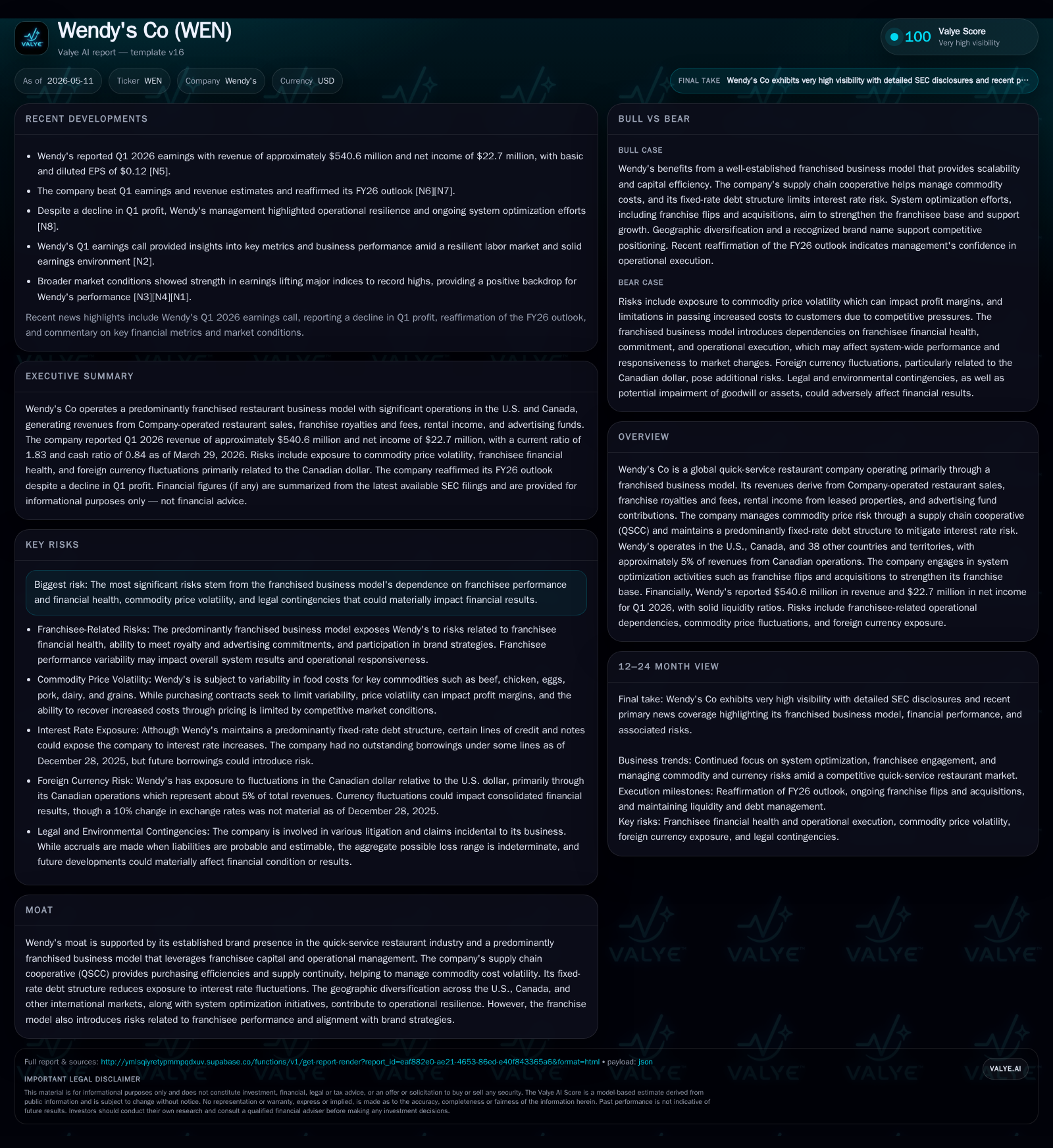
In Q1 2026, Wendy’s Co reported $540.6 million in revenue with net income of $22.7 million, reflecting a decline influenced by operational costs despite solid top-line growth. The company’s predominantly franchised operating model underpins its revenue streams through royalties, fees, and lease income, enhanced by supply chain management via its cooperative (QSCC). System optimization efforts such as franchise flips and acquisitions continue to support growth alongside geographic diversification across the U.S., Canada, and international markets. Risks remain centered on franchisee performance, commodity price volatility, and legal exposures. Financially, Wendy’s maintains strong liquidity with a current ratio of 1.83 and manages interest rate risk through predominantly fixed-rate debt.
Q1 2026 Operating Highlights and What They Signal
Wendy's Co's first quarter of fiscal 2026 marks a continuation of its strategic emphasis on franchising, supply chain management, and system optimization initiatives. According to the latest 10-Q filing dated May 8, 2026 [S2], Wendy's generated revenue of $540.6 million for the quarter ending March 29, 2026, signaling sustained consumer demand in its core quick-service segment despite challenging cost environments. However, net income declined to approximately $22.7 million [S2], reflecting elevated operational expenses that pressured margins.
The quarter included tangible progress in system optimization activities—namely franchise flips and acquisitions—that enhance the quality and operational efficiency of the franchise base. This continued focus reinforces Wendy’s strategy to leverage third-party operator capital while improving unit economics across its portfolio [S2]. The company also reaffirmed its fiscal year 2026 outlook during this period [N13], underscoring confidence in steady growth tempered by ongoing cost management challenges.
Complementing these efforts is Wendy's well-managed commodity exposure through the Quality Supply Chain Cooperative (QSCC), its independent purchasing co-op responsible for contract negotiations with approved suppliers across U.S. and Canadian operations [S1]. By leveraging QSCC’s bulk procurement power, Wendy’s partially offsets raw material price fluctuations in beef, chicken, eggs, pork, dairy, and grains—a critical margin lever given QSR industry sensitivities to input cost swings.
Wendy’s Business Model and Product Offering Quality
Wendy's operates primarily through a franchised business model worldwide. This model generates revenues from several key streams: sales from company-operated restaurants; royalties based on franchisees’ sales volumes; fees related to development commitments; rental income from properties leased or subleased to franchisees; and contributions to advertising funds managed both centrally and locally [S1]. Approximately 95% of operations are franchised, allowing Wendy's to leverage decentralized entrepreneurial vigor while minimizing capital intensity.
Franchisees act as independent operators who pay royalties and fees tied directly to their restaurant performance but independently manage daily operations [S2]. Such alignment incentivizes local responsiveness but introduces operational risks tied to franchisee financial health and adherence to brand standards. Wendy’s brand equity depends heavily on consistent customer experiences delivered by these external parties.
Product-wise, Wendy’s maintains a competitive offering within the quick-service restaurant sector focusing on fresh ingredients like premium beef patties and signature menu items that distinguish it from competitors. Its positioning targets consumers seeking higher-quality fast food while balancing value propositions essential in this highly competitive category.
Competitive Positioning within Quick-Service Restaurants
Wendy's competitive moat is anchored in four principal elements:
- Established brand identity: It holds substantial awareness as one of the leading quick-service hamburger chains globally.
- Franchise-based scalability: By focusing on franchising rather than company-owned units, Wendy’s reduces capital expenditure needs while benefiting from extensive operational footprint expansion.
- Supply chain efficiencies: QSCC provides a structural advantage in negotiating favorable prices amid commodity volatility common in foodservice inputs [S1].
U.S. markets remain core revenue drivers supported by significant penetration into Canada (about 5% of total revenue) and broader international presence across roughly 38 countries [S7]. This geographic breadth helps mitigate localized economic or regulatory shocks but intensifies competitive dynamics given varying consumer tastes and levels of market development.
Pricing power in quick-service remains limited due to intense competition among major players including McDonald’s, Burger King, and newer entrants emphasizing convenience or delivery models. Thus any margin expansion prospects hinge largely on cost efficiencies like those achieved through franchise system enhancements or supply chain negotiation wins.
Capacity constraints are generally not explicit but reflect typical QSR sector challenges—securing prime real estate locations for new unit growth especially in mature urban areas remains competitive.
Growth Drivers: Franchise Optimization, Geographic Expansion, and Supply Chain
Wendy’s identifies several growth avenues actively pursued:
- Franchise flips: Transfers or sales of existing restaurants among more capable franchise operators aim to improve system-wide quality standards and profitability metrics [S2]. These transactions help re-invigorate underperforming units without capital-intensive investment from the Company itself.
- Acquisitions: Selective purchases supplement organic growth by adding strategically desirable units or portfolios within target regions.
- Geographic expansion: While deeply entrenched in North America, efforts continue toward growing presence internationally—a vital hedge against mature market saturation risks.
- Supply chain cooperation via QSCC: Continual refinements enable cost containment or price locking for key commodities reducing margin pressure amid inflationary environments.
- Menu innovation & marketing initiatives: Though less emphasized in filings reviewed here explicitly, sustaining customer engagement through product relevance remains critical for same-store sales growth.
Collectively these drivers contribute to what the company refers to as “system optimization” during early 2026 —a phrase capturing both portfolio refinement actions plus margin improvement initiatives executed at scale across franchises [S2]. Geographic diversification also slightly rebalances revenue concentration reducing single-market dependency risk.
Risks to Monitor: Franchisee Dependencies, Commodity Pricing, and Litigation Exposure
Key risks inherent in Wendy's operating framework are clearly documented:
- Franchisee performance risk: Since the majority of store operations occur under independent ownerships [S15], variability in financial strength or quality controls among franchisees could impair royalty flows or damage brand reputation if standards slip. Moreover, agility in responding to fast-changing market demands may be impeded by varying incentives across franchise partners.
- Commodity price volatility: Although QSCC mitigates some input cost fluctuations [S1], exposure still exists due to market unpredictability especially for protein sources which represent significant menu cost components.
- Legal contingencies: The company faces multiple litigation matters with uncertain outcomes that could materially impact future earnings or cash flows [S3][S4]. While accruals exist where probable losses are estimable, indeterminate damages range wide due to early proceeding stages limiting forecasting certainty.
These risks encapsulate both operational execution uncertainties typical for large franchised QSR entities plus external factors such as raw material markets or judicial/legal developments outside direct control.
Upcoming Catalysts: Guidance, System Enhancements, and Revenue Drivers
Looking ahead through FY26 planners should track several milestones aligning with existing strategy pillars:
- Management reaffirmed full-year guidance during Q1 announcements indicating expectations for steady system-wide sales growth balanced against input cost headwinds [N13].
- Progress on franchise flips/acquisitions providing lift in royalty bases alongside improved unit economics will be closely monitored focus points as evidence accumulates over upcoming quarters [S2].
- Further margin gains could emerge from optimized purchasing contracts negotiated via QSCC or promotional spend discipline enhancing operating leverage.
- Potential product launches or digital ordering improvements though not explicitly detailed here remain traditional levers within quick-service spaces impacting mix/margin dynamics over time.
Investor attention should center on reported KPIs such as royalty revenue trends relative to same-unit sales growth at franchised restaurants plus potential cost-control effectiveness indicators announced periodically.
Financial Snapshot Reflecting Liquidity, Leverage and Profitability
Latest financial snapshot
| Metric | Value | Period |
|---|---|---|
| Cash & equivalents | $299mm | |
| 2026-03-29 | ||
| Total debt | $2.79bn | |
| 2025-12-28 | ||
| Net debt | $2.49bn | |
| 2025-12-28 | ||
| Current assets | $652mm | |
| 2026-03-29 | ||
| Current liabilities | $356mm | |
| 2026-03-29 | ||
| Current ratio | 1.83x | |
| 2026-03-29 |
Source: SEC companyfacts cache [F1].
Liquidity remains solid with current assets comfortably exceeding current liabilities by a factor of nearly two (current ratio 1.83) as per March 29 quarter-end figures [F1]. Total debt is sizeable at approximately $2.79 billion [F1]. Cash holdings of nearly $300 million provide operational flexibility amid ongoing investments in franchise system enhancements [F1].
This analysis synthesizes the latest publicly available SEC filings combined with credible recent news commentary providing a comprehensive view into Wendy’s Co operational posture entering mid-2026 without speculative extrapolation beyond reported facts. It highlights how core franchising strengths intertwined with proactive supply chain coordination position Wendy’s competitively while flagging inherent execution risks primarily stemming from partner dependencies typical in the quick-service restaurant segment.
This article does not constitute investment advice or recommendations but reflects an informed industry analyst perspective grounded firmly in disclosed data sources cited throughout.
Disclaimer: This is research-only, informational analysis and not investment advice. It may include AI-generated interpretation and general industry context. Always verify important details using primary sources.

Comments