
NEXTNRG Faces Liquidity Challenges While Advancing AI-Driven Energy and Mobile Fueling Services
Recent debt financing highlights capital constraints as NEXTNRG pursues growth in smart microgrids and mobile fuel delivery.
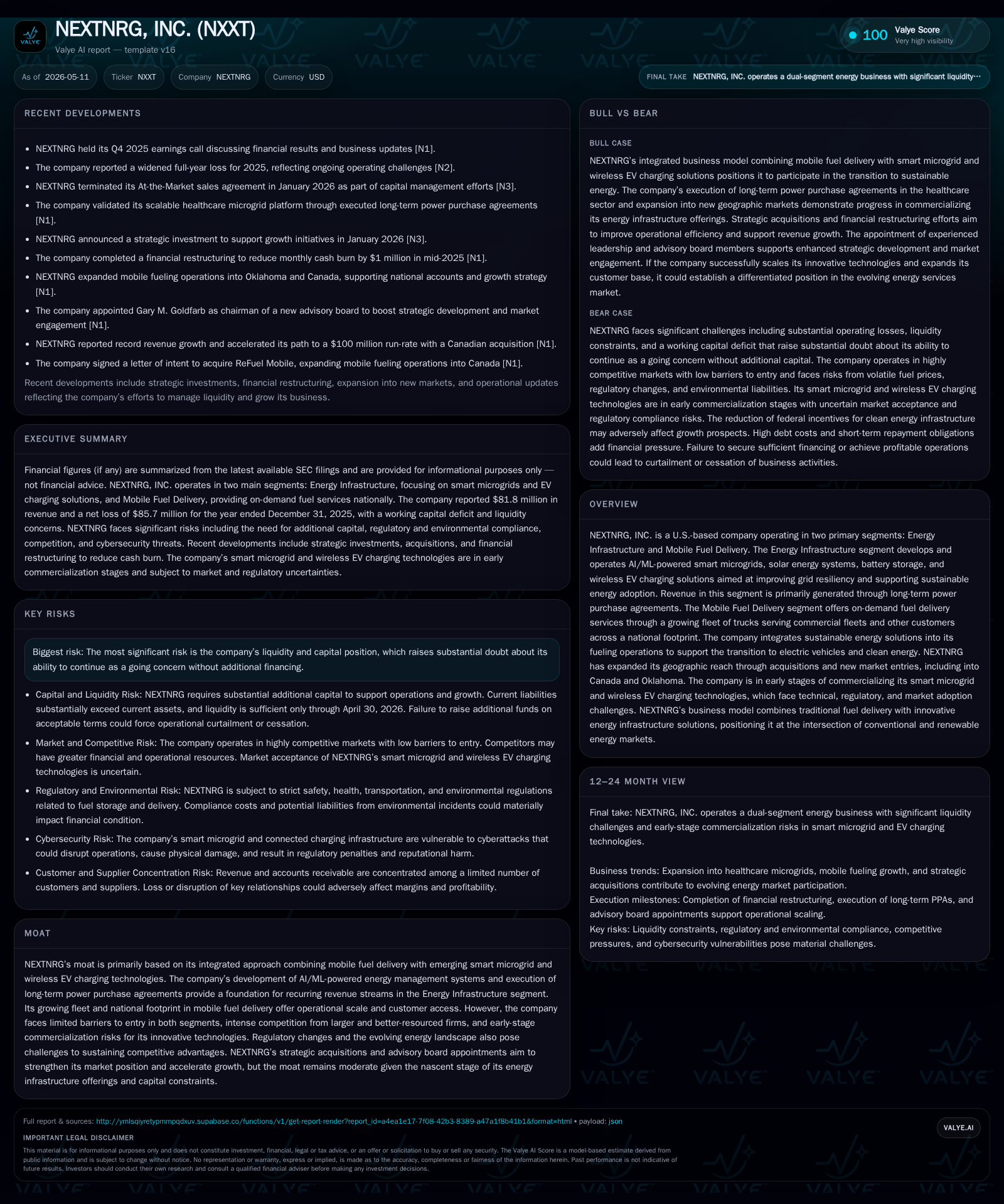
NEXTNRG, Inc. operates two intertwined segments focusing on innovative energy infrastructure solutions and a national mobile fuel delivery service, integrating sustainable technologies. A recent $1 million venture debt agreement underscores ongoing liquidity pressures, with restrictive covenants limiting further borrowing without lender consent. Despite a strategic push into AI-powered microgrids and wireless EV charging, the company’s financials reveal a fragile capital structure and significant losses. Market expansion through acquisitions and new operations signal growth intent, but substantial risks remain around funding sustainability and competitive dynamics in evolving clean energy markets.
Recent Operating Update
On April 27, 2026, NEXTNRG entered into a Business Loan and Security Agreement securing a $1 million venture debt facility from Venture Debt, LLC. After fees, net proceeds were approximately $930,000. The loan carries an unusually high total interest expense of $450,000, effectively pushing the total repayment to $1.45 million due by October 13, 2026. Repayment is structured in 24 weekly installments beginning immediately post disbursement. This arrangement imposes significant pressure on the company’s near-term cash flow given the steep interest cost (~203% annual percentage rate) [S3][S20].
The agreement enforces negative covenants that prevent NEXTNRG from incurring additional indebtedness without prior written consent from Venture Debt, especially concerning credit card advances or working capital loans—violations trigger substantial fees. The lender holds first lien security interests over essentially all assets and may exercise swift remedies upon default including accelerated payment demands and collateral seizure [S5][S20][S28]. This financing move highlights acute liquidity challenges underscored by the company's disclosures indicating cash runway through late April 2026 necessitating urgent capital infusion to sustain operations beyond that date [S1][S24].
Business Model
NEXTNRG operates through two principal business segments:
Energy Infrastructure: This division focuses on the design, deployment, and management of smart microgrids using artificial intelligence and machine learning algorithms that optimize energy distribution and consumption for commercial, industrial, municipal, and tribal clients. Their product suite includes solar arrays, battery energy storage systems, and emerging wireless electric vehicle charging solutions. Revenues are largely generated via long-term power purchase agreements (PPAs), leasing models, and licensing arrangements which can provide steady recurring income streams once projects are operational [S1][N2].
Mobile Fuel Delivery: Operating a nationwide fleet of fuel trucks, this unit provides on-demand fueling services for commercial customers offering convenience alternatives to conventional gas stations. The segment is integrating clean energy technologies such as electrification of its fleet and wireless EV charging support targeting fleet customers undergoing transition to electric vehicles. This combinatory approach aims at building operational scale while tapping into emerging sustainable mobility trends [S1][N2][S16].
Revenue mechanics involve contractual volumes under PPAs for infrastructure segment projects whose economics depend on pricing terms negotiated with utilities or other buyers plus utilization rates of deployed assets. In mobile fueling, revenue derives from volume delivered per customer contract combined with delivery fees; margins can be influenced by fuel pricing volatility as well as fleet operational efficiencies.
Industry Structure and Competitive Position
NEXTNRG situates itself at the intersection of two dynamic but fragmented sectors: distributed clean energy infrastructure technology, including smart grids; and last-mile mobile fueling services evolving to support electric mobility.
Within Energy Infrastructure, there is intense competition from large utilities expanding distributed resources as well as specialized technology providers offering AI or ML controls alongside solar+battery systems. Barriers to entry remain moderate given the modularity of solar/battery tech but innovation in AI-driven grid management and associated intellectual property provide some differentiation.
For Mobile Fuel Delivery, competition includes established fuel logistics firms with deeper capitalization as well as nascent startups targeting EV-related market niches. Scale in fleet size confers advantages in cost efficiency and market penetration but is challenged by regulatory environments related to fuel transport safety and emissions.
NEXTNRG’s relatively integrated model combining these domains along with proprietary AI/ML capabilities forms a niche moat. However, their early-stage commercial deployments entail typical technological execution risks alongside the vulnerability of being out-invested by larger players moving aggressively into these spaces [N2][S1].
Growth Drivers
- Grid Modernization Demand: Growing needs for resilient power delivery amid climate change impacts increase demand for smart microgrid solutions that can operate independently or connectedly within utility systems to manage distributed energy resources effectively.
- Electric Vehicle Transition: As commercial fleets adopt EVs at scale driven by corporate sustainability goals and regulation compliance mandates (e.g., California Advanced Clean Fleets rule), there is rising demand for flexible refueling/recharging solutions like those offered by NEXTNRG’s mobile fuel delivery integrated with wireless EV charging.
- Geographic Expansion: Recent moves including launching EzFill services in Gainesville FL extend market footprint which amplifies revenue potential assuming scalable fleet operations can be maintained without excessive capital drain.
- Strategic Acquisitions: Targeted acquisitions such as the purchase involving GSPP JEA Ingle FL project rights indicate attempted vertical integration or pipeline building in renewable projects though some impairments have been recorded signaling implementation challenges.
- Recurring Revenue via PPAs: Signing long-term contracts underpinning revenue visibility for Energy Infrastructure segment offers foundational support for valuation alignment once stable cash flows materialize.
The combination of these factors underpins structural growth potential hinging heavily on successful technology commercialization along with balanced capital deployment.
Risks / Watchpoints / Growth Constraints
- Liquidity & Going Concern Doubt: Public filings disclose substantial doubt regarding NEXTNRG’s ability to continue as a going concern absent additional financing beyond April 2026; historical operating losses have been significant relative to current asset base [S1][S24].
- High-Cost Debt & Covenant Restrictions: Existing debt instruments carry onerous interest rates with stringent covenants restricting further indebtedness that could stifle operational flexibility or require dilutive equity raises if cash flows falter [S3][S5][S20].
- Technology & Commercialization Risk: Early-stage AI/ML smart grid applications coupled with new wireless charging technologies face adoption uncertainties; project delays or cost overruns could impair margins or stall revenue ramp-up.
- Competition & Regulatory Pressure: Larger incumbents possess scale advantages while evolving energy policies or tariffs may abruptly alter market conditions affecting input costs or exit barriers.
- Legal Contingencies: Litigation arising from prior acquisition disputes (e.g., alleged misrepresentations concerning solar project feasibility) introduces financial exposure or distraction risk [S1].
- Customer & Market Adoption: The pace at which commercial fleets embrace mobile fueling alternatives aligned with clean energy may be uneven geographically; maintaining customer retention amid competitive offerings requires continuous service quality advancement.
What To Watch Next
Investors should monitor:
- Progress on repayment schedule adherence for existing high-interest loans especially the Venture Debt Loan due October 2026.
- Updates on any new equity or debt financings intended to alleviate liquidity pressures.
- Bookings or announcements regarding new power purchase agreements or sizable microgrid deployments indicating tangible revenue momentum.
- Geographic expansion updates especially within growing markets like Florida’s EzFill rollout reflecting scaling capability.
- Legal proceedings outcomes related to acquisition issues that may influence asset valuations or resource allocation.
- Any management commentary clarifying strategic pivots or cost-control initiatives aimed at extending cash runway.
Financial Profile Snapshot (Latest Available)
Latest financial snapshot
| Metric | Value | Period |
|---|---|---|
| Current assets | $3mm | |
| 2025-12-31 | ||
| Current liabilities | $28mm | |
| 2025-12-31 | ||
| Current ratio | 0.11x | |
| 2025-12-31 |
Source: SEC companyfacts cache [F1].
These figures demonstrate a high-burn profile with substantial operating deficits relative to revenues. The imbalance between current assets and liabilities corroborates acute short-term funding stress [F1]. The debt levels combined with recent expensive venture lending exacerbate financial fragility despite efforts to secure financing facilities reflecting lender skepticism about near-term performance viability [S3][S20].
This analysis presents an objective assessment rooted in company SEC filings and recent disclosures as of May 2026 outlining NEXTNRG’s challenging operating environment tempered by promising technology-enabled offerings geared toward decarbonized energy solutions 2626 clean transportation support. Prospective developments hinge critically on capital access continuity alongside execution efficacy within highly competitive sectors undergoing rapid transformation.
Disclaimer: This is research-only, informational analysis and not investment advice. It may include AI-generated interpretation and general industry context. Always verify important details using primary sources.

Comments