
Southland Holdings Focuses Resources to Reinforce Specialty Infrastructure Leadership
Latest quarterly results underscore Southland Holdings’ strategic refocus on specialty infrastructure against liquidity and margin pressures.
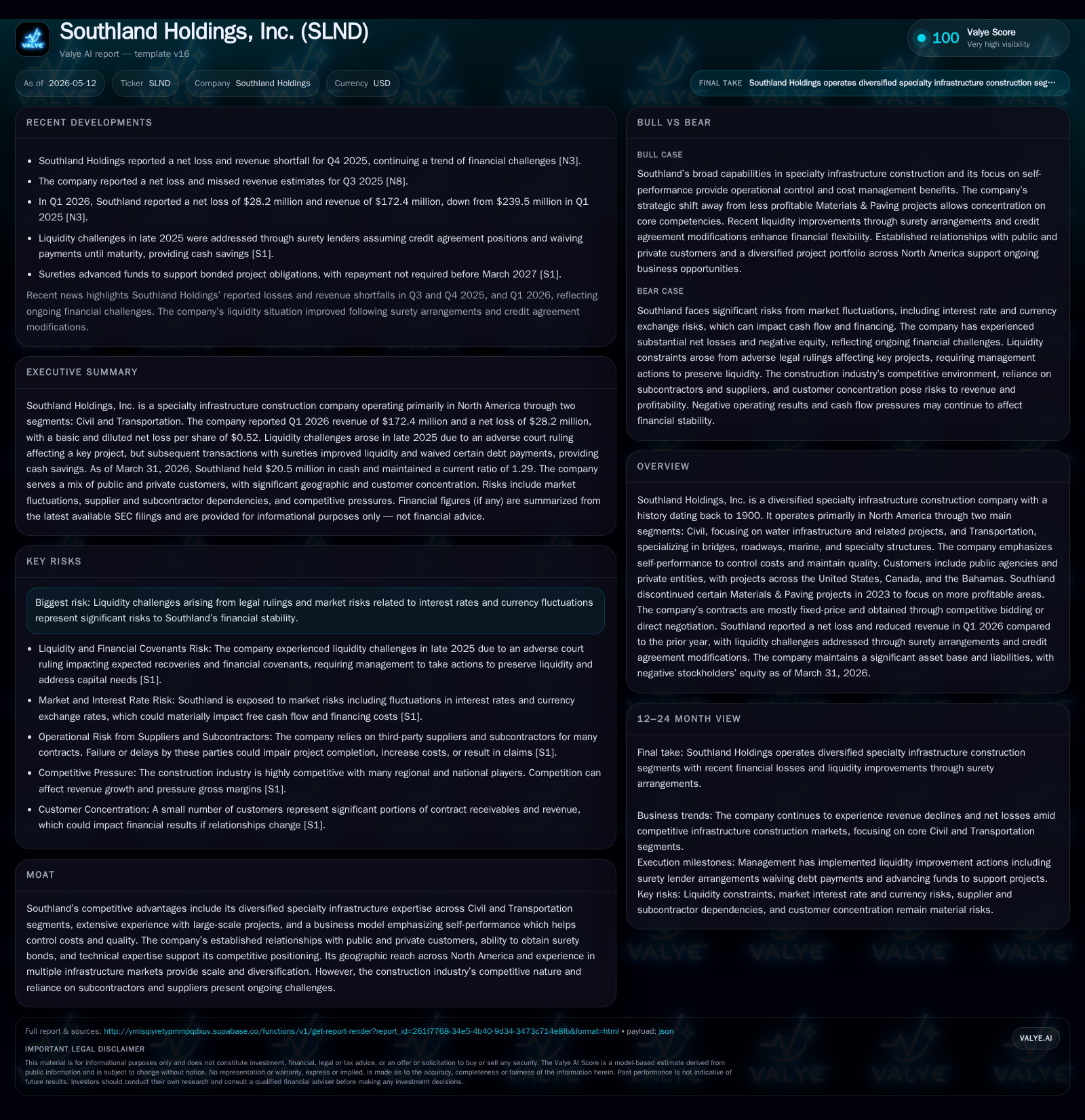
In Q1 2026, Southland Holdings reported reduced revenue and a net loss amid competitive revenue pressures and liquidity challenges linked to an adverse legal ruling. The company continues to emphasize self-performed Civil and Transportation infrastructure work across North America, having exited lower-margin Materials & Paving projects. Surety advances and lending restructuring have mitigated near-term liquidity risks, while ongoing demand from federal stimulus initiatives supports growth potential. Key risks remain in financing costs, legal exposure, and competitive margin compression as Southland navigates these headwinds.
Q1 2026 Operating Performance and Key Developments
Southland Holdings disclosed its Q1 2026 financial report on May 12, highlighting ongoing challenges amid a shifting competitive landscape. Revenue declined relative to the prior year period alongside a net loss, reflecting increased pressure on gross profit margins attributable to competitor migration between public and private sectors. This sector switching creates downward pressure on pricing as competitors pursue contracts wherever opportunities yield better returns, complicating Southland’s own revenue growth dynamics [S2][N1].
Simultaneously, liquidity headwinds stemming from an adverse fourth-quarter 2025 court ruling related to the WSCC Project continue to influence the financial profile. However, Southland achieved meaningful mitigation through sureties assuming lender roles under its credit agreement in March 2026. This restructuring resulted in waived principal and interest payments until September 2028 maturity – an infusion of about $30.2 million in cash flow relief over the next twelve months. Furthermore, sureties advanced funding exceeding $100 million post-year-end in support of bonded project obligations, extending repayment deferral until at least March 2027 [S2][S5][S10].
These developments set a cautious tone for the near term but also reaffirm the company’s ability to maintain operational continuity amid inherent industry volatility.
Business Model and Segment Overview
Southland operates primarily across North America with two core segments: Civil and Transportation [S1]. The Civil segment focuses on specialty services encompassing water pipelines, wastewater treatment plants, pump and lift stations, tunneling activities, alongside concrete and structural steel components essential for municipal water infrastructure projects.
The Transportation segment handles construction of bridges, roadways, marine facilities (including ports and ship terminals), dredging operations, and specialty structures such as convention centers or sports stadiums. This segment is notable for delivering landmark infrastructure requiring significant technical expertise.
Southland has historically emphasized self-performance of significant portions of its work—leveraging internal crews for specialized tasks rather than relying solely on subcontractors. This approach aims to improve cost control and quality assurance but requires maintaining highly skilled labor forces internally.
Customer composition is predominantly public agencies—federal departments, state transportation authorities, local transit bodies—and supplemented by private industrial or commercial clients primarily within the United States but also stretching into Canada and the Bahamas [S1]. Contracts are largely fixed-price awarded from competitive bids or direct negotiation.
Notably since mid-2023, Southland discontinued Materials & Paving projects within its Transportation segment where large-scale asphalt/concrete production was central. This divestiture streamlined focus toward higher margin specialty infrastructure construction areas where scale advantages and technical differentiation are stronger [S1].
Competitive Positioning and Industry Dynamics
Southland’s specialized scope positions it among a niche cohort focusing on technically complex infrastructure projects that require substantial engineering or construction expertise beyond generic civil work [S1]. Its legacy since 1900 fosters trust with many public clients who value consistent performance history.
However, the market is intensely competitive with peers able to flexibly shift resources between public works funded by government budgets and private sector projects dependent on real estate or commercial investment cycles. This dual-sector agility allows competitors to capture work when one sector softens—a dynamic that heightens competition intensity during uneven public spending periods [S2].
Gross profit margins show vulnerability as price competition intensifies; Southland must balance winning bids against maintaining returns while managing subcontractor throughput risks.
Regulatory factors play a role given bonding requirements. Southland’s ability to secure surety bonds influences contract competitiveness significantly; this leverage can both protect incumbents yet constrain expansion if liquidity or creditworthiness deteriorates [S1][S2].
Federal stimulus initiatives particularly the Infrastructure Investment and Jobs Act (IIJA) have injected capital for water system upgrades and transportation projects nationwide—sources that underpin growing demand for specialized construction capabilities embedded in Southland’s portfolio [S2].
Growth Catalysts in Specialty Infrastructure Construction
Renewed spending momentum attributable to economic stimulus at federal/state/local levels remains a clear catalyst supporting backlog replenishment across both Civil and Transportation segments. Given Southland’s established relationships with governmental agencies controlling such funding flows, it stands to benefit from project awards tied to IIJA programs focused on water infrastructure resiliency and freight mobility enhancements [S2][S1].
Operationally, improving contract backlog conversion rates through more effective bidding strategies might enable recovery of previously pressured fee margins. The divestiture of low-margin Materials & Paving assets permits redeployment of management focus and capital toward more profitable project classes where differentiated skill sets command premium returns.
Moreover, specialization in complex marine structures or treatment plants may offer sustainable niche advantages difficult for broader generalist contractors to replicate profitably.
Hence measurable KPIs like new contract awards volume in specialty lines or improved gross margin percentages on Transportation segment heritage projects could serve as early markers for sustained growth trajectories.
Risks and Constraints on Expansion
Foremost among risks is liquidity constraint amplified by legacy legal rulings—specifically involving the WSCC contract adjudication that limited recoverability of claim amounts totaling approximately $89 million inclusive of fees/interest—which tightened financial covenants under the credit agreement [S1][S2]. While recent surety actions alleviated some immediate repayment pressures through loan assumption and payment waivers effective until maturity dates out to late 2028, net debt remains elevated at roughly $215 million compared with limited cash balances ($20.5 million) as of end Q1 2026 [F1][S2].
Interest rate fluctuations pose additional financial risk given borrowing costs linked partly to SOFR plus spread as stipulated in their $140 million term loan facility expiring September 2028. Rising rates escalate interest expenses thereby pressuring free cash flow availability.
Currency volatility impacts are relevant due to cross-border operations notably in Canada/Bahamas which expose contract income streams or supply arrangements denominated partly in foreign currencies.
Competition-induced pricing pressure combined with reliance upon third-party suppliers/subcontractors constrains margin expansion potential; any cost overruns or delivery delays can exacerbate profitability deterioration given fixed-price contractual nature.
These constraints necessitate vigilant covenant compliance monitoring linked especially to liquidity thresholds (must maintain minimum liquidity above $20 million) alongside proactive contracting risk management to avoid surprises impairing results further.
Key Indicators and Near-Term Monitoring
Observers should track:
- Quarterly updates on contract backlog size changes signaling booking momentum or attrition,
- Gross margin percentage improvements evidencing better cost controls or pricing resilience,
- Status reports relating to surety agreement renewals/expansions reflecting financing stability,
- Legal case resolutions potentially releasing contingent liabilities or cash flow offsets,
- Management commentary within upcoming earnings releases regarding bidding pipeline depth especially for federal/state specialty infrastructure projects,
- Cash flow trends demonstrating operating cash sufficiency beyond mere technical profit/loss metrics.[S2][N1]
Such milestones will provide signals whether operational turnaround efforts translate into financial stabilization.
Latest Financial Profile and Liquidity Assessment
Latest financial snapshot
| Metric | Value | Period |
|---|---|---|
| Cash & equivalents | $20.54mm | |
| 2026-03-31 | ||
| Total debt | $235.31mm | |
| 2026-03-31 | ||
| Net debt | $214.77mm | |
| 2026-03-31 | ||
| Current assets | $678.54mm | |
| 2026-03-31 | ||
| Current liabilities | $527.41mm | |
| 2026-03-31 | ||
| Current ratio | 1.29x | |
| 2026-03-31 |
Source: SEC companyfacts cache [F1].
At March 31, 2026, Southland reported cash & equivalents of $20.54 million against total debt of approximately $235.31 million yielding net debt near $214.77 million alongside current assets of $678.54 million versus current liabilities of $527.41 million resulting in a current ratio of 1.29 — indicative of fragile but positive short-term liquidity coverage [F1].
Credit facilities include a four-year secured $140 million term loan maturing September 30, 2028 requiring quarterly principal amortization started end-2024 plus interest at roughly SOFR+7.25%. Recent transactions involved sureties stepping into lender roles waiving principal and interest payments until maturity, thereby avoiding imminent repayment demands that could otherwise trigger covenant defaults [S2].
Surety fund advances over $100 million post-year-end reflect critical collateral support ensuring ongoing project performance without immediate repayments required before March 27, 2027—further bolstering liquidity amid lingering market uncertainties [S2][S10].
It does not constitute investment advice or a recommendation regarding Southland Holdings' securities.
Disclaimer: This is research-only, informational analysis and not investment advice. It may include AI-generated interpretation and general industry context. Always verify important details using primary sources.

Comments