
CorMedix Advances DefenCath Commercialization and Melinta Integration While Managing Regulatory and Supply Risks
Latest quarterly disclosures highlight CorMedix’s expansion in infectious disease therapeutics alongside ongoing clinical programs and market development for its flagship catheter infection prevention product.
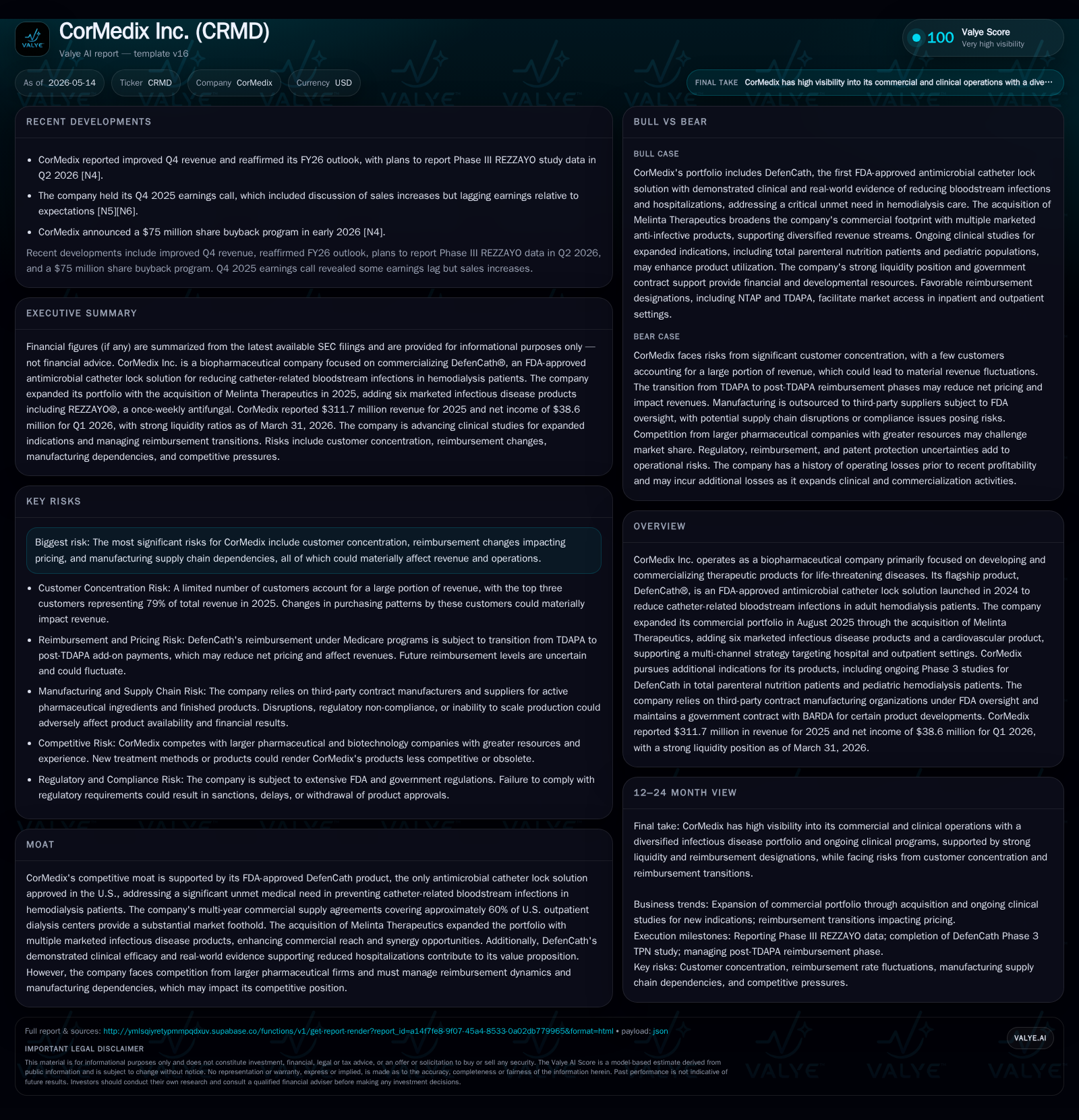
In Q1 2026, CorMedix Inc. continues to leverage its FDA-approved DefenCath antimicrobial catheter lock solution amid ongoing clinical trials for expanded patient indications while integrating its recent Melinta Therapeutics acquisition that broadens its commercial portfolio with six marketed anti-infectives. The company maintains a strong current ratio near 3.0, supporting operational scalability despite inherent risks linked to reimbursement dynamics, manufacturing dependencies, and patent litigation challenges. CorMedix’s growth is anchored on penetrating hospital and outpatient dialysis settings through multi-year supply agreements covering a majority of U.S. outpatient dialysis centers, with potential upside from new indications and synergies from the expanded infectious disease product lines.
Recent Operating Update
CorMedix Inc.’s latest quarterly filing dated May 14, 2026 [S2] reaffirms the steady commercialization trajectory of DefenCath® while integrating its August 2025 acquisition of Melinta Therapeutics. The Q1 2026 results reflected continued efforts to penetrate both inpatient hospital settings and outpatient dialysis centers with DefenCath — an FDA-approved antimicrobial catheter lock solution designed to reduce catheter-related bloodstream infections (CRBSIs) in adult hemodialysis patients. No material changes were reported in the company’s risk factors [S2], maintaining visibility into regulatory compliance, reimbursement challenges, and supply chain dependencies.
The concurrent event filing also includes a financial update confirming sound operating liquidity as the company balances promotional investment for multiple products [S3]. CorMedix is actively advancing Phase 3 clinical trials aimed at expanding DefenCath's label to total parenteral nutrition (TPN) patients — a population highly vulnerable to central line-associated bloodstream infections (CLABSIs) — as well as pediatric hemodialysis patients whose treatment options remain limited [S1]. This clinical push is crucial for broadening DefenCath’s addressable market beyond adult chronic hemodialysis.
Business Model
CorMedix generates revenue primarily through the commercial sale of therapeutic products targeting life-threatening infectious complications. Its flagship product, DefenCath®, is sold directly to hospitals and outpatient dialysis center operators across the United States following its FDA approval in November 2023. DefenCath's pricing is driven by the value proposition of reducing costly bloodstream infections which carry high morbidity among hemodialysis patients reliant on central venous catheters (CVCs). This product’s unique FDA-approved status as the only antimicrobial catheter lock solution in the U.S. confers a significant competitive edge.
In August 2025, CorMedix strategically augmented its portfolio via acquisition of Melinta Therapeutics [S1]. This addition brought six marketed infectious disease drugs — such as REZZAYO® (rezafungin), MINOCIN® IV (minocycline), VABOMERE® (meropenem/vaborbactam), KIMYRSA®, ORBACTIV®, and BAXDELA® — plus TOPROL-XL®, a cardiovascular medication. These products diversify revenue sources and enable CorMedix to implement a multi-channel sales approach targeting hospital ecosystems including emergency departments, outpatient clinics, and home infusion services.
Revenue-driving mechanics include volume-based sales linked to installed patient populations in dialysis centers covered by multi-year commercial supply agreements amounting to approximately 60% of U.S. outpatient dialysis facilities. Pricing is influenced both by payer reimbursement policies—Medicare Part B coverage, Medicaid Drug Rebate Program participation—and contractual negotiations with healthcare institutions [S25]. Additionally, contract manufacturing organizations (CMOs) are engaged under comprehensive FDA oversight to meet capacity while maintaining cGMP standards [S6].
Industry Structure and Competitive Position
The catheter-related infection prevention market is highly specialized and regulated given safety-critical requirements. CorMedix occupies a differentiated niche developing antimicrobial CLSs that directly address CRBSIs — an area with a significant unmet medical need owing to high hospitalization rates and treatment costs associated with infections.
Competition includes large pharmaceutical companies advancing alternative prevention or treatment modalities for vascular access infections. However, DefenCath holds orphan-like exclusivity due to FDA approval as the only product specifically indicated for this purpose in adult hemodialysis patients. The Melinta portfolio products compete against generics and branded anti-infectives used across hospital infectious disease protocols, facing pressure especially on pricing and patent protection.
Barriers include regulatory complexity around approvals for additional indications or label expansions; establishing durable reimbursement; navigating patent challenges such as ongoing Minocin IV litigation; and scaling manufacturing under stringent quality controls. CorMedix’s ability to establish long-term supply contracts encompassing major outpatient dialysis operators reinforces its stable market foothold while ramping its commercial infrastructure post-Melinta acquisition enhances distribution reach [S1].
Growth Drivers
Expanded Patient Indications
Key growth catalysts lie in ongoing clinical trials pursuing FDA approval extensions for DefenCath use in broader patient groups: pediatric hemodialysis patients who have limited existing options for infection prevention and total parenteral nutrition (TPN) patients vulnerable to CLABSIs outside the hemodialysis setting [S1]. Success here would materially increase addressable markets.
Portfolio Synergies from Melinta Acquisition
Melinta’s six marketed anti-infective products bolster recurring revenue streams via established channels in hospitals and outpatient clinics. Their inclusion facilitates cross-selling opportunities targeting serious gram-positive, gram-negative, and fungal infections within integrated care pathways where infection control remains critical.
Multi-Year Supply Agreements
Supply arrangements covering roughly 60% of U.S. outpatient dialysis centers provide revenue visibility based on installed patient volumes rather than solely transactional sales. These contracts underpin stable base demand for DefenCath while allowing incremental growth through increased adoption rates.
Reimbursement Optimization
Active engagement with third-party payors—governmental programs like Medicare/Medicaid alongside private insurers—to ensure favorable coverage terms constitutes an essential driver of uptake. Establishing consistent payment mechanisms facilitates provider willingness to adopt DefenCath broadly rather than resorting to off-label or substitute therapies [S25].
Risks / Watchpoints / Growth Constraints
Reimbursement Dynamics
CorMedix faces key risks around reimbursement policy shifts that could limit pricing power or patient access. Legislative changes increasing scrutiny on drug pricing or tightening budgets among Medicare/Medicaid could lead to reduced payments or coverage gaps impacting revenue flow [S25].
Manufacturing Dependence
Reliance on third-party CMOs introduces supply chain vulnerabilities including possible disruptions impacting product availability or quality compliance issues that might trigger FDA enforcement actions [S6].
Intellectual Property Litigation
Patent infringement lawsuits—particularly involving Minocin IV—pose substantial financial risks if adverse rulings enable generic competition ahead of patent expiry [S20]. Such outcomes could erode revenues from parts of Melinta’s portfolio.
Market Competition & Innovation Risk
Emergence of novel or superior competitor solutions addressing CRBSI prevention or infectious diseases faster or more effectively than CorMedix’s products could limit market share gains or render portions of its portfolio obsolete [S19].
Regulatory Compliance & Post-Marketing Obligations
Maintaining FDA approvals requires rigorous adherence to pharmacovigilance reporting, labeling standards, marketing restrictions, and pediatric study commitments among others. Failure in these respects can result in penalties including suspension or revocation of approvals [S6][S21].
What To Watch Next
- Continued enrollment progress and data readouts from Phase 3 trials evaluating DefenCath’s expanded indications will be pivotal milestones indicative of future growth potential.
- Updates on patent litigation outcomes affecting Minocin IV will clarify portfolio risk exposures.
- Progress in securing broader reimbursement across public and private payors will be critical demand markers for sustainable volume growth.
- Execution against synergy targets from the Melinta integration—including cross-selling effectiveness and salesforce deployment—will impact medium-term financial performance.
- Any supply chain disruptions or regulatory action announcements related to manufacturing quality warrant close monitoring due to their immediate operational impact.
- Explicit guidance updates on full-year DefenCath sales forecasts will help calibrate growth expectations post-Q1 results.
Financial Profile Summary (As of March 31, 2026)
Latest financial snapshot
| Metric | Value | Period |
|---|---|---|
| Cash & equivalents | $178mm | |
| 2026-03-31 | ||
| Current assets | $383mm | |
| 2026-03-31 | ||
| Current liabilities | $129mm | |
| 2026-03-31 | ||
| Current ratio | 2.98x | |
| 2026-03-31 |
Source: SEC companyfacts cache [F1].
CorMedix reported no material new financial details in its Q1 filing beyond maintaining strong liquidity metrics supporting ongoing operations [S2][F1]. Key balance sheet points:
- Cash & Equivalents: $178 million [F1]
- Current Assets: $383 million [F1]
- Current Liabilities: $129 million [F1]
- Current Ratio: Approximately 2.98, indicating robust short-term financial health supporting working capital needs [F1]
This analysis synthesizes SEC filings up through May 14, 2026, news releases through early May, company disclosures regarding clinical development progress, business strategy implementation post-acquisition, regulatory landscape complexity, competitive dynamics within specialized infection control therapeutics markets, intellectual property environment exposures, operational risks related to manufacturing dependencies, reimbursement pressures under evolving healthcare policies, plus balance sheet strength indicators derived from recent financial disclosures.
This memorandum does not offer investment advice but aims to provide comprehensive industry-informed insight useful for understanding CorMedix’s strategic positioning and near-term operational outlook within biopharmaceutical infectious disease prevention sectors.
Disclaimer: This is research-only, informational analysis and not investment advice. It may include AI-generated interpretation and general industry context. Always verify important details using primary sources.

Comments