
Algorhythm Holdings Advances SemiCab Logistics Platform Amid Liquidity Challenges
The company’s focus on its AI-driven SemiCab platform drives strategic expansion, though liquidity constraints pose a significant risk.
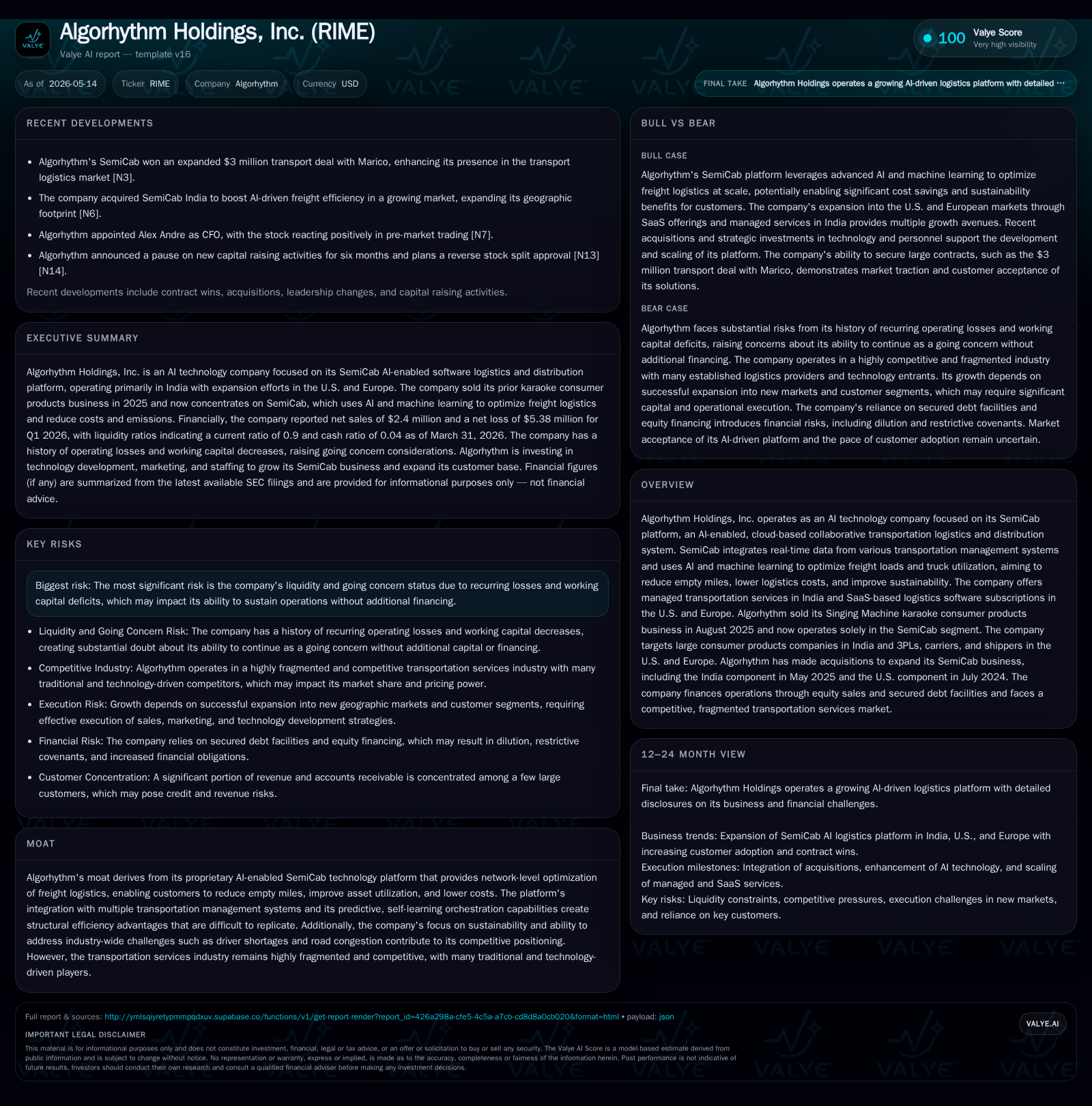
Algorhythm Holdings, Inc. (RIME) continues to pivot fully toward its AI-enabled SemiCab logistics platform following the divestiture of its karaoke business in August 2025. The latest quarterly filing reveals ongoing investment in expanding SemiCab’s footprint in India, the U.S., and Europe, targeting large consumer goods firms and 3PLs with network-level freight optimization solutions. Despite technological differentiation through proprietary AI orchestration, the company faces material liquidity concerns and operating losses that challenge near-term sustainability without additional financing. Revenue growth potential is tied to customer adoption and geographic expansion, but execution risks and competitive fragmentation remain high.
Recent Operating Update
Algorhythm Holdings’ latest quarterly filing (10-Q dated May 14, 2026) frames the near-term operational reality: a continued ramp-up in SemiCab business activity paired with sizable net losses and persistent working capital deficits [S2]. During Q1 2026, the company reported operating losses primarily driven by investments in technology enhancement and sales expansion across India, the United States, and Europe. Net loss narrowed to $5.38 million compared to $7.55 million a year prior largely due to the absence of a steep $6.47 million non-cash charge related to changes in warrants valuation seen in the prior-year quarter [S21]. However, cash consumed by operations increased sequentially reflecting intensifying spending.
Cash on hand stood at approximately $10.9 million at quarter-end versus current liabilities of $15.16 million, producing a current ratio below unity at 0.9 per company facts [F1]. This dynamic compounds concerns previously disclosed about going concern status given recurring losses and working capital demands [S2][S17]. The company acknowledges it must seek additional financing or equity raises to sustain operations beyond the next twelve months [S7].
Financially supporting the growth effort are proceeds totaling around $9 million from recent prepaid purchase agreements (debt-like instruments secured with cash deposits) with Streeterville Capital executed in late 2025 [S4][S19][S24]. Yet no repayments have been made on these obligations and fees payable to placement agents consume liquidity.
Business Model
Algorhythm is now exclusively focused on its SemiCab subsidiary following the sale of its legacy consumer karaoke business (Singing Machine) in August 2025 [S1][S2]. SemiCab offers an AI-enabled cloud platform for transportation logistics orchestration designed to alleviate inefficiencies prevalent within traditional trucking supply chains.
Revenue is generated mainly through managed transportation services (particularly in India) as well as SaaS subscriptions sold to third-party logistics providers (3PLs), carriers, shippers, and consumer goods brands predominantly located in the U.S. and Europe [S1][S14]. Clients pay either via service contracts tied to executed freight loads or via monthly software licensing fees. The platform’s AI-driven orchestration integrates real-time data streams harvested via APIs from transportation management systems (TMS), warehouse management systems (WMS), electronic logging devices (ELD), and load tendering workflows facilitated across industry participants.
SemiCab’s core value proposition lies in optimizing truck utilization by minimizing empty miles through predictive load matching across diverse shippers' networks — enabling fully loaded round trips even cross-regionally by pooling demand over lanes invisible to traditional logistics platforms [S1][S24]. This network-level artificial intelligence system continuously learns from operational data to improve routing efficiency dynamically.
Importantly, the solution also addresses macro-industry pain points such as severe driver shortages, road congestion constraints, carbon footprint reduction goals via improved asset utilization without adding trucks or driven miles — thereby aligning with broader sustainability initiatives embraced by supply chain stakeholders [S1][S2].
Industry Structure and Competitive Position
The transportation services industry is highly fragmented with numerous traditional trucking outfits owning physical fleets competing alongside technology-driven entrants offering digital freight brokerage or load-matching platforms [S14]. Algorhythm occupies a hybrid niche combining software-as-a-service with managed logistics operations.
Its moat derives principally from proprietary AI technology enabling structural efficiencies rather than temporary tactical improvements found in typical dispatch or load board tools. By orchestrating collaboration among manufacturers, distributors, retailers, and carriers via integrated real-time data streams across multiple systems, SemiCab aims for scalability handling millions of loads involving hundreds of thousands of trucks simultaneously [S1][S24].
But market competition remains intense with players ranging from established TMS vendors expanding into AI features to nimble startups leveraging blockchain or crowdsourcing for freight optimization. Algorhythm's differentiation also hinges on its ability to demonstrate measurable cost savings to customers through reduced empty miles which translates directly into improved unit economics for trucking partners—a critical factor amidst rising fuel costs and labor scarcity.
The company's geographic focus strategically targets India’s growing FMCG sector where inefficiencies are abundant along with developed markets in the U.S. and Europe where sustainability mandates increasingly pressure logistics optimization solutions [S14]. Large customers currently concentrate revenue sources—over 70% attributed to top clients primarily based in India—reflecting nascent scale but also customer concentration risk [S14].
Growth Drivers
Expansion of Customer Footprint
Algorhythm has systematically expanded through acquisitions (notably purchasing stakes of SemiCab entities in India during 2025) and organic growth efforts targeting large fast-moving consumer goods companies and logistics providers [S1][S13]. Siince many customers are rapidly digitizing their freight operations post-pandemic disruptions, demand for integrated predictive platforms shows structural tailwinds.
Increasing SaaS Penetration Across Regions
The platform subscription model opens avenues for recurring revenue streams that could scale once proven use cases propagate within client organizations beyond initial implementations.
Technology Advancements & Platform Enhancements
Ongoing R&D investments into AI algorithms for routing optimization combined with increasing integration breadth across TMS/WMS ecosystems aim to strengthen switching costs by embedding deeply into customers’ operational workflows [S10][S24].
Sustainability Imperatives Spur Demand
With regulatory shifts emphasizing carbon emissions reductions in transport sectors worldwide plus rising interest in eco-conscious supply chains among enterprise buyers—SemiCab’s promise of reducing empty truck miles positions it well as a preferred solution provider.
Potential Further Acquisitions & Partnerships
Management signals intent to acquire complementary AI logistics businesses or form strategic partnerships that accelerate market penetration or extend technology capabilities globally [S1][S13].
Risks / Watchpoints / Growth Constraints
Liquidity & Going Concern Risk
Despite a recent capital infusion via prepaid purchase agreements totaling several millions dollars, the company faces substantial doubt regarding its ability to continue operations absent further financing given ongoing negative cash flows from operations and current liabilities outstripping current assets at March quarter-end [F1][S7]. Dilution risk looms if equity raises ensue.
Customer Concentration Risk
Significant revenue dependency on a handful of large Indian clients poses credit exposure challenges especially considering allowance for credit losses escalated post acquisition of Indian subsidiary SMCB [S14][S25]. Failure to retain these accounts could materially impair revenues.
Competitive Pressure & Market Fragmentation
The crowded logistics tech marketplace features aggressive price competition coupled with rapid innovation cycles requiring sustained investment which may pressure margins before scale economies fully materialize.
Regulatory & Legal Uncertainties
Pending litigation related to legacy contractual disputes inherited from acquired businesses adds legal costs uncertainty; unfavorable rulings could affect financials materially.
Execution Risk In Geographic Expansion
Scaling technology adoption effectively across diverse international markets with varying regulatory environments demands robust operational capabilities often difficult for early-stage tech companies.
What to Watch Next
- Quarterly revenue progression especially from US/Europe subscription rollouts,
- Margins evolution as volume scales absorb fixed costs,
- Announcements on future financing or additional acquisitions,
- Customer renewal rates and onboarding metrics,
- Updates on legal proceedings resolution status,
- Management guidance revisions tied explicitly disclosed only when made public.
Financial Profile Summary
Latest financial snapshot
| Metric | Value | Period |
|---|---|---|
| Current assets | $14mm | |
| 2026-03-31 | ||
| Current liabilities | $15mm | |
| 2026-03-31 | ||
| Current ratio | 0.9x | |
| 2026-03-31 |
Source: SEC companyfacts cache [F1].
As of Q1 2026 quarter-end:
| Metric | Value | Period |
|---|---|---|
| Cash & Equivalents | $10.94M | |
| 2026-03-31 | ||
| Current Assets | $13.63M | |
| 2026-03-31 | ||
| Current Liabilities | $15.16M | |
| 2026-03-31 | ||
| Current Ratio | 0.9 | |
| 2026-03-31 | ||
| Net Loss Q1 | $5.38M | Q1 2026 |
Algorhythm Holdings continues bleeding cash from operations reflecting heavy investment stages despite lifting revenue levels since acquisition integration completed last year (revenue increased significantly post acquiring SMCB India unit) [F1][S21][S13]. Prepaid Purchase facilities provide bridge funding but principal repayments not started yet leaving long-term debt structure unsettled [S4][S19][S24].
Disclaimer: This analysis is based exclusively on publicly available SEC filings up to May 2026. It does not constitute investment advice or recommendations. Readers should conduct their own due diligence before making any decisions involving Algorhythm Holdings or similar companies.
Disclaimer: This is research-only, informational analysis and not investment advice. It may include AI-generated interpretation and general industry context. Always verify important details using primary sources.

Comments