
BayCom Corp Leverages Regional Strength and Strategic Acquisitions for Growth
BayCom’s latest quarterly report underscores its robust regional banking model supported by targeted acquisitions and disciplined risk management amid evolving market conditions.
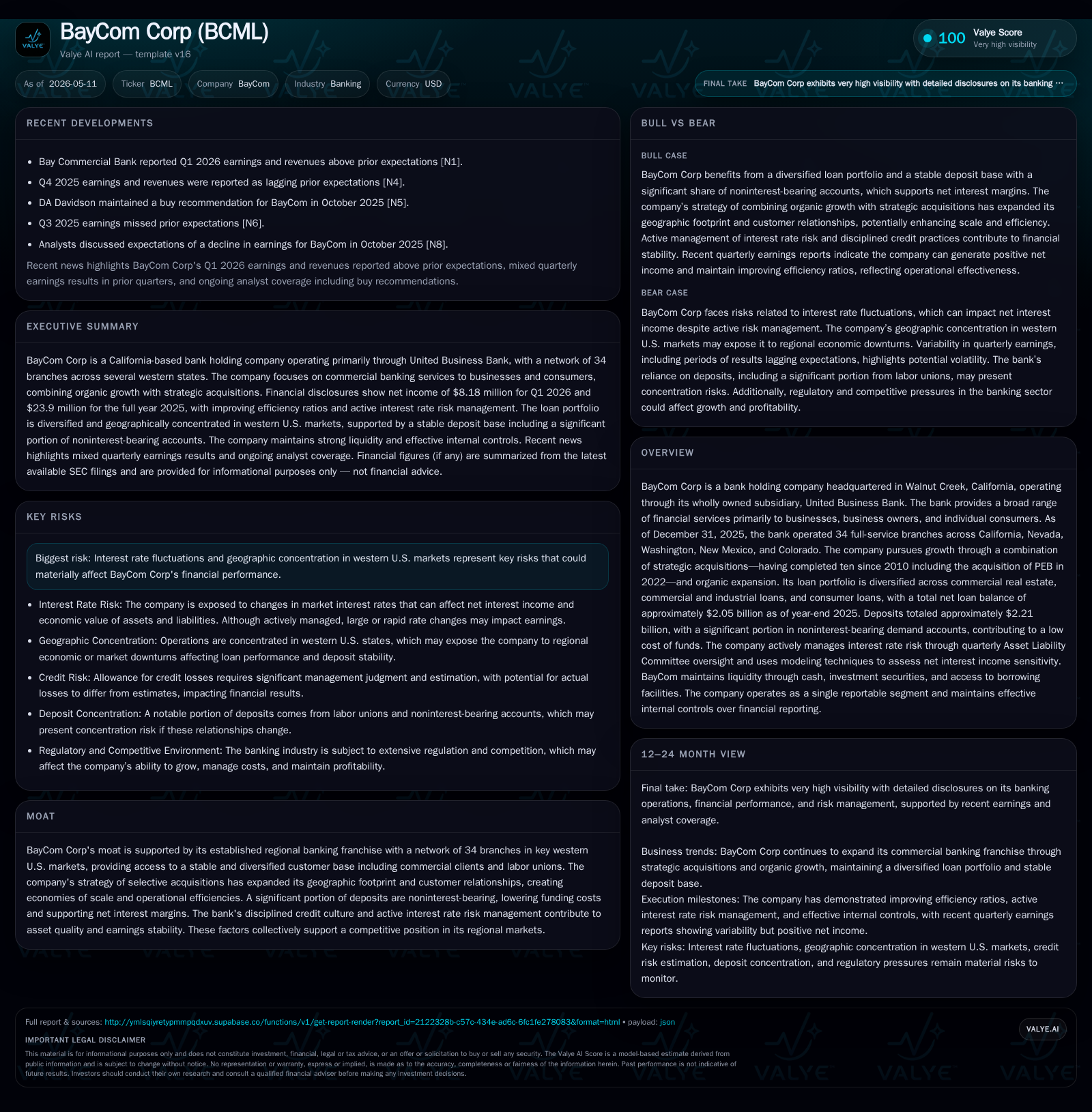
In its most recent 10-Q filing dated May 11, 2026, BayCom Corp demonstrated solid earnings performance, surpassing estimates, supported by stable loan portfolios and a cost-efficient deposit base. The company’s core revenue engine is United Business Bank's commercial banking services concentrated in five western states, enhanced by a history of selective acquisitions, including the pivotal 2022 PEB acquisition. BayCom’s competitive moat benefits from its strong regional footprint, high proportion of noninterest-bearing deposits, and effective interest rate risk oversight. Key growth drivers include continued organic expansion in underserved western U.S. markets and potential synergy realization from past acquisitions. Market risks center on interest rate sensitivity and geographic concentration in western markets. Monitoring deposit retention trends and credit quality will be critical to assessing ongoing momentum.
Latest Quarterly Operating Update: Earnings and Balance Sheet Highlights
BayCom Corp’s latest quarterly report filed on May 11, 2026 ([S2]) confirms continuity in its operating momentum established through prior periods. The bank reported earnings that outstripped consensus estimates per April earnings release ([N1]), signaling effective execution amid a challenging interest rate environment. Key balance sheet metrics reveal a loan portfolio steady at approximately $2.05 billion at YE 2025 ([S1]), diversified among commercial real estate (CRE), commercial & industrial (C&I), and consumer categories.
Total deposits remain robust at around $2.21 billion ([S1]), with management emphasizing the strategic advantage from a significant proportion held in noninterest-bearing demand accounts. This deposit mix underpins BayCom’s net interest margin stability by lowering funding costs despite rate volatility. The bank retains convenient access to liquidity through unused Federal Home Loan Bank credit lines totaling over $580 million ([S5]).
Operational commentary from the April 23 event filing ([S3]) highlighted solid organic loan growth drivers aligned with regional economic activity across California, Nevada, Washington, New Mexico, and Colorado. Synergies from the PEB acquisition completed in 2022 contribute incremental scale benefits observed in early 2026 results.
BayCom’s Business Model: Focused Regional Banking with Diversified Loan Portfolio
BayCom operates through its wholly owned subsidiary United Business Bank which targets primarily business clients alongside select individual consumers in Western U.S. markets (, [S1]). Revenue generation centers on net interest income derived from lending activities funded predominantly by depositor balances plus fees from ancillary services such as treasury management.
The diversified loan portfolio spans CRE secured by owner-occupied and investment properties, C&I loans supporting local businesses’ operational needs, and consumer loans providing retail finance options ([S1]). Such diversification mitigates sector-specific downturns but retains some cyclical sensitivity notably related to real estate valuations.
Critical to BayCom’s margin resilience is its ability to maintain a high fraction of noninterest-bearing deposits which do not accrue interest expense but provide stable funding for earning assets (, [S1]). This feature reduces funding costs compared to peer regional banks often reliant on higher-cost certificates of deposit or borrowed funds.
Branch locations totaling 34 full-service outlets across strategically chosen metropolitan hubs enable convenient customer access while supporting relationship-driven banking that diminishes switching risk (, [S1]). Many branches incorporate ATM networks and drive-through services adapting to evolving consumer preferences.
Competitive Positioning within Western U.S. Financial Markets
BayCom’s moat is grounded in its focused footprint along key economic corridors primarily within California extending into Nevada, Washington, New Mexico, and Colorado (). This geographic concentration facilitates deep market knowledge enabling tailored lending solutions for businesses ranging from small enterprises to mid-sized firms.
Competition includes regional community banks offering similar localized services but usually with smaller scale; national banks whose wider product suites face challenges developing strong local ties; and emerging fintech contenders introducing technology-driven platforms for specific financial products ([S1] analysis).
Acquisition-led growth has augmented BayCom's scale advantages producing economies both on fixed cost absorption and cross-selling opportunities within consolidated client bases from deals like PEB (2022). These have aided improved operational efficiency relative to smaller competitors.
Regulatory oversight typical of state-chartered banks entwined with Federal Reserve scrutiny shapes a moderately contained compliance burden notably absent of the complexities facing larger national institutions ([S1]). This regulatory environment permits BayCom nimbleness while maintaining sound risk controls.
Customer relationships benefit from moderate switching costs fostered via business deposit integrations such as payroll services or payment processing that enhance customer retention.
Growth Drivers: Acquisition Strategy and Organic Expansion Initiatives
BayCom pursues growth via a hybrid strategy blending strategically timed acquisitions with organic branch expansion (, [S3]). Since 2010, ten acquisitions have incrementally extended geographic reach or product breadth. The substantial integration of PEB in 2022 stands as a recent milestone expanding Western regional penetration particularly into segments favored by business owners underwriting commercial real estate.
Organic growth focuses on deepening customer wallet share within existing markets through enhanced relationship management teams deploying refined lending solutions suited to sector characteristics such as CRE or C&I loans attuned to industry cycles. New branch openings or relocations target densely populated business centers where unmet demand exists.
Opportunities also reside in expanding fee-based services such as treasury management or specialty lending areas aligned with California’s dynamic economy.
Cost synergies from acquisitions manifest through shared technology platforms reducing IT overheads; consolidated back-office functions trimming operating expenses; and cross-selling financial products enhancing overall revenue per client ([N1], [S3]).
Risks and Constraints: Interest Rate Sensitivity and Geographic Concentration
Despite strengths, BayCom faces inherent risks attributable chiefly to its western U.S.-centric footprint exposing it to regional economic volatility especially tied to real estate markets (, [S1]). Commercial real estate loans constitute a pronounced share of total lending portfolios creating cyclical credit risk heightened by downturns impacting property values or tenant occupancy trends.
Interest rate risk remains pivotal given the sensitivity of net interest margin to shifts in short-term rates relative to asset repricing schedules. The Asset Liability Committee (ALCO) actively manages this exposure establishing policy limits on repricing gaps ensuring that rising rates either modestly improve margins (asset-sensitive positioning) or at worst limit compression ([S1]).
Yield curve shape changes present additional complexity impacting interest income predictability especially when rates move non-parallelly (e.g., short-term vs long-term Treasury yields) requiring sophisticated scenario modeling frequently updated each quarter by ALCO ([S1]).
Cybersecurity risks receive robust governance oversight highlighted by detailed board-level reporting frameworks covering incident mitigation preparedness leveraging expertise of senior IT leadership certified in security standards ([S1]).
Key Factors to Monitor: Upcoming Milestones and Market Developments
Watching future quarters will require close attention to deposit retention trends amid maturing certificates of deposit approaching $471 million within one year at end-2025 ([S5]). Competitive pricing pressures could influence the extent deposits roll over or migrate into higher-yield alternatives affecting funding cost structure.
Loan portfolio health markers such as levels of nonperforming assets (NPAs) or modified loans will be critical indicators of emerging credit stress given macroeconomic uncertainties (). Outlook clarity may sharpen following subsequent ALCO reports detailing interest rate risk postures beyond Q2/Q3 updates.
Insider purchasing activity reported contemporaneously on May 11 aligns with management confidence sustained through recent results reflecting perceived intrinsic value preservation despite external volatility ([N4]).
Dividends remain stable adhering to quarterly payout of $0.30 per share reinforcing shareholder alignment while subject to future regulatory capital considerations ([S10]).
Any announcements regarding new acquisitions or strategic initiatives should be noted for their potential impact on franchise positioning or balance sheet composition.
Financial Overview: Capital, Liquidity, and Profitability Snapshot
As per the latest filings ([S2]), BayCom maintains a strong capital base evidenced by shareholders’ equity increasing modestly reflecting retained earnings accumulation through profitable operations. The bank retains convenient access to liquidity through unused Federal Home Loan Bank credit lines totaling over $580 million ([S5]).
Operating cash flows reported previously have consistently provided sufficient coverage for strategic investments including branch expansions alongside manageable capital expenditures directed largely toward technology infrastructure upgrades essential for competitive service delivery enhancements.[S7]
Overall financial discipline meshed with targeted growth investments permits BayCom to sustain shareholder value creation aligned with prudent risk parameters established by both board policies and regulatory minimums.
Disclaimer: This analysis is based solely on publicly available disclosures including SEC filings dated up to May 11, 2026, news reports linked herein, and company factual data explicitly cited. It does not constitute investment advice or recommendations.
Disclaimer: This is research-only, informational analysis and not investment advice. It may include AI-generated interpretation and general industry context. Always verify important details using primary sources.

Comments