
Electronic Arts Confronts Merger Uncertainties Amid Live Services Shift
EA’s latest quarterly update reveals operational constraints tied to its pending merger while live services remain a critical revenue pillar.
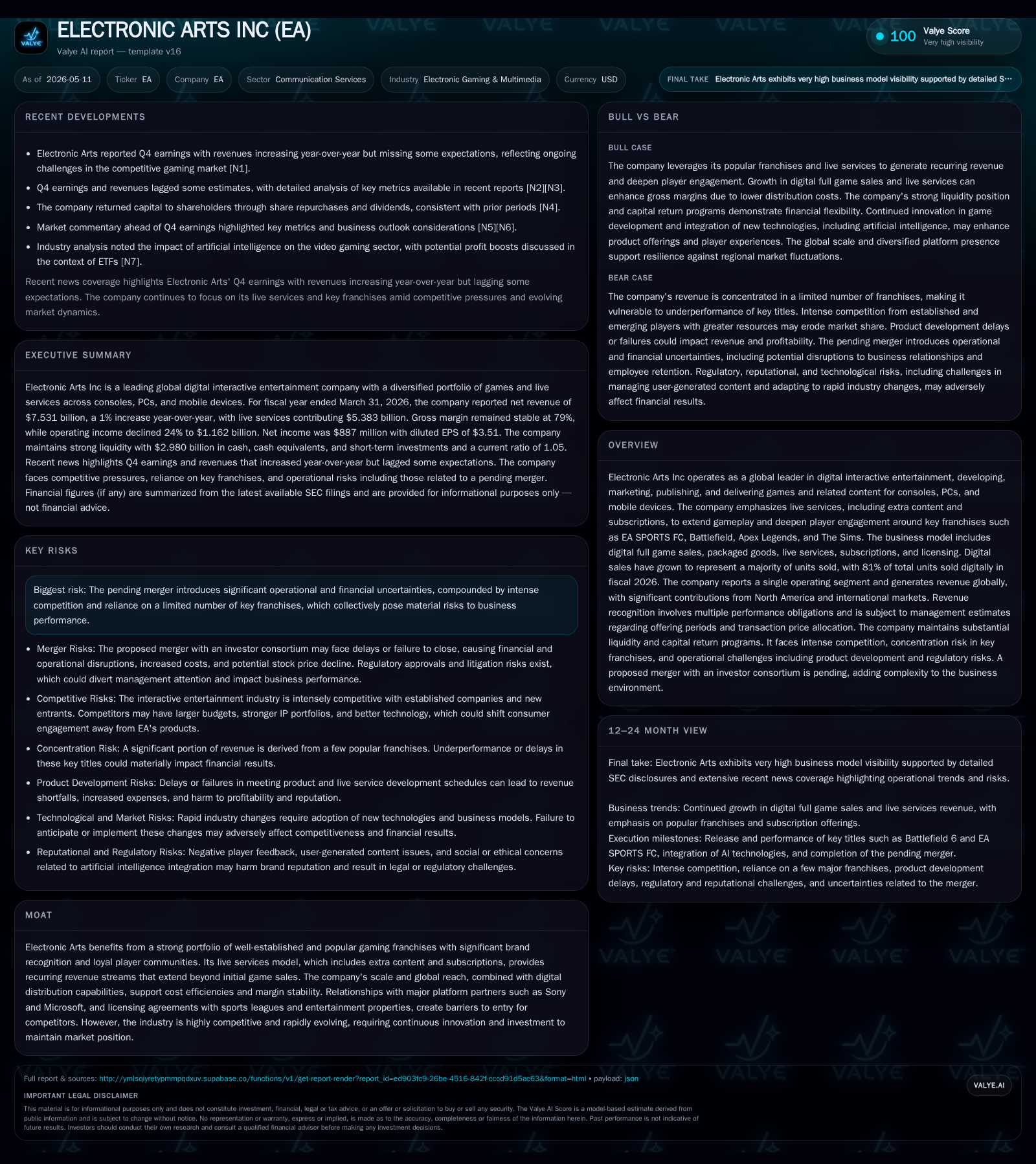
In its fiscal third quarter ending March 2026, Electronic Arts (EA) highlighted near-term operational curbs connected to a pending merger, which imposes restrictions on strategic investments and financial flexibility. Despite these challenges, EA’s business model continues evolving with a strong emphasis on live services—including subscriptions and extra content—contributing the majority of revenue and unit sales shifting predominantly to digital channels. The company’s entrenched franchise portfolio and global distribution offer competitive moats, yet reliance on key IPs and regulatory uncertainty around the merger present risks to growth execution. Upcoming catalysts include anticipated regulatory approvals, new content rollouts, and subscriber engagement trends that will clarify the path forward.
First Quarter Update: Merger Impact and Operational Ripples
Electronic Arts’ Q3 fiscal 2026 filing dated February 3, 2026 [S2] paints a clear picture of constrained near-term operations tied directly to its pending acquisition by a consortium led by the Public Investment Fund and private investors affiliated with Silver Lake and Affinity Partners. The Merger Agreement imposes strict restrictions on EA’s ability to pursue acquisitions, invest strategically, or access capital markets without investor consent until deal closure or termination — expected in early FY27 but subject to regulatory hurdles outside company control.
This impacts EA’s agility to capitalize on opportunistic projects or bolster growth via strategic deals during the pendency period. Additionally, the announcement has created uncertainty among stakeholders that could impair key personnel retention and complicate vendor relationships. Costs associated with the merger process itself are significant, including possible termination fees up to $1 billion if the transaction fails under certain conditions.
An 8-K update on May 5, 2026 [S3], while brief, signals ongoing efforts toward obtaining regulatory approvals and maintaining operational stability despite these constraints.
EA’s Revenue Model: Balancing Full Game Sales with Live Services
EA operates a hybrid revenue model combining high-value full-game sales with live services extensions that prolong engagement and enhance monetization. The company’s annual report filed May 11, 2026 [S1] indicates live services net revenue stood at $5.38 billion in FY26 — just shy of prior-year figures — underscoring durability despite competitive pressures.
Within this segment, extra content sales generated through Ultimate Team modes of core sports franchises such as EA SPORTS FC remain substantial revenue drivers. This mode allows players to curate personalized teams by purchasing packs containing current and historic players, underpinning recurring microtransaction flows.
Digital full game downloads have surged to over 81% of total units sold (by volume) in FY26 compared to just 73% three years prior. This shift reflects enduring consumer preference for digital distribution via platforms like Sony PlayStation Store or Microsoft Xbox Marketplace — improving gross margins due to lower physical production costs.
Packaged goods sales have correspondingly declined from $672 million in FY24 to $440 million in FY26 as digital formats dominate.
This portfolio balance—between upfront game purchases and ongoing transactional revenue—positions EA well for stable cash generation while demanding continued content refreshes to drive player retention.
Competitive Landscape: Franchise Power versus Industry Dynamics
The company benefits from well-established franchises imbued with deep brand equity: Battlefield’s military-themed first-person action; Apex Legends’ free-to-play battle royale innovation; The Sims’ vast life-simulation ecosystem; alongside flagship EA SPORTS properties leveraging league licenses globally.
These intellectual properties create formidable barriers through licensing exclusivity agreements with major sports leagues (e.g., FIFA licensing negotiations transitioning into EA SPORTS FC), established fan bases fueling organic community growth, and high switching costs due to customization invested by players.
However, EA contends with intense competitive pressure among peers pushing innovation cycles rapidly. Subscription fatigue looms as consumers juggle multiple recurring charges across entertainment platforms.
Further complexity arises from evolving gamer demographics demanding mobile-optimized experiences alongside traditional console/PC titles. Customer engagement requires continuous storyline evolution woven tightly with interactive multiplayer functionality — areas where rivals such as Activision Blizzard or Take-Two Interactive also aggressively invest [N1],[N2],[N3].
Growth Drivers: Expanding Digital Content and Subscriptions
Key levers for growth lie primarily within expanding the live services ecosystem:
- Increasing digital penetration: The rising share of digital unit sales (81% in FY26) offers higher margin opportunity relative to legacy packaged goods due to cost efficiencies.
- Subscription offerings: Developing more robust subscription KPIs linked to steady monthly recurring revenues provides revenue predictability beyond volatile full game releases.
- International market expansion: Penetration into Asia-Pacific markets with localized content adaptations aligns with global gaming consumption trends.
- Mobile platform development: Incremental investments harnessing smartphone ubiquity catch rising demand beyond traditional console ecosystems.
These dynamics suggest structural survivability underpinned by persistent engagement metrics focused on session duration increases and monetized interactions around core franchises [S1,S2].
Risks and Limitations: Merger Delays, Franchise Dependency, and Market Pressures
Merger execution uncertainty forms the centerpiece risk narrative—the transaction may face protracted regulatory reviews delaying closure beyond early FY27 expectations or not close at all leading to substantial termination fees. Such outcomes introduce volatility impacting employee morale and partner confidence [S2].
Significant dependency exists on concentrated marquee titles; fluctuations in consumer reception or product lifecycle declines could disproportionately affect top-line performance given the bulk of live services net revenue streams derive from Ultimate Team offerings within sport-based IPs [S1].
Operating expenses rose by approximately 9% year-over-year reflecting increased investments into product innovation but creating margin pressure amidst relatively flat gross profits [S1]. Additionally, subscription fatigue amongst players coupled with heightened competition may stifle sustainable revenue growth without compelling new franchise development.
Regulatory challenges potentially imposed on data management practices or loot box monetization aspects pose incremental compliance costs risking player backlash or fines.
Upcoming Catalysts: Regulatory Approvals, Product Launches, and Consumer Trends
Critical milestones include projected merger completion in early fiscal year 2027 dependent on satisfactory regulatory clearance across multiple jurisdictions [S3]. Market reception at that juncture will heavily influence operational freedom going forward.
Monitoring new game launches—particularly expansions within established franchises—and corresponding adoption rates will serve as bellwethers for both near-term revenue momentum and long-term community engagement health.
Subscription metric shifts post-Q3 earnings reports are vital markers of product-market fit for newer offerings aiming to diversify recurrent streams beyond sports-centric modes [N5,N6].
Latest financial snapshot
| Metric | Value | Period |
|---|---|---|
| Cash & equivalents | $2.8bn | |
| 2025-12-31 | ||
| Current assets | $4.0bn | |
| 2026-03-31 | ||
| Current liabilities | $3.8bn | |
| 2026-03-31 | ||
| Current ratio | 1.05x | |
| 2026-03-31 |
Source: SEC companyfacts cache [F1].
Disclaimer: This is research-only, informational analysis and not investment advice. It may include AI-generated interpretation and general industry context. Always verify important details using primary sources.

Comments