
NET Power Inc. Advances Project Permian with New Gas Turbines Amid Broadening Strategy
NET Power signals a tactical pivot in its Project Permian rollout through gas turbine procurement and integration of post-combustion capture technology, redefining commercialization timelines and growth pathways.
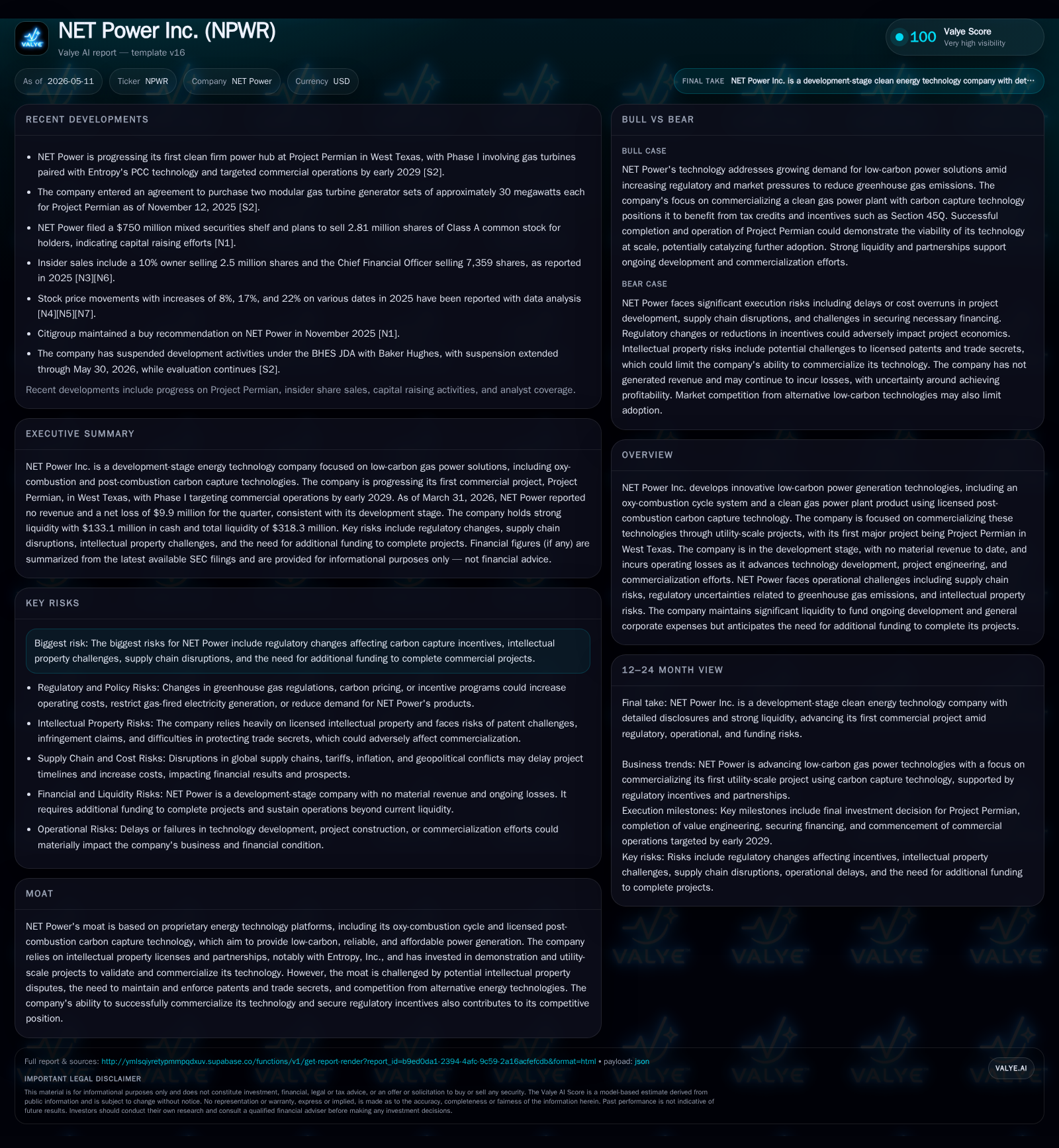
In its May 2026 quarterly filing, NET Power disclosed a significant operational update with the purchase contract for modular gas turbines to be deployed at Project Permian, marking a strategic shift from exclusive reliance on its proprietary oxy-combustion technology toward licensing post-combustion carbon capture (PCC) integration. This repositioning aligns with broader ambitions to expand market entry via licensing while updating the final investment decision (FID) timeline to H2 2026 and commercial operations targeted by early 2029. The company continues as a development-stage entity with no material revenue but maintains a robust liquidity buffer of approximately $133 million in cash and $318 million in total liquid assets at quarter-end. The key growth drivers revolve around successfully executing on Project Permian’s phased installation and scaling licensing arrangements, whereas risks center on regulatory shifts, capital intensity, supply-chain vulnerabilities, and intellectual property uncertainties.
Quarterly Developments Signal Strategic Shift in Project Execution
NET Power’s May 2026 quarterly report marks a pivotal operational update anchored by the executed purchase agreement for two modular natural gas turbine generator sets totaling approximately 60 megawatts gross capacity for installation at Project Permian in West Texas [S2], [S3]. This represents a concretization of the company’s broadened approach to power generation: moving away from exclusive dependence on its proprietary oxy-combustion cycle system towards adopting Entropy Inc.’s post-combustion carbon capture (PCC) technology integrated with more conventional gas turbines.
The latest disclosures revise the timeline for its first commercial facility: a final investment decision (FID) scheduled for the second half of calendar year 2026 with commissioning and commercial operations anticipated by early 2029 [S2]. These milestones reset expectations after strategic reprioritization marked by suspension of prior oxy-combustion testing activities at the La Porte Demonstration Facility during late 2025 and reflect increased reliance on established turbine platforms augmented by licensed PCC systems.
This shift also underscores key operational dependencies including supply chain dynamics during prevailing geopolitical trade tensions that affect delivery schedules and component costs [S2]. The procurement contract highlights progress yet illustrates significant capital planning challenges as the company balances long lead equipment orders against engineering validation and value optimization at scale.
Innovative Business Model Centered on Proprietary Low-Carbon Power Solutions
NET Power’s business model is anchored in developing low-emission natural gas power plants leveraging cutting-edge technological platforms. Historically focused on an oxy-combustion system designed to inherently capture virtually all combustion emissions without complex exhaust gas treatment [S1], the firm now embraces a hybrid approach incorporating Entropy’s patented post-combustion carbon capture — a move designed to expedite commercialization while broadening application scope [S2].
Revenue generation remains highly prospective and will initially derive from project development consulting fees, technology licensing revenues tied to PCC integration contracts, and eventual asset operation income upon plant commissioning. Customer willingness to pay premiums for clean energy over unabated natural gas-fired power is critical to justifying incremental project costs associated with capture technologies [S1].
The company’s moat largely depends on its convergent IP architecture combining the oxy-combustion patents it owns or licenses alongside exclusive contracts with Entropy for PCC technology deployment [S1]. Partnerships facilitate validation through utility-scale demonstration projects such as Project Permian but expose NET Power to risk from potential patent challenges or third-party priority disputes within this nascent sector.
Market and Competitive Landscape in Clean Gas Power and Carbon Capture
Within a rapidly evolving energy transition ecosystem, NET Power faces competition not only from conventional combined-cycle natural gas plants but also emerging decarbonization solutions including hydrogen blends, renewable energy coupled with storage, and alternative carbon capture methodologies. Its strategic choice to integrate widely available simple cycle turbines with licensed PCC tech positions it competitively but also subjects it to margin pressures linked to cost inflation from raw materials and tariffs amid ongoing global trade disruptions [S2].
Additionally, federal regulatory environments remain fluid: recent policy shifts have seen certain clean energy initiatives scaled back or restructured, potentially tempering incentives that bolster carbon capture adoption [S1]. While programs like the Inflation Reduction Act provide tax credits for CO2 sequestration, their continuation and scope are subject to political risk influencing customer economics.
The industry structure involves complex stakeholder interactions encompassing utilities seeking compliance pathways under emissions regulations, technology licensors reliant on enforceable IP rights, equipment manufacturers navigating supply chains under tariff risks, and regulators shaping incentive frameworks.
Growth Catalysts: Project Permian and Licensing Expansion
Project Permian forms the cornerstone growth initiative aiming to establish up to one gigawatt of clean firm power capacity using phased deployment—initially employing two modular gas turbines equipped with PCC technology. Success here is critical: achieving FID in H2 2026 followed by operational ramp-up will serve as proof points validating product viability amidst market skepticism regarding novel carbon capture implementations [S2], [S3].
Parallel expansion efforts focus on broadening licensing arrangements for integrating Entropy’s PCC technology within third-party natural gas turbine systems. Licensing revenue streams potentially offer scalable growth less capital intensive than direct plant ownership but hinge heavily on securing regulatory approvals and customer acceptance.
Clear KPIs include progress on turbine deliveries and commissioning timelines, formalized licensing contracts evidencing market traction, backlog accumulation tied to follow-on projects derived from initial success at Project Permian.
Risks Highlighted by Regulatory, IP, and Funding Uncertainties
Key risk vectors center on regulatory unpredictability impacting carbon pricing schemes and incentive stability. Reduced or delayed federal support jeopardizes customer economics underpinning premium clean power pricing models [S1]. Supply chain fragilities amplify execution risk given reliance on foreign-sourced components subject to tariffs or logistical bottlenecks worsened by ongoing geopolitical conflicts [S2].
Intellectual property exposures arise from potential patent validity challenges against both Net Power’s oxy-combustion claims and licensed PCC technology patents held by Entropy or contested third parties [S1]. Legal proceedings including securities class actions alleging misstatements concerning project timelines further complicate governance risk profile [S13].
Finally, current liquidity buffers, while substantial relative to liabilities, remain finite relative to projected capital outlays necessary for construction completion; additional fundraises or partnership financing will be requisite ahead of revenue generation commencement [F1], [S4].
Near-Term Milestones and What to Watch for Next
Critical upcoming developments include:
- Achieving FID on Phase I of Project Permian in H2 2026—a determinant event guiding capital deployment cadence.
- Progress reports on turbine fabrication orders' fulfillment dates crucial to schedule adherence.
- Finalizing additional licensing deals expanding the footprint of Entropy-powered PCC systems.
- Monitoring regulatory updates surrounding CO2 emission reduction incentives which materially influence project IRR calculations.
- Evaluating quarterly operating expense trends vis-à-vis cash burn rates signaling financial health ahead of revenue inception.
Tracking these metrics will clarify execution momentum toward commercialization validating NET Power's strategic repositioning efficacy.
Financial Position Reflecting Cash Reserves and Operating Burn
Latest financial snapshot
| Metric | Value | Period |
|---|---|---|
| Cash & equivalents | $133mm | |
| 2026-03-31 | ||
| Current assets | $311mm | |
| 2026-03-31 | ||
| Current liabilities | $13mm | |
| 2026-03-31 | ||
| Current ratio | 23.82x | |
| 2026-03-31 |
Source: SEC companyfacts cache [F1].
As of March 31, 2026 quarter-end, NET Power held $133.1 million in cash & equivalents within total current assets approximating $311.1 million versus current liabilities of $13.1 million yielding a strong current ratio near 23.8—indicative of short-term liquidity sufficiency [F1].
Operating expenses remain elevated reflecting ongoing R&D ($19.7 million in Q1 ’26), general administrative functions ($8.9 million), plus project development costs despite declines versus prior year periods due mostly to discontinued La Porte testing efforts [S25]. Capital expenditures increased modestly supporting Project Permian Phase I infrastructure buildout initiatives.
Net cash used in operating activities amplified year-over-year driven partially by contract cancellation fees related to terminated long-lead equipment procurement under previous strategies [$26.1 million] plus suspended La Porte demo facility operations signaling costly transition phases [S16]. Available-for-sale securities valued at approximately $185 million supplement cash holdings providing investible liquidity buffers [S4].
While finances currently undergird short-term obligations comfortably, they highlight dependence on securing fresh capital infusions aligned with step-change commercialization needs ahead.
This analysis presents an objective synthesis grounded strictly in publicly filed regulatory disclosures without offering investment guidance or market commentary beyond the factual content therein.
Disclaimer: This is research-only, informational analysis and not investment advice. It may include AI-generated interpretation and general industry context. Always verify important details using primary sources.

Comments